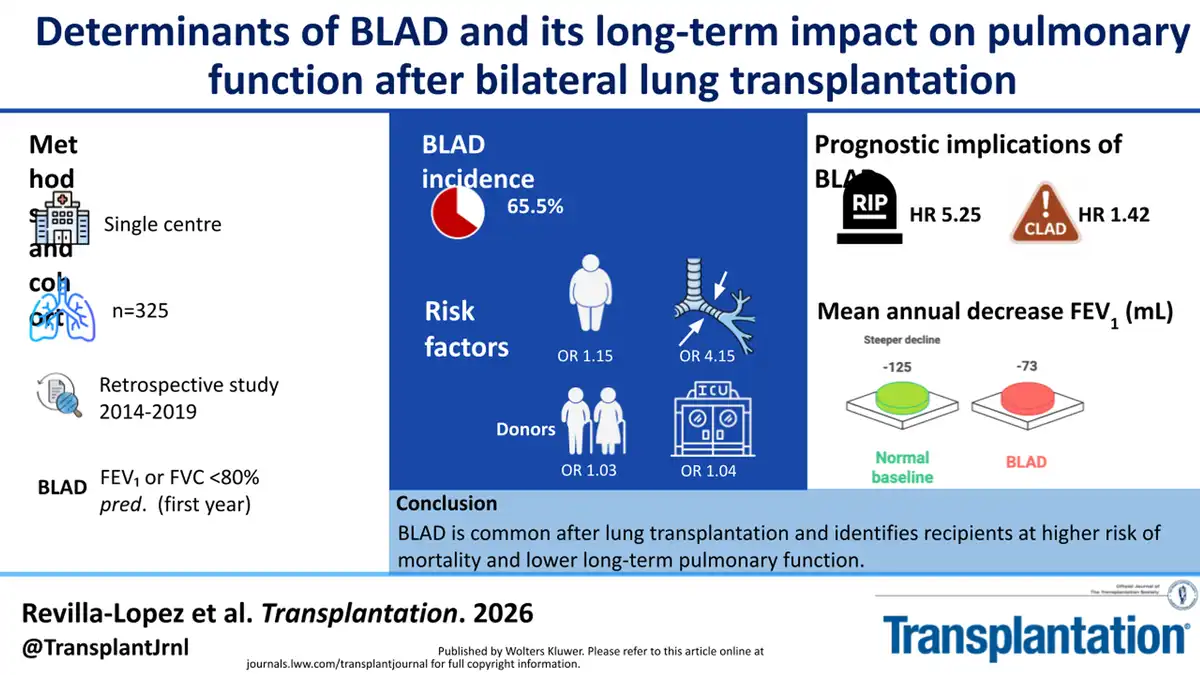
Baseline Lung Allograft Dysfunction After Bilateral Lung Transplantation: Determinants and Long-Term Pulmonary Outcomes

Baseline Lung Allograft Dysfunction After Bilateral Lung Transplantation: Determinants and Long-Term Pulmonary Outcomes

Baseline lung allograft dysfunction (BLAD) affects over 60% of bilateral lung transplant recipients, associates with increased mortality, and influences long-term lung function trajectories. Risk factors include higher BMI, prolonged ICU stay, bronchial stenosis, and older donor age.
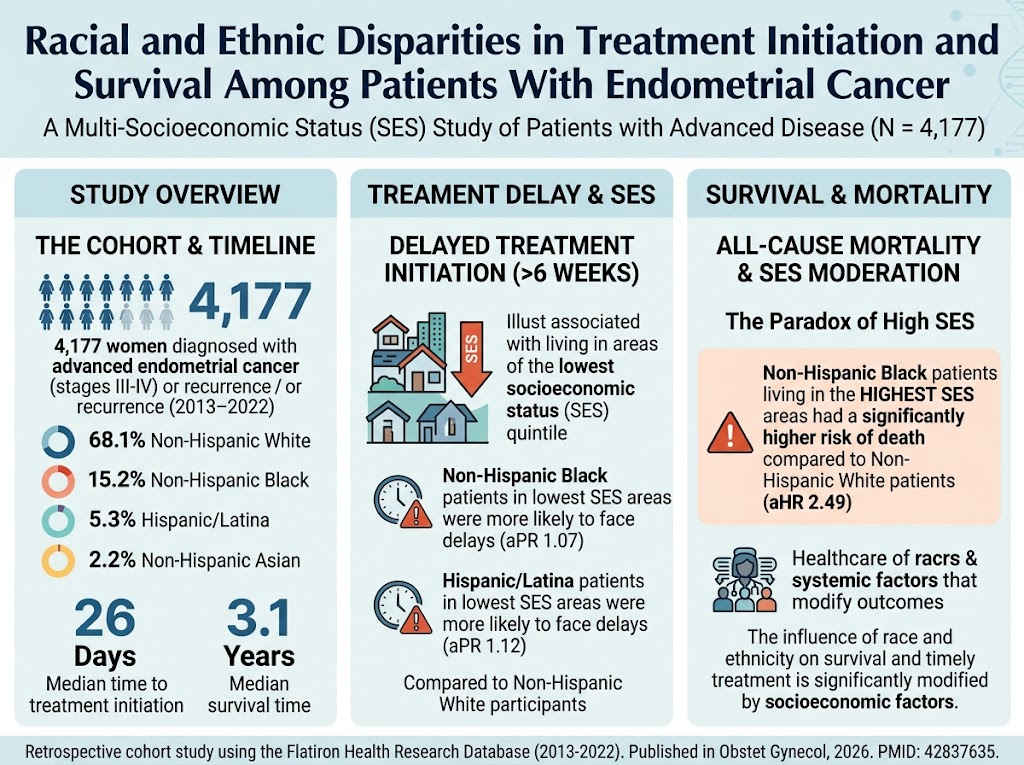
Racial and Ethnic Disparities in Treatment Initiation and Survival Among Patients With Endometrial Cancer: Socioeconomic Modifiers and Clinical Implications

Racial and Ethnic Disparities in Treatment Initiation and Survival Among Patients With Endometrial Cancer: Socioeconomic Modifiers and Clinical Implications

This review synthesizes recent evidence demonstrating persistent racial and ethnic disparities in treatment initiation and survival among patients with advanced endometrial cancer, highlighting the critical influence of socioeconomic status and social determinants on outcomes.
Centralized Multidisciplinary Retinoblastoma Care: Closing Outcome Gaps in Resource-Limited Settings with Telemedicine and Advanced Globe Salvage

Centralized Multidisciplinary Retinoblastoma Care: Closing Outcome Gaps in Resource-Limited Settings with Telemedicine and Advanced Globe Salvage

Centralized multidisciplinary retinoblastoma care incorporating telemedicine and international partnership at KHCC improved survival and globe salvage rates to levels comparable with high-income countries, demonstrating a scalable model for reducing global disparities over two decades.
Incidence, Survival, and Symptomatology of Recurrence in Vulvar Cancer: Insights from Population-Based Cohort Studies and Contemporary Evidence

Incidence, Survival, and Symptomatology of Recurrence in Vulvar Cancer: Insights from Population-Based Cohort Studies and Contemporary Evidence

Vulvar cancer exhibits significant recurrence rates, predominantly local, with survival declining sharply after recurrence. Awareness of recurrence-associated symptoms enhances early detection. Surgery remains pivotal in management, with frailty and tumor characteristics influencing prognosis.
Molecular and Spatial Differences in the Tumor Microenvironment of High-Grade Serous Ovarian Cancer With Short vs Long-Term Survival

Molecular and Spatial Differences in the Tumor Microenvironment of High-Grade Serous Ovarian Cancer With Short vs Long-Term Survival

This study found that advanced high-grade serous ovarian cancers from short-term survivors had more fibroblasts and stromal invasion signals, while tumors from long-term survivors showed stronger immune pathways, suggesting the tumor microenvironment may shape survival outcomes.
Carboplatin in Neoadjuvant Chemotherapy for Triple‑Negative Breast Cancer: No EFS Gain but an Overall Survival Signal Driven by Premenopausal Patients

Carboplatin in Neoadjuvant Chemotherapy for Triple‑Negative Breast Cancer: No EFS Gain but an Overall Survival Signal Driven by Premenopausal Patients

A phase III trial found that adding weekly carboplatin to taxane‑anthracycline neoadjuvant chemotherapy did not significantly improve event‑free survival overall but was associated with improved overall survival, with benefits concentrated in premenopausal women; hematologic toxicity increased.