Highlight
This study introduces a novel, patient-level measure capturing 13 specific social determinants of health (SDOH) components within an integrated health network. Findings demonstrate that high-risk SDOH status independently predicts metastatic presentation at diagnosis and worse survival in patients with colon adenocarcinoma. These insights advocate for incorporating individualized social risk assessment into cancer care pathways to identify patients who may benefit from targeted interventions.
Study Background
Colon cancer remains a leading cause of cancer morbidity and mortality worldwide. Despite advances in detection and treatment, disparities in outcomes persist. Social determinants of health—non-medical factors like socioeconomic status, access to healthcare, and living conditions—profoundly influence cancer prognosis. Historically, SDOH measures are based on population-level data, limiting their ability to capture individual patient risk. Precise, patient-level SDOH assessment may better inform prognostication and tailored care, yet evidence linking such measures to oncologic outcomes is scarce.
Study Design
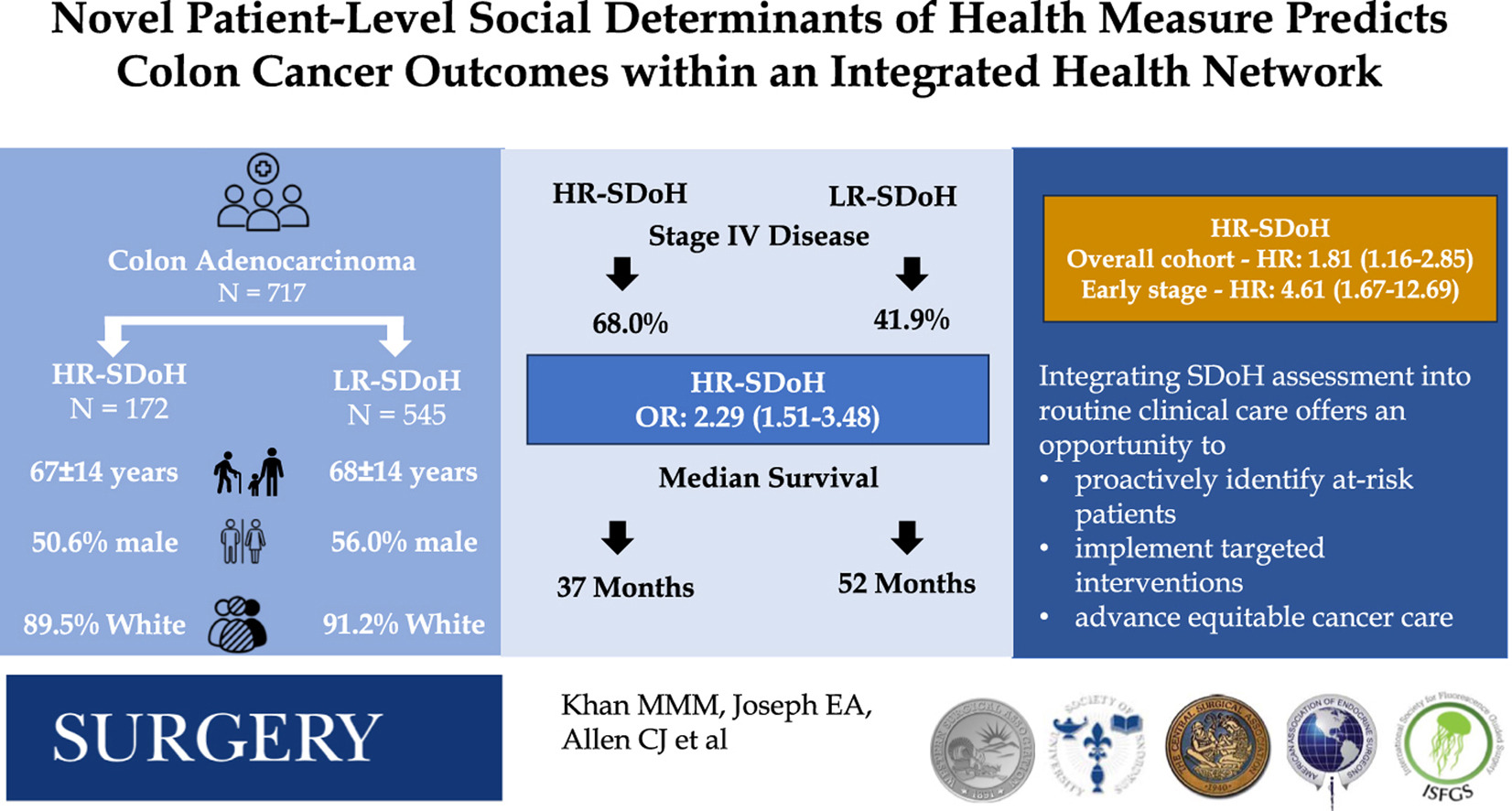
This prospective cohort study analyzed 717 patients diagnosed with colon adenocarcinoma from 2020 to 2023 within a large integrated health network. A dedicated program collected 13 defined patient-level SDOH components per individual. Patients reporting significant impairments in any SDOH domain were classified as high-risk SDOH. Clinical variables including age, sex, race, Charlson Comorbidity Index, and cancer stage were recorded. Primary outcomes were stage at diagnosis and overall survival. Multivariable logistic and Cox regression models evaluated independent associations between high-risk SDOH status and oncologic outcomes.
Key Findings
The cohort’s mean age was 67.9 years, predominantly White (90.8%), with 24.0% classified as high-risk SDOH. Notably, both groups were balanced in sex, race, and comorbidity burden, reducing confounding by these factors. High-risk SDOH independently predicted metastatic (stage IV) disease at diagnosis with an odds ratio of 2.32 (95% CI, 1.45–3.73; P < .001). Regarding survival, high-risk SDOH correlated with increased mortality risk across all stages (hazard ratio 1.81; 95% CI, 1.16–2.85; P = .010). Among early-stage patients (stage I-II), high-risk SDOH was particularly prognostic, imparting over fourfold increased mortality risk (hazard ratio 4.61; 95% CI, 1.67–12.69; P = .003).
Median overall survival was 50 months in the cohort, with stage IV disease present in 21.3%. The consistency of SDOH impact on both cancer severity at presentation and survival underscores the critical role of individualized social context in oncologic outcomes.
Expert Commentary
This study compellingly demonstrates how integrating patient-level social risk factor data can refine risk stratification in colon cancer. Unlike prior population-level indices, the prospective and specific SDOH measure allows identification of vulnerable patients otherwise indistinguishable by demographic or clinical metrics alone. These findings corroborate growing evidence linking social adversity to delayed diagnosis, treatment barriers, and poorer cancer outcomes.
Limitations include the predominantly White and integrated network cohort which may limit generalizability to more diverse or fragmented health systems. Additionally, the direct mechanisms by which SDOH influence cancer biology or healthcare utilization remain to be elucidated. Nonetheless, by adjusting for comorbidity and demographics, the study isolates social determinants as independent prognostic factors.
Future research should assess how targeted support services addressing these social needs might improve cancer detection rates and survival. Health systems may consider embedding routine patient-level SDOH screening into cancer workflows as a means to enable precision supportive care and resource allocation.
Conclusion
This investigation highlights a practical approach to systematically measure patient-level social determinants of health within an integrated network and confirms their independent association with advanced disease and mortality in colon cancer. Incorporating such individualized social risk assessments could facilitate earlier intervention and personalized care strategies, improving oncologic outcomes and reducing disparities. The study encourages a paradigm shift toward integrating social health screening as a standard component of oncology practice to comprehensively address non-medical factors impacting cancer prognosis.
Funding and ClinicalTrials.gov
The study does not specify funding sources or clinical trial registration numbers.
References
1. Khan MMM, Boyev A, Joseph EA, et al. Novel patient-level social determinants of health measure predicts colon cancer outcomes within an integrated health network. Surgery. 2026;198:110378. doi:10.1016/j.surg.2026.110378
2. Bradley CJ, Given CW, Roberts C. Race, socioeconomic status, and breast cancer treatment and survival. J Natl Cancer Inst. 2002;94(7):490-496.
3. Guerra C, Krumholz HM, Negro D, et al. Social Determinants of Health in Oncology: A Framework for Eliminating Disparities. Cancer Epidemiol Biomarkers Prev. 2021;30(11):2068-2074.
4. Pruitt SL, Greer JA, Dobransky-Fasiska A, et al. Screening for Social Needs in Clinical Settings: A Review of Tools and Guidelines. Ann Intern Med. 2023;176(3):423-434.