Highlights
- Centralized multidisciplinary retinoblastoma (RB) programs with telemedicine can markedly improve survival and eye preservation in low- and middle-income countries (LMICs).
- Integration of structured capacity building and international twinning partnerships facilitates local expertise and sustainable care delivery.
- Advanced globe-salvage therapies including systemic chemotherapy, focal laser therapies, intra-arterial and intravitreal chemotherapy contribute to high salvage rates even in advanced cases.
- King Hussein Cancer Center (KHCC) provides a scalable model with outcomes comparable to high-income countries despite resource constraints.
Background
Retinoblastoma (RB) is the most common intraocular malignancy of childhood, with approximately 8,000 new cases worldwide annually. Outcomes vary drastically between high-income and low/middle-income countries due to disparities in early diagnosis, access to care, and treatment infrastructure. In LMICs, late presentation with advanced tumors, fragmented care systems, and limited specialized expertise contribute to high mortality and enucleation rates. These disparities underscore an urgent need for strategies to optimize RB management worldwide, emphasizing multidisciplinary care, capacity building, and innovative methods such as telemedicine to bridge geographic and resource barriers. Over two decades, the King Hussein Cancer Center (KHCC) in Jordan developed a centralized multidisciplinary RB program incorporating telemedicine-supported international partnerships, advanced globe-salvage therapies, and structured training, seeking to close these outcome gaps regionally.
Key Content
Chronological Development of Evidence and Program Evolution
Historically, RB treatment in LMICs was marked by high mortality and enucleation rates. A 2006 Turkish study reported a 3-year survival around 90%, emphasizing multidisciplinary team approaches and government support for universal coverage (PMID: 16911081). However, mortality remained higher in many resource-limited settings, exemplified by Uganda’s 2022 retrospective study showing advanced presentations, high metastatic spread, and 3-year survival median of 2.18 years with significant attrition to follow-up (PMID: 35308301).
The implementation of telemedicine and centralized care at KHCC commencing in 2003 marked a pivotal transition. A 2021 analysis of 478 patients highlighted dramatic reductions in mortality from 38% pre-implementation to 5% post-implementation and eye salvage improvement from 4% to 61%, with telemedicine enabling real-time case discussions with St. Jude Children’s Research Hospital and fostering local expertise (PMID: 32682835). Over time, the need for external consultation declined, reflecting capacity building and knowledge transfer.
The current comprehensive 23-year cohort study (2003–2025) involving 601 children with 1000 affected eyes consolidates and extends prior findings (PMID: 42759575). It demonstrates sustained improvements in survival and globe salvage, establishing KHCC as a regional referral hub leveraging multidisciplinary teams, telemedicine, and advanced therapies.
Clinical Characteristics and Staging
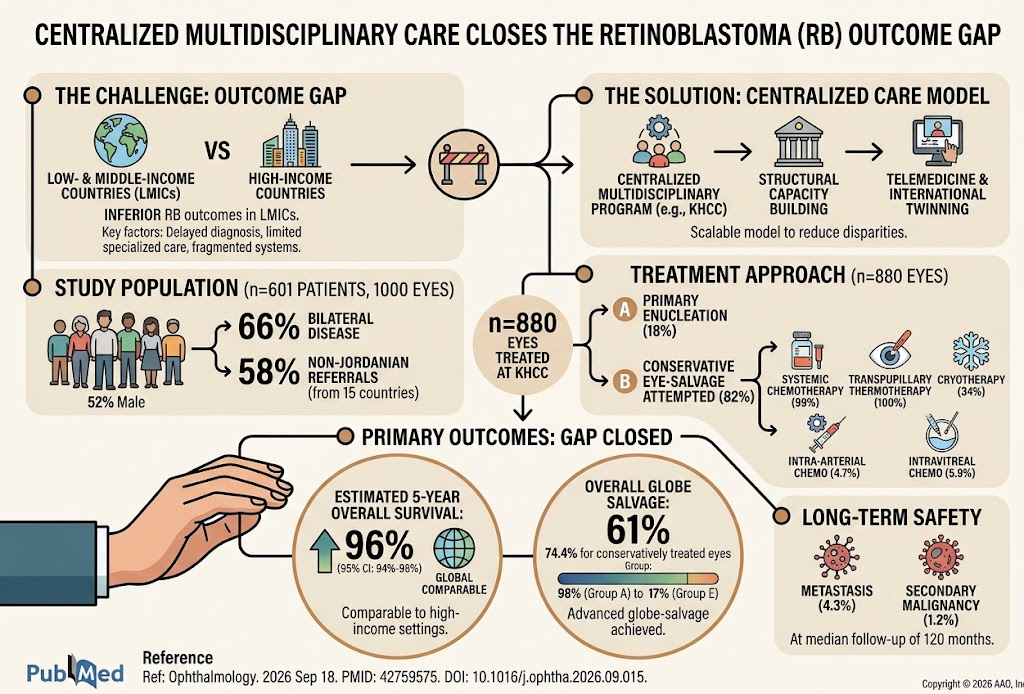
Among 601 children, 66% had bilateral disease, reflecting a high-risk cohort. Referral pathways extended across 15 countries, with 58% of patients non-Jordanian. Of 1000 eyes, 12% had pre-referral enucleation. Among 880 eyes treated at KHCC, at presentation, tumor staging by the International Classification of RB showed distribution predominantly in advanced groups (Group D: 39%, Group E: 9.2%). Only 5.2% were Group A.
Multidisciplinary Treatment Modalities and Globe Salvage Outcomes
Conservative eye-salvage treatment was attempted in 82% of eyes treated at KHCC, utilizing an integrative approach combining systemic chemotherapy (99% of eyes), transpupillary thermotherapy (TTT, 100%), cryotherapy (34%), and newer modalities including intra-arterial (4.7%), intravitreal (5.9%), and subtenon chemotherapy (3.3%), as well as iodine-125 plaque brachytherapy (3.2%). Notably, some early group A eyes were treated with focal therapies alone without systemic chemotherapy, reflecting risk-adapted treatment.
Overall eye salvage was 61%, and among conservatively treated eyes, 74.4%, with stratified salvage rates of 98% in Group A down to only 17% in the most advanced Group E. These outcomes align favorably with high-income country benchmarks and demonstrate that advanced globe-salvage techniques can be feasibly implemented with remarkable success in LMIC contexts when supported by centralized expertise.
Survival and Long-Term Outcomes
At a median follow-up of 10 years, metastasis occurred in only 4.3% of patients, and secondary malignancies in 1.2%. The estimated 5-year overall survival was an excellent 96%, comparable to outcomes reported in developed countries. This contrasts starkly with higher mortality reported in other LMIC cohorts lacking centralized programs and multidisciplinary coordination.
Comparative Data and Supporting Evidence from Other Settings
Prior to centralized care, eye preservation and survival rates remained suboptimal. The Mexican single-center study pre-chemotherapy in situ era reported overall survival of 86%, with eye preservation achieved in 81% of treated eyes using systemic chemotherapy plus focal therapies and radiotherapy, underscoring the importance of multidisciplinary treatments though resource limitation affected outcomes (PMID: 32743978).
Observational studies highlight the detrimental impact of delayed diagnosis and fragmented care in LMICs, as seen in lower salvage and survival rates in Uganda and other African settings. A multinational observational study during the COVID-19 pandemic showed that mortality in childhood cancers was higher in lower-income countries and that timely multidisciplinary treatment diminished the odds of death, reaffirming the necessity of integrated complex care pathways for RB and other pediatric cancers (PMID: 36261229).
Expert Commentary
The KHCC model exemplifies how centralized, multidisciplinary RB care integrating telemedicine and international partnerships can bridge the resource divide between LMICs and high-income countries. Key success factors include:
- Centralization: Concentrating expertise, infrastructure, and resources to optimize care delivery and allow comprehensive multidisciplinary management.
- Capacity Building: Training local teams through repeated telemedicine consultations and case discussions fosters autonomous decision-making and sustainable care.
- Technology Utilization: Telemedicine minimizes geographic barriers, enabling expert review and shared decision-making without patient transfer delays.
- Advanced Therapeutics: Incorporation of intra-arterial and intravitreal chemotherapy expands salvage options for advanced ocular tumors once considered enucleation-only cases.
These strategies mitigate previously unavoidable treatment gaps related to late presentation and limited access. Mechanistically, early systemic chemotherapy combined with focal destruction therapies targets both intraocular tumor bulk and micrometastases, preventing dissemination. Local therapies preserve visual function while minimizing systemic toxicity. The gradual institutional knowledge transfer reduces dependence on external centers, promoting autonomy.
Challenges remain, including accessibility for rural populations, follow-up retention, and managing treatment complications. Generalizability to other LMIC contexts requires adaptation to local healthcare infrastructures and resource availability. However, KHCC’s experience offers a robust template.
Conclusion
Centralized multidisciplinary retinoblastoma programs supported by telemedicine and international collaboration represent a paradigm shift in addressing global inequities in RB outcomes. The KHCC experience over two decades demonstrates that survival and globe salvage rates similar to high-income countries are attainable in resource-limited settings. This model highlights the critical value of integrated care pathways, capacity building, and technology-enabled expert support to enhance pediatric ocular oncology worldwide. Future efforts should focus on expanding regional referral networks, increasing awareness to reduce diagnostic delay, and implementing sustainable funding and policy frameworks to globally standardize RB care quality.
References
- Yousef YA, Halalsheh H, Mohammad M, et al. Centralized Multidisciplinary Retinoblastoma Care Closes the Outcome Gap: Survival and Globe Salvage for 1000 Eyes from 601 Patients. Ophthalmology. 2026 Sep 18:S0161-6420(26)00687-1. doi: 10.1016/j.ophtha.2026.09.015. PMID: 42759575.
- Shawagfeh M, Yousef YA, et al. How Telemedicine and Centralized Care Changed the Natural History of Retinoblastoma in a Developing Country: Analysis of 478 Patients. Ophthalmology. 2021 Jan;128(1):130-137. doi: 10.1016/j.ophtha.2020.07.026. PMID: 32682835.
- Mohamed K, et al. Clinical presentation and outcomes in children with retinoblastoma managed at the Uganda Cancer Institute. J Cancer Epidemiol. 2022;2022:8817215. doi: 10.1155/2022/8817215. PMID: 35308301.
- Romero-Cabral JA, et al. Ocular preservation in patients with bilateral retinoblastoma before chemotherapy in situ era: A report from a Mexican Retinoblastoma Reference Hospital. Pediatr Blood Cancer. 2020 Oct;67(10):e28625. doi: 10.1002/pbc.28625. PMID: 32743978.
- Çetinkaya Y, et al. Retinoblastoma in Turkey: survival and clinical characteristics 1981-2004. Pediatr Int. 2006 Aug;48(4):369-73. doi: 10.1111/j.1442-200X.2006.02223.x. PMID: 16911081.
- Tomlinson D, et al. Twelve-month observational study of children with cancer in 41 countries during the COVID-19 pandemic. BMJ Glob Health. 2022 Oct;7(10):e008797. doi: 10.1136/bmjgh-2022-008797. PMID: 36261229.