Highlight
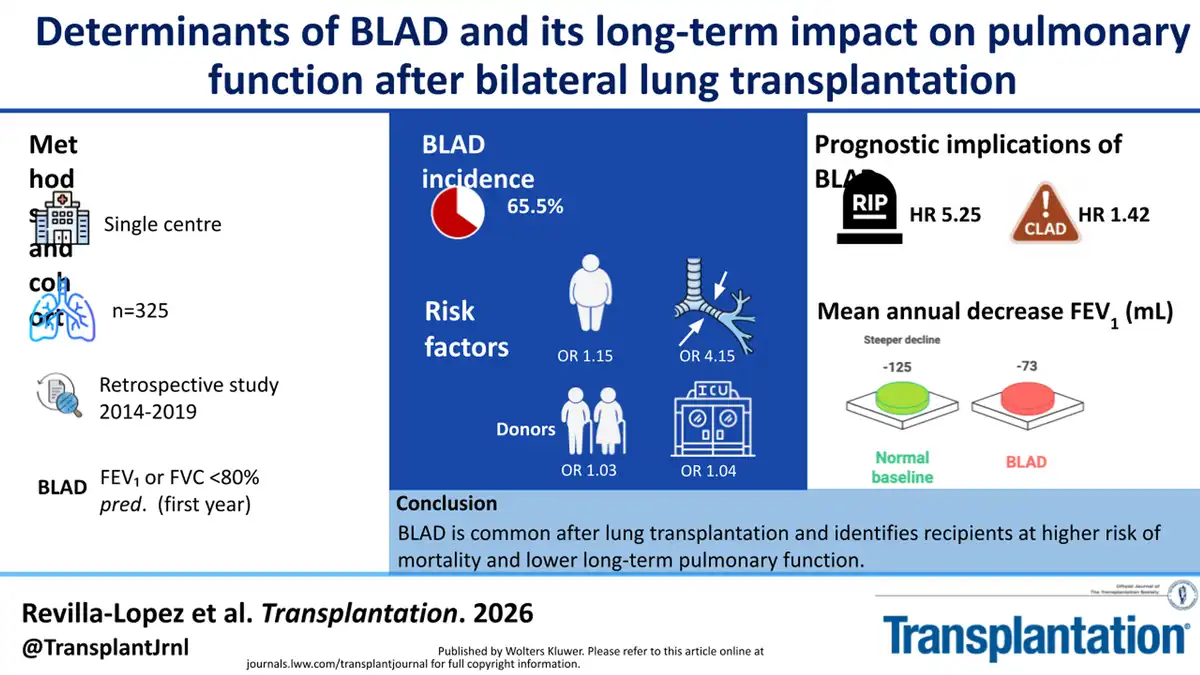
- Baseline lung allograft dysfunction (BLAD) occurs in 65.5% of bilateral lung transplant recipients and independently predicts higher mortality.
- BLAD is linked to increased risk of chronic lung allograft dysfunction (CLAD), though structural and mechanical factors confound this association.
- Key risk factors for BLAD include elevated recipient body mass index, prolonged intensive care unit (ICU) stay, bronchial stenosis, and older donor age.
- Over the long term, recipients with BLAD experience slower decline in spirometric measures compared to those with normal baseline function, with CLAD driving later pulmonary deterioration.
Background
Lung transplantation (LT) remains the definitive treatment modality for select patients with end-stage pulmonary diseases such as idiopathic pulmonary fibrosis, chronic obstructive pulmonary disease, and cystic fibrosis. Despite advances in surgical techniques and immunosuppressive regimens, a significant proportion of recipients do not achieve optimal restoration of pulmonary function posttransplant. This suboptimal posttransplant lung performance, termed baseline lung allograft dysfunction (BLAD), is characterized by failure to reach predicted forced expiratory volume in 1 second (FEV1) or forced vital capacity (FVC) thresholds, specifically <80% predicted, within the first year following double lung transplantation.
Understanding the determinants of BLAD and its relationship with chronic lung allograft dysfunction (CLAD), a leading cause of late graft failure, is critical for improving clinical outcomes and long-term survival. However, the etiology of BLAD is multifactorial and incompletely characterized; elucidating risk factors and impact on long-term lung function trajectories can refine surveillance and management strategies.
Study Design and Methods
This retrospective cohort study analyzed 325 adult recipients of bilateral lung transplantations performed from 2014 to 2019, with clinical follow-up extending through December 2024 at a tertiary transplant center. BLAD was operationally defined as an inability to achieve either FEV1 or FVC ≥80% of predicted values within the first post-LT year.
Comprehensive clinical data including recipient demographics, perioperative variables, donor characteristics, and complications such as bronchial stenosis were collected. Multivariable logistic regression modeling identified independent risk factors for BLAD development. To investigate long-term outcomes, Cox proportional hazards models assessed the impact of BLAD on overall survival and CLAD incidence. Longitudinal lung function changes were examined using linear mixed-effects models over a median follow-up of 5 years.
Key Findings
BLAD was prevalent, occurring in 65.5% (213/325) of recipients after bilateral LT. This condition was strongly associated with increased mortality; BLAD independently predicted reduced survival with a hazard ratio (HR) of 5.25 (95% confidence interval [CI], 3.84-7.18; P < 0.001).
The presence of BLAD also correlated with a higher risk of developing CLAD (HR 1.42; 95% CI, 1.00-2.00; P = 0.047). However, when excluding recipients with structural or mechanical causes potentially reducing spirometry results—such as bronchial stenosis or other obstructive pathologies—the association between BLAD and CLAD risk diminished. This suggests that some cases of BLAD represent heterogeneous phenotypes, including reversible mechanical limitations rather than intrinsic allograft dysfunction.
Multivariable analysis identified several independent determinants of BLAD: elevated recipient body mass index (BMI), prolonged ICU length of stay posttransplant, presence of bronchial stenosis, and increased donor age. These factors likely reflect complex perioperative and patient-related vulnerabilities influencing early graft function.
Longitudinally, recipients with initial BLAD showed a slower decline in spirometric parameters over 5 years compared to those achieving normal baseline lung function. Despite this, CLAD remained the principal driver of late pulmonary function deterioration across all recipients. This indicates that BLAD may negatively impact short-term function and survival, but it does not necessarily portend accelerated lung function decline beyond the early posttransplant period in the absence of CLAD.
Expert Commentary
This robust longitudinal study highlights BLAD as a prevalent and clinically significant early posttransplant phenotype that independently worsens survival outcomes. The identification of modifiable risk factors like BMI and intensive care duration offers potential intervention targets to reduce BLAD incidence.
Notably, the attenuation of BLAD’s association with CLAD after excluding recipients with mechanical causes underscores the heterogeneity of early allograft dysfunction. Distinguishing intrinsic graft injury from extrinsic factors such as bronchial stenosis is vital in clinical decision making. Functional impairment due to reversible airway complications may respond to interventional procedures, potentially improving long-term outcomes.
The finding that BLAD recipients experience slower spirometric decline posttransplant compared to those with normal baseline function is intriguing and may reflect survivorship bias or differential progression trajectories. This warrants further mechanistic work to clarify pathophysiological pathways linking early graft dysfunction and chronic rejection.
Limitations include the retrospective design and potential residual confounders despite multivariable adjustments. Additionally, functional definitions based solely on spirometry may overlook subtler perfusion or ventilation abnormalities.
Conclusions
Baseline lung allograft dysfunction is a common, multifactorial early complication after bilateral lung transplantation that portends increased mortality and impaired long-term pulmonary function. Key risk factors are identifiable and include recipient BMI, ICU stay length, bronchial stenosis, and donor age.
Though BLAD correlates with increased CLAD risk, this relationship is partially confounded by reversible structural or mechanical impediments influencing lung function measurements. Therefore, clinicians should consider BLAD as a heterogeneous phenotype requiring individualized evaluation and management.
Future prospective studies integrating imaging, biomarker, and mechanistic assessments are needed to further elucidate BLAD’s pathobiology and refine strategies to optimize graft function and survival in lung transplant recipients.
Funding and Registration
The study was supported by institutional research funding. No clinical trial registration was reported.
References
1. Revilla-Lopez E, et al. Determinants of Baseline Lung Allograft Dysfunction and its Long-term Impact on Pulmonary Function After Bilateral Lung Transplantation. Transplantation. 2026 Jun 24;110(10):e2135-e2143. PMID: 42335329.
2. Glanville AR, et al. Chronic lung allograft dysfunction: Definition and update of restrictive allograft syndrome–a consensus report from the Pulmonary Work Group of the ISHLT. J Heart Lung Transplant. 2019;38(5):483-492.
3. Snell GI, et al. Evaluation and management of airway complications following lung transplantation. Thorax. 2016;71(11):1195-1202.
4. Weill D, et al. A consensus document for the selection of lung transplant candidates: 2014—An update from the Pulmonary Council of the International Society for Heart and Lung Transplantation. J Heart Lung Transplant. 2015;34(1):1-15.