Highlight
1. This NCDB analysis demonstrates that HPV-positive status confers better overall survival in patients with keratinizing nasopharyngeal carcinoma (NPC).
2. No significant survival difference was seen with HPV positivity in non-keratinizing subtypes of NPC.
3. HPV testing in NPC could serve as an important prognostic biomarker, influencing clinical management.
4. Multivariate analysis confirmed the independent prognostic value of HPV positivity beyond established demographic and clinical factors.
Study Background
Nasopharyngeal carcinoma (NPC) is a distinct head and neck malignancy endemic in certain geographic regions with diverse histologic subtypes. Historically, the Epstein-Barr virus (EBV) has been recognized as an important etiologic and prognostic factor in NPC, especially non-keratinizing forms. However, the role of human papillomavirus (HPV), well-established in oropharyngeal carcinomas, has remained less clear in NPC. Keratinizing squamous cell carcinoma of the nasopharynx is less common and generally associated with poorer prognosis compared to non-keratinizing types.
Given the rising incidence of HPV-related head and neck cancers and improving diagnostic capabilities, investigating HPV’s prognostic impact on NPC subtypes, particularly keratinizing NPC, is critical. Understanding HPV’s role may refine prognostication and treatment strategies, addressing an unmet need in head and neck oncology.
Study Design
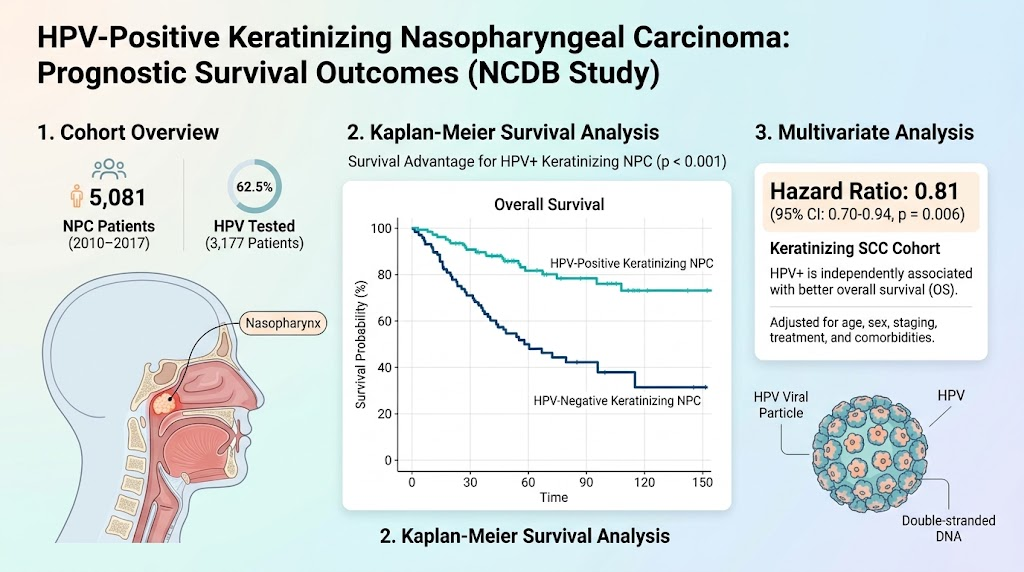
This retrospective cohort study utilized the National Cancer Data Base (NCDB) capturing patients diagnosed with NPC between 2010 and 2017 who underwent HPV testing. A total of 5081 patients were identified, with available HPV testing data in 62.5% (n=3177). Demographic, clinical, pathologic, and treatment variables were extracted.
Logistic regression evaluated predictors of HPV testing and positivity. Kaplan-Meier survival analysis compared overall survival (OS) between HPV-positive and HPV-negative groups, focusing on different histologic subtypes of NPC. Univariate and multivariate Cox proportional hazards models were constructed to identify independent prognostic factors, adjusting for sex, age, race, insurance, treatment facility type and volume, socioeconomic status (education at zip code level), Charlson comorbidity index, staging, and therapies received.
Key Findings
Among patients with keratinizing NPC, HPV-positive status was associated with significantly improved OS compared to HPV-negative counterparts (log-rank p<0.001). The survival benefit was not observed in non-keratinizing or other histologic NPC subtypes, indicating a subtype-specific prognostic relevance.
Multivariate Cox analysis focusing on the keratinizing cohort demonstrated HPV positivity independently predicted better survival outcomes (Hazard Ratio [HR] 0.81, 95% Confidence Interval [CI]: 0.70-0.94, p=0.006). This association persisted after adjusting for confounding demographic and clinical factors.
Factors such as younger age, female sex, and treatment at high-volume or academic centers also correlated with improved survival. Insurance status and zip code-level education, representing socioeconomic determinants, showed impact, underlining the multifactorial nature of NPC prognosis.
The study highlights the heterogeneity in NPC biology and epidemiology and positions HPV as a favorable prognostic biomarker specifically in the keratinizing NPC subtype.
Expert Commentary
This NCDB study is among the largest to elucidate the prognostic role of HPV in NPC, with a focus on the keratinizing subset. It aligns with analogous findings in oropharyngeal squamous cell carcinoma where HPV positivity is linked to better prognosis due to distinct molecular and immune profiles.
Keratinizing NPC typically carries worse outcomes; thus, the identification of HPV positivity as a survival-enhancing factor suggests a biologically distinct tumor subgroup that may respond differently to standard therapies. This could influence therapeutic de-escalation strategies or prompt targeted clinical trials in the future.
Limitations include the retrospective design and potential selection bias inherent to registry data. HPV testing use was not universal, and test methodologies might vary. The study lacked detailed data on EBV status and HPV viral load or genotype, which could further refine prognostic models. Additionally, treatment details such as chemotherapy regimens and radiation dose were not deeply analyzed.
Future prospective studies are warranted to explore the mechanistic underpinnings of HPV positivity in keratinizing NPC and validate these findings in diverse populations. Integration of HPV testing into routine NPC workup could enhance personalized management and prognostication.
Conclusion
HPV-positive keratinizing nasopharyngeal carcinoma is independently associated with better overall survival compared to HPV-negative cases. This points to the importance of incorporating HPV testing in the diagnostic algorithm of NPC, especially for histologically keratinizing subtypes. Recognizing HPV status may guide prognostication and influence therapeutic decision-making, ultimately improving patient outcomes in this challenging disease.
Ongoing research should address mechanistic explanations and explore if HPV-directed interventions or de-escalated treatment regimens are feasible and effective in this subset.
Funding and Clinicaltrials.gov
This study was conducted using deidentified data from the National Cancer Data Base (NCDB). There are no specific funding sources disclosed. No clinical trial registration is applicable to this registry-based analysis.
References
- Chen H, Bowman T, O’Neil Danis D, et al. HPV-Positive Keratinizing Nasopharyngeal Carcinoma Is Associated With Better Survival: A NCDB Study. The Laryngoscope. 2026 Oct 13. PMID: 42869851.
- Chan ATC, Ma BBY. Nasopharyngeal carcinoma: Current management and future clinical trials. Cancer Treat Rev. 2010;36(7):489-495.
- Ang KK, Harris J, Wheeler R, et al. Human papillomavirus and survival of patients with oropharyngeal cancer. N Engl J Med. 2010;363(1):24-35.
- Garden AS, Klippenstein DL, Morrison WH, et al. Treatment Outcomes and Patterns of Care in Nasopharyngeal Carcinoma. Int J Radiat Oncol Biol Phys. 2006;65(4):992-999.
- Ramanakumar AV, Spinelli JJ, Hatse S, et al. HPV and Epstein-Barr virus infections in patients with nasopharyngeal carcinoma and controls. Int J Cancer. 2018;142(12):2624-2632.