Highlight
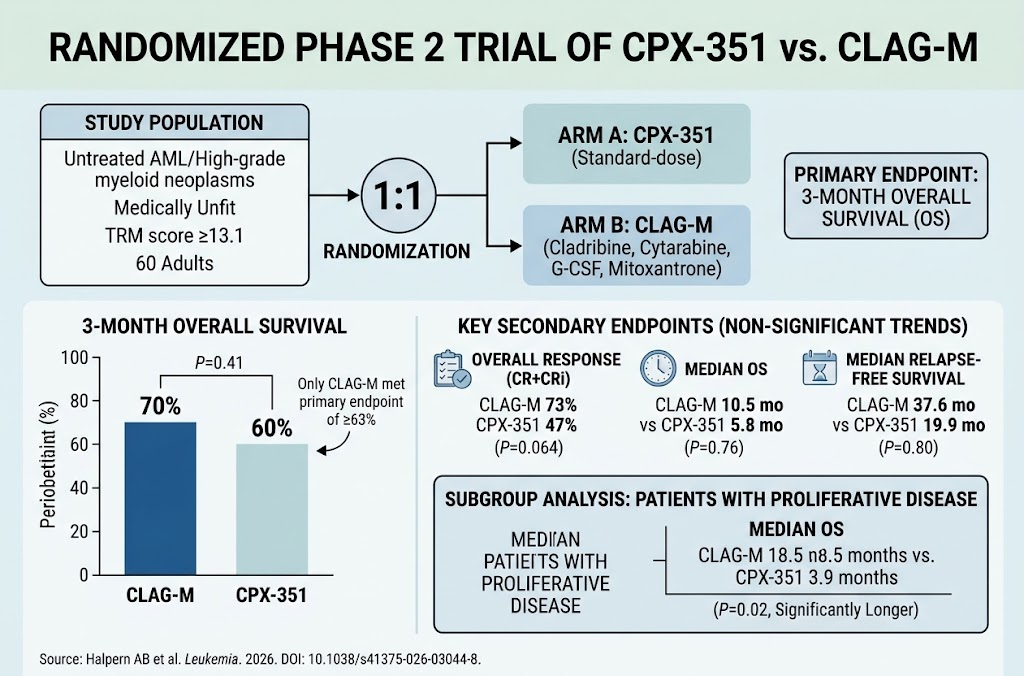
- This randomized phase 2 trial compares CPX-351 to CLAG-M in medically unfit adults with AML or high-grade myeloid neoplasms.
- CLAG-M achieved the primary endpoint of ≥63% 3-month overall survival, outperforming CPX-351 (70% vs. 60%).
- Complete remission rates were higher with CLAG-M (73% vs. 47%), though marginally non-significant.
- In patients with proliferative disease, CLAG-M significantly improved overall survival versus CPX-351.
Study Background
Acute myeloid leukemia (AML) predominantly affects older adults who often present with comorbidities and poor performance status, rendering them medically unfit for intensive standard chemotherapy. Despite advances in targeted and lower-intensity therapies, optimal treatment strategies for medically unfit AML patients remain unclear due to limited evidence from randomized trials. Treatment-Related Mortality (TRM) risk models help identify such unfit patients who are at higher risk of early death from therapy. Previous studies have suggested that intensive regimens, such as CLAG-M—which combines cladribine, high-dose cytarabine, G-CSF, and mitoxantrone—may offer higher response rates without excessive toxicity even in this population. Nonetheless, approved liposomal agents like CPX-351 have become alternatives that might be better tolerated but potentially less effective in proliferative disease. There is a critical need to rigorously evaluate these therapeutic options in medically unfit cohorts to guide clinical decision-making and improve outcomes.
Study Design
This single-institution, open-label, randomized phase 2 clinical trial (NCT04195945) enrolled 60 adults with untreated AML or other high-grade myeloid neoplasms. Eligible patients were classified as medically unfit based on a Treatment-Related Mortality (TRM) score ≥13.1, a metric predictive of high early mortality risk with intensive chemotherapy, with 68% exhibiting Eastern Cooperative Oncology Group (ECOG) performance status 3 to 4, indicative of poor functional status.
Participants were randomized 1:1 to receive either CPX-351 at standard dosing or CLAG-M at standard dosing. The primary endpoint was 3-month overall survival (OS), a meaningful early outcome reflecting therapy safety and initial efficacy. Secondary endpoints included overall response rate (ORR; combining complete remission [CR] and CR with incomplete hematologic recovery [CRi]), measurable residual disease (MRD) negativity rates, toxicity profiles, treatment-related mortality, relapse-free survival (RFS), and long-term OS.
Key Findings
The trial demonstrated that only CLAG-M met the pre-specified primary endpoint of ≥63% 3-month OS with a rate of 70% (versus 60% for CPX-351; P = 0.41). This suggests a trend favoring CLAG-M but not statistically significant for OS at three months.
CLAG-M treatment induced higher rates of overall remission (CR plus CRi) at 73%, compared to 47% with CPX-351 (P = 0.064), indicating a substantial improvement in initial disease clearance that approached but did not reach statistical significance. Measurable residual disease negativity, an emerging prognostic indicator, was also evaluated but detailed comparative data were not provided.
Regarding safety, both regimens displayed comparable toxicity and treatment-related mortality rates, underscoring the tolerability of the intensive CLAG-M regimen even in this high-risk unfit population.
Longer-term outcomes showed no statistically significant differences between the two arms in median relapse-free survival (37.6 months for CLAG-M vs. 19.9 months for CPX-351; P = 0.80) or overall survival (10.5 vs. 5.8 months; P = 0.76), indicating similar durability of responses and survival benefits.
Importantly, a subgroup analysis in patients with proliferative disease (defined by elevated white blood counts at diagnosis) revealed a significant survival advantage with CLAG-M (median OS 18.5 months vs. 3.9 months; P = 0.02). This finding highlights that patients with aggressive disease biology might derive meaningful benefit from intensive chemotherapy despite medical unfitness.
Expert Commentary
This trial addresses a key clinical dilemma: balancing efficacy and safety in AML patients lacking fitness for conventional intensive therapy. The encouraging survival and remission rates with CLAG-M challenge the paradigm that all unfit patients require attenuated regimens, suggesting that with careful patient selection and supportive care, more intensive therapy is feasible and advantageous for certain subgroups.
The comparable toxicity profiles reflect improved supportive measures and patient monitoring employed in contemporary trials. However, the study’s limited sample size and single-center design warrant cautious interpretation, and findings require validation in larger, multicenter settings.
Moreover, although CPX-351 has demonstrated efficacy, particularly in secondary and therapy-related AML, its apparent inferiority in proliferative disease according to this study suggests that biological disease characteristics remain critical in tailoring therapy.
Future research should integrate molecular and clinical prognosticators to refine treatment personalization. Additionally, evaluating combinations with novel targeted agents may enhance outcomes for medically unfit AML patients beyond conventional chemotherapy.
Conclusion
In medically unfit adults with AML or high-grade myeloid neoplasms, CLAG-M chemotherapy achieved superior early survival and remission rates compared with CPX-351, meeting the primary endpoint of 3-month OS. Importantly, patients with proliferative disease particularly benefit from intensive therapy, highlighting the need for individualized treatment approaches despite medical frailty. Both regimens showed similar safety profiles, supporting the cautious use of intensive chemotherapy in selected unfit patients. These results reinforce the necessity for risk-adapted treatment strategies and underscore ongoing challenges in optimizing outcomes within this vulnerable patient population.
Funding and Clinical Trials Registration
This study was conducted under the auspices of the treating institution and funding details were not provided in the abstract. The trial is registered at ClinicalTrials.gov under identifier NCT04195945.
References
Halpern AB, Othus M, Percival MM, Ghiuzeli C, Appelbaum JS, Hendrie PC, Cassaday RD, Smith M, Russell K, Scott BL, et al. Randomized phase 2 trial of CPX-351 vs. CLAG-M (cladribine, cytarabine, G-CSF, and mitoxantrone) for medically unfit adults with acute myeloid leukemia or other high-grade myeloid neoplasms. Leukemia. 2026 Jul 13;40(9):1977-1984. PMID: 42443407. https://pubmed.ncbi.nlm.nih.gov/42443407/