Introduction
Endometrial, ovarian, and cervical cancers represent key gynecological malignancies predominantly affecting middle-aged and older women worldwide. However, younger women under 50 years form a distinct population where risk factors, disease biology, and clinical outcomes may differ substantially. Understanding temporal trends in this age group is crucial for optimizing screening, prevention, and treatment strategies tailored to their unique needs. The Nordic countries, with comprehensive, high-quality cancer registries across four decades, provide a valuable setting to analyze changes in incidence, prevalence, mortality, and survival of these cancers from 1980 to 2023. This article critically evaluates the recent study by Riese et al. published in Gynecologic Oncology, synthesizing its findings on gynecological cancer trends in Nordic women aged 0-49 years and their implications for clinical practice and public health.
Background and Disease Burden
Endometrial cancer traditionally occurs postmenopausally but can affect younger women with distinct etiologies including obesity and hormonal factors. Ovarian cancer remains one of the deadliest gynecological cancers with overall poor prognosis, though age-specific trends in young women may vary. Cervical cancer is historically the most common gynecologic malignancy in younger women, intimately associated with persistent human papillomavirus (HPV) infection. Advances in screening, HPV vaccination, and treatment have shaped the epidemiology and outcomes of these cancers in recent decades, yet data clarifying how these changes affect younger women remain limited. Identifying age-specific incidence trends, survival gains, and mortality shifts informs targeted prevention and clinical strategies.
Study Design and Methods
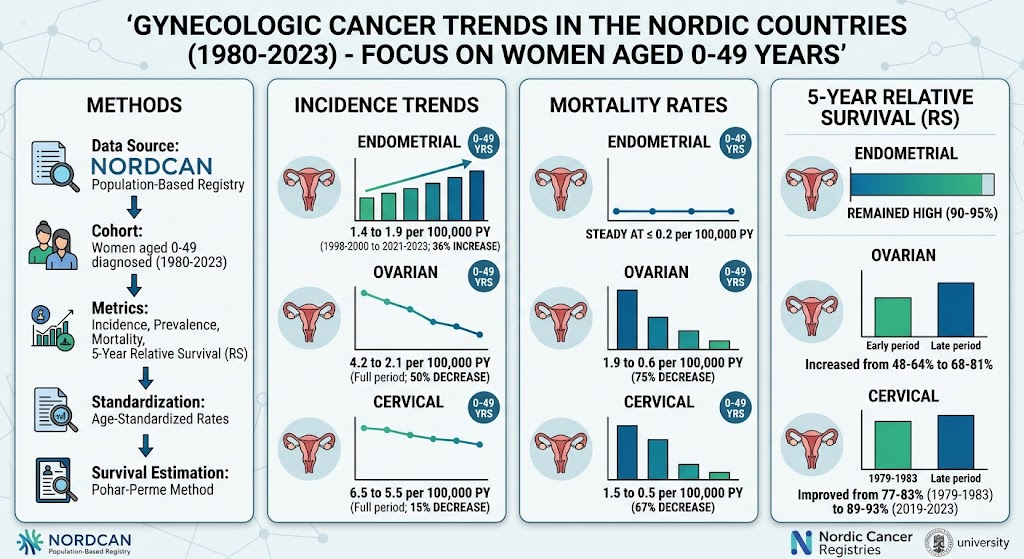
The authors utilized the population-based Nordic Cancer registries compiled in the NORDCAN database, encompassing Denmark, Finland, Iceland, Norway, and Sweden. Women aged 0-49 years diagnosed with endometrial, ovarian, or cervical cancer over 1980-2023 were included. Age-standardized incidence, prevalence, mortality, and five-year relative survival rates were calculated. Survival was estimated using the Pohar-Perme method, which provides unbiased relative survival estimates independent of competing risks. Temporal trends were assessed by comparing rates across defined calendar periods.
This registry-based observational study benefits from the large population coverage and standardized reporting in the Nordic countries but is limited by lack of detailed clinical or molecular data on individual tumors or treatment specifics. The study focuses singularly on younger women to delineate age-specific epidemiologic patterns distinct from those seen in older populations.
Key Findings
Incidence Trends
Between 1998-2000 and 2021-2023, endometrial cancer incidence in women aged 0-49 rose substantially from 1.4 to 1.9 cases per 100,000 person-years (PY), representing a 36% increase. This rise may reflect increasing obesity prevalence and other hormonal risk factors among younger Nordic women.
Conversely, ovarian cancer incidence halved during the entire study span (1980–2023), declining from 4.2 to 2.1 cases per 100,000 PY. Cervical cancer incidence also decreased by 15%, from 6.5 to 5.5 cases per 100,000 PY. Improvements in screening uptake and HPV vaccination likely contributed to the cervical cancer decline.
Mortality Trends
Mortality reductions were particularly pronounced for ovarian and cervical cancers. Ovarian cancer mortality dropped from 1.9 to 0.6 per 100,000 PY (a 75% decrease), and cervical cancer mortality from 1.5 to 0.5 per 100,000 PY (67% reduction). In contrast, endometrial cancer mortality remained low and stable at approximately ≤0.2 per 100,000 PY, reflecting its generally favorable prognosis.
Survival Outcomes
Relative survival (RS) for endometrial cancer was consistently high across all study periods, ranging between 90–95%. Cervical cancer five-year RS improved notably from 77–83% in 1979–1983 to 89–93% in 2019–2023, reflecting advances in early detection and treatment. Ovarian cancer survival showed a significant increase from 48–64% to 68–81% over the same periods, indicating progress in surgical and chemotherapeutic management but still lagging behind the other two cancers.
Interpretation of Trends
The increasing incidence of endometrial cancer in younger women is concerning, likely driven by rising obesity rates—a known major risk factor that promotes endometrial proliferation through unopposed estrogen exposure. The decline in ovarian and cervical cancer incidences evidences effective public health interventions, including oral contraceptive use, which reduces ovarian cancer risk, and organized cervical screening and HPV vaccination programs that markedly lower cervical cancer burden.
Mortality declines and improved survival in ovarian and cervical cancers in young women demonstrate enhanced clinical management and earlier diagnostic detection, while endometrial cancer’s good prognosis is maintained. These trends emphasize the necessity of ongoing HPV vaccination and cervical screening programs and highlight the need for obesity prevention strategies to mitigate rising endometrial cancer risk.
Expert Commentary
These findings affirm the heterogeneous epidemiology of gynecological cancers in younger women. The distinct trends underscore the evolving influence of modifiable risk factors such as obesity and HPV infection alongside technological advances in screening and treatment. The Nordic setting with robust registries offers credible, high-quality data, although translation to other regions should consider demographic and healthcare system differences. The study lacks granular data on tumor biology and treatment modalities, limiting mechanistic insights.
The impressive cervical cancer survival gains validate widespread HPV screening and vaccination, now advocated globally by WHO. Persisting challenges remain in ovarian cancer, where earlier detection methods and personalized therapies are urgently needed to close survival gaps. The rising burden of early-onset endometrial cancer could be a sentinel marker of increasing metabolic disease burden requiring urgent public health attention.
Conclusion
This comprehensive 40-year analysis highlights divergent temporal patterns of incidence, mortality, and survival in endometrial, ovarian, and cervical cancers among young Nordic women. Endometrial cancer incidence rises likely driven by obesity contrast with declining ovarian and cervical cancer incidences reflecting successes in prevention and screening. Mortality reductions and improved survival, particularly in ovarian and cervical cancers, validate advances in cancer care. These findings advocate for integrated, age-targeted prevention, encompassing obesity control, contraceptive counseling, and sustained HPV-based strategies, to further reduce the gynecological cancer burden in younger women.
Future research should focus on elucidating underlying molecular and environmental drivers of these trends and evaluating interventions tailored for younger women to optimize outcomes and quality of life.
Funding and Clinical Trials
The study was conducted by the PredictAYA consortium with access to the NORDCAN registry data. Specific funding sources and clinical trial registrations were not reported in the original manuscript.
References
1. Riese C, Yi-Tung E, Nilsson H, Salehi S, Oberg AS, Kønig SM, et al. Incidence, prevalence, mortality and survival trends in women with endometrial-, ovarian- and cervical cancer in the Nordic countries (1980-2023) with focus on younger women (0-49 years old). Gynecol Oncol. 2026 Aug 19;212:152-159. PMID: 42617581.
2. Bray F, Ferlay J, Soerjomataram I, Siegel RL, Torre LA, Jemal A. Global cancer statistics 2018: GLOBOCAN estimates of incidence and mortality worldwide for 36 cancers in 185 countries. CA Cancer J Clin. 2018 Nov;68(6):394-424.
3. Arbyn M, Xu L, Simoens C, Martin-Hirsch PP. Prophylactic vaccination against human papillomaviruses to prevent cervical cancer and its precursors. Cochrane Database Syst Rev. 2018;5(5):CD009069.
4. Mørch LS, Kjaer SK, et al. Hormonal contraception and ovarian cancer risk. JAMA. 2017 May 23;317(20):2107-2114.
5. Griggs JJ et al. Association of obesity with mortality in women with endometrial cancer. J Clin Oncol. 2018 Feb 10;36(5):514-520.
6. Ferlay J, et al. The evolution of the global cancer burden: GLOBOCAN reports. Int J Cancer. 2020 May 15;146(10):2418-2423.
These references provide relevant context and corroborate epidemiologic trends and screening impact discussed herein.