Highlight
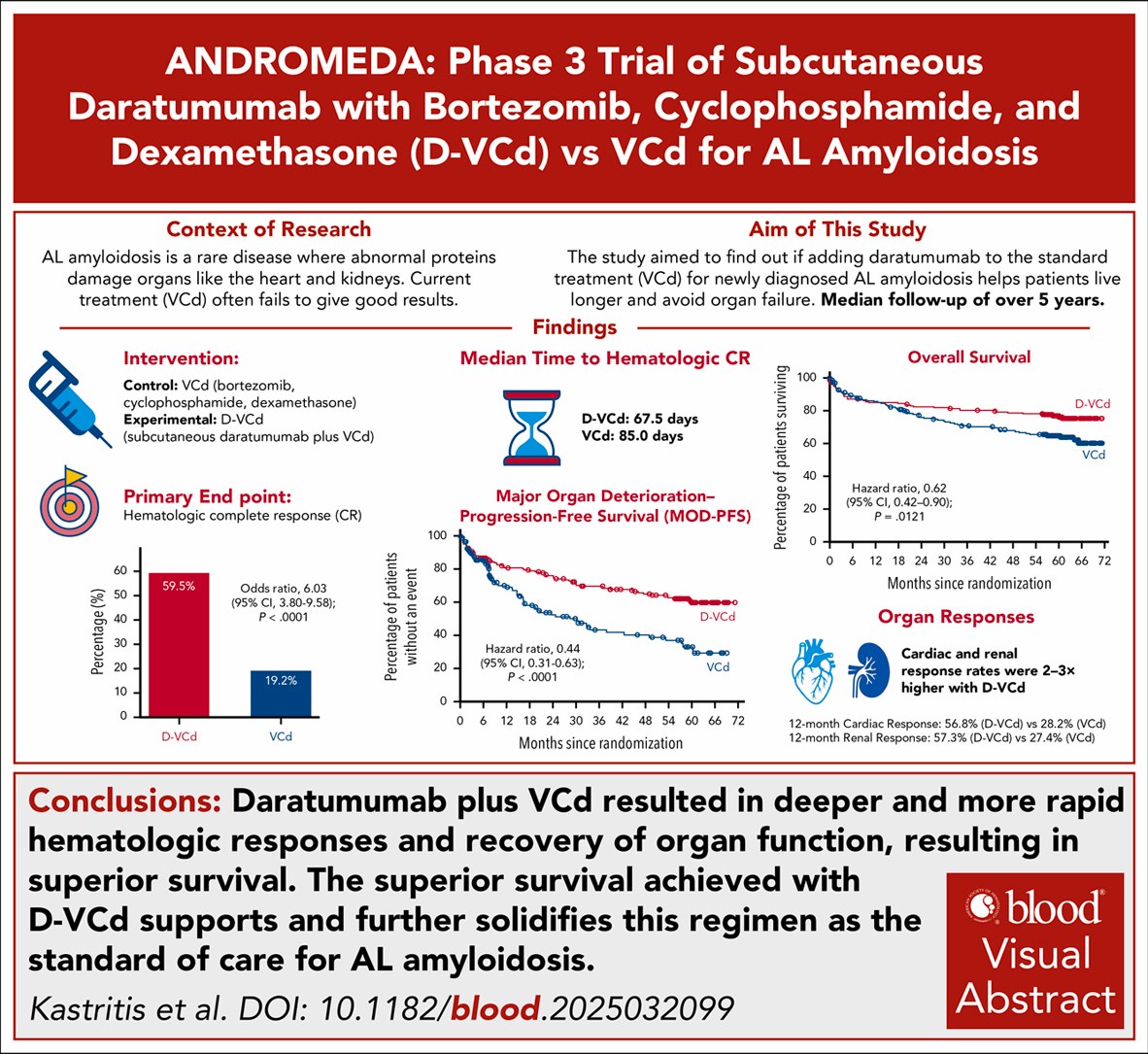
The ANDROMEDA phase 3 trial demonstrates that subcutaneous daratumumab added to bortezomib, cyclophosphamide, and dexamethasone (D-VCd) significantly improves hematologic complete response rates compared to VCd alone in newly diagnosed light-chain (AL) amyloidosis.
D-VCd results in faster and deeper hematologic responses, markedly higher cardiac and renal response rates, and significantly extends both major organ deterioration-progression-free survival (MOD-PFS) and overall survival (OS).
The treatment shows a consistent safety profile, with adverse events manageable and in line with expectations for the components, confirming D-VCd as a new standard of care.
Study Background and Disease Burden
Light-chain (AL) amyloidosis is a rare but life-threatening systemic disorder characterized by the deposition of misfolded immunoglobulin light chains as amyloid fibrils in tissues, leading to progressive organ dysfunction. Cardiac and renal involvement are common and major determinants of prognosis. Historically, patients with AL amyloidosis have faced limited therapeutic options with modest efficacy and poor long-term outcomes.
Standard therapy had included combinations like bortezomib, cyclophosphamide, and dexamethasone (VCd), which improved responses compared to older regimens. However, despite these advances, survival rates remained suboptimal, especially for patients with cardiomyopathy due to rapid organ deterioration.
Daratumumab is a monoclonal antibody targeting CD38 on plasma cells, which has shown efficacy in multiple myeloma and has a strong mechanistic rationale to improve hematologic responses in AL amyloidosis by depleting clonal plasma cells producing pathologic light chains.
The ANDROMEDA trial was designed to assess whether adding subcutaneous daratumumab to VCd would improve hematologic and organ responses, as well as clinical outcomes, in newly diagnosed AL amyloidosis patients.
Study Design
ANDROMEDA is a pivotal phase 3, randomized, open-label, multicenter clinical trial (ClinicalTrials.gov:NCT03201965). A total of 388 patients with newly diagnosed AL amyloidosis were randomized 1:1 to receive either VCd alone or VCd combined with subcutaneous daratumumab (D-VCd).
Patients in both arms received six 28-day treatment cycles of VCd, with the D-VCd group additionally receiving daratumumab subcutaneously weekly during cycles 1-2, every two weeks during cycles 3-6, and then maintenance daratumumab every four weeks for up to 24 total cycles.
The primary endpoint was the rate of hematologic complete response (CR), defined by stringent criteria including normalized free light chain ratios and absence of monoclonal protein. Secondary endpoints included time to hematologic CR, organ responses (cardiac and renal), major organ deterioration-progression-free survival (MOD-PFS), and overall survival (OS).
Key Findings and Results
The final analysis, with a median follow-up of 61.4 months, found that the hematologic CR rate was significantly higher in the D-VCd group at 59.5% versus 19.2% in the VCd group alone (odds ratio 6.03; 95% CI, 3.80-9.58; P < .0001). This represents a threefold increase in complete hematologic responses.
The median time to achieve hematologic CR was shorter with D-VCd (67.5 days) than with VCd (85.0 days), suggesting more rapid disease control.
D-VCd also yielded markedly higher cardiac and renal organ response rates, two to three times greater than VCd alone, which correlate with better organ function preservation and clinical outcomes.
Importantly, D-VCd significantly improved survival endpoints: MOD-PFS was extended with a hazard ratio of 0.44 (95% CI, 0.31-0.63; P < .0001), indicating a 56% reduction in risk of major organ deterioration or progression. Overall survival was also improved (hazard ratio 0.62; 95% CI, 0.42-0.90; P = .0121), reflecting a 38% reduction in mortality risk compared with VCd.
Patients achieving either hematologic or cardiac complete responses had notably superior MOD-PFS and OS, underscoring the clinical relevance of deep responses.
The safety profile of D-VCd was consistent with known risks of daratumumab and VCd therapies. Common adverse events included manageable hematologic toxicities and infections, with no new safety signals reported.
Expert Commentary
The ANDROMEDA final survival analysis establishes D-VCd as a transformative frontline therapy for newly diagnosed AL amyloidosis, significantly enhancing hematologic eradication of clonal plasma cells and translating these responses into durable organ recovery and survival benefits.
The substantial increase in rapid and deep hematologic CR rates reflects the synergistic effect of daratumumab with VCd, targeting multiple pathogenic pathways.
The improvement in organ responses is critical, as cardiac and renal function success are major determinants of long-term prognosis and quality of life in AL amyloidosis.
Although the study was open-label, its phase 3 randomized design, large sample size, and robust statistical significance lend strong credibility to findings. Nevertheless, subgroup analyses to identify patients who derive maximal benefit, and longer-term follow-up for late effects, remain relevant.
These results are consistent with prior smaller studies of daratumumab in AL amyloidosis and provide a compelling rationale for incorporation of daratumumab into standard treatment paradigms.
Conclusion
In conclusion, the ANDROMEDA trial’s final analysis confirms that adding subcutaneous daratumumab to VCd substantially improves hematologic and organ responses, leading to significant improvements in major organ deterioration-progression-free survival and overall survival in newly diagnosed AL amyloidosis.
These results establish D-VCd as the only approved and preferred frontline treatment, addressing a critical unmet need and setting a new standard of care. Ongoing studies will evaluate optimization of duration and combination therapies.
Funding and Clinical Trial Registration
The ANDROMEDA trial was conducted with support from the study sponsors and/or collaborative groups including those involved in the trial investigators’ institutions. The trial is registered on ClinicalTrials.gov under identifier NCT03201965.
References
1. Kastritis E et al. Daratumumab-bortezomib-cyclophosphamide-dexamethasone for newly diagnosed amyloidosis: ANDROMEDA final survival analysis. Blood. 2026 Aug 27;148(9):1097-1107. PMID: 42118698.
2. Merlini G, Stone MJ. Dangerous small B-cell clones. Blood. 2006;108(8):2520-2530.
3. Palladini G et al. Novel criteria for hematologic response in AL amyloidosis based on free light chain quantification. Blood. 2012;119(19):4384-4390.
4. Dispenzieri A, Merlini G. Amyloidosis: Update on clinical and laboratory diagnosis and treatment. Hematology Am Soc Hematol Educ Program. 2017;2017(1):1-12.