Highlight
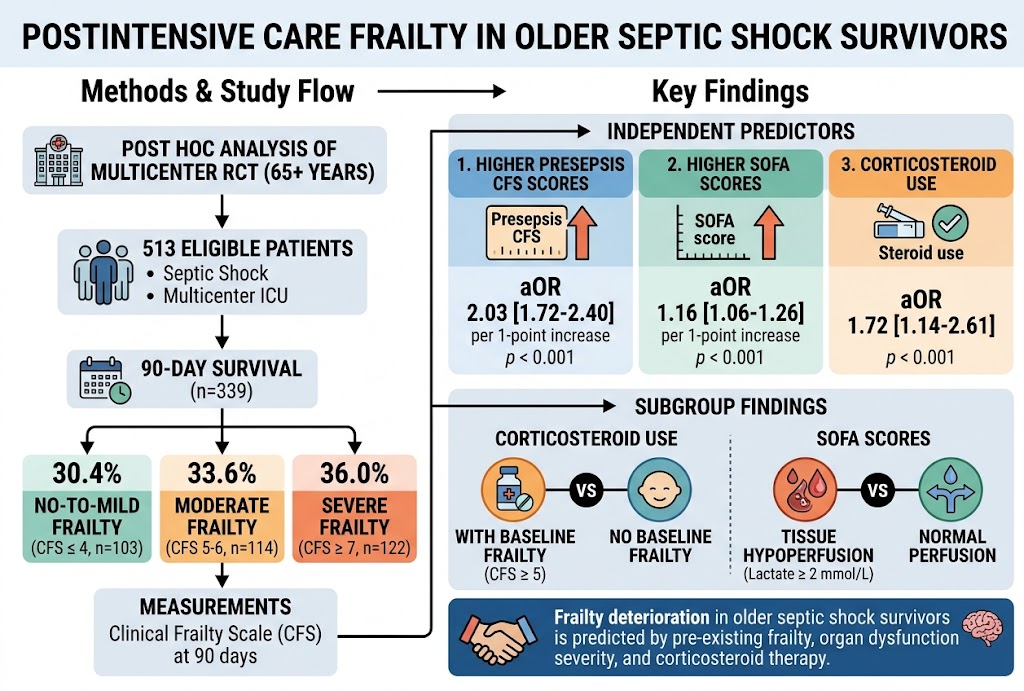
- Baseline frailty before septic shock strongly predicts frailty severity after intensive care in older adults.
- Higher Sequential Organ Failure Assessment (SOFA) scores during ICU stay correlate with increased post-ICU frailty.
- Corticosteroid use during ICU treatment independently associates with worsened frailty post-recovery, especially in patients who were already frail.
Study Background
Sepsis and septic shock pose significant mortality and morbidity risks, especially in older adults. Survivors of septic shock often endure persistent physical and cognitive impairments, with frailty emerging as a common and impactful syndrome characterized by decreased physiological reserve and increased vulnerability to stressors. Frailty after intensive care has profound implications for quality of life, functional independence, and healthcare utilization. Although anabolic hormone deficiency and prolonged inflammation have been hypothesized as underlying mechanisms, there is a gap in identifying clinical factors contributing to frailty progression following septic shock recovery. Understanding these predictors can inform tailored strategies to improve outcomes in this vulnerable population.
Study Design
This article presents a post hoc analysis of a multicenter randomized controlled trial conducted in Japan that originally investigated optimal blood pressure targets in patients aged 65 years or older with septic shock. The study population comprised 513 older adults with septic shock admitted to intensive care units (ICUs). Frailty was assessed using the Clinical Frailty Scale (CFS) at baseline (pre-sepsis) and at 90 days after ICU admission. Frailty classification was defined as no-to-mild (CFS ≤4), moderate (CFS 5-6), and severe (CFS ≥7). Baseline demographics, illness severity using the Sequential Organ Failure Assessment (SOFA) score, corticosteroid exposure, and other clinical variables were collected and analyzed. Ordinal logistic regression with generalized estimating equation modeling identified factors associated with frailty progression post-ICU.
Key Findings
Of the 513 patients included, 339 survived to day 90. Distribution of frailty levels at 90 days was 30.4% no-to-mild, 33.6% moderate, and 36.0% severe. The analysis revealed three independent predictors of higher post-ICU frailty severity:
- Baseline CFS Score: Each 1-point increase in pre-sepsis CFS score doubled the odds of worse frailty category at day 90 (adjusted odds ratio [aOR], 2.03; 95% confidence interval [CI], 1.72–2.40; p < 0.001). This underscores the strong influence of pre-morbid functional status on recovery trajectory.
- SOFA Score on ICU Admission: Greater organ dysfunction severity was independently associated with frailty (aOR, 1.16 per 1-point increase; 95% CI, 1.06–1.26; p < 0.001), highlighting acute illness burden as a key pathophysiological contributor.
- Corticosteroid Use: Patients receiving corticosteroids during ICU care had significantly higher odds of worsening frailty (aOR, 1.72; 95% CI, 1.14–2.61; p < 0.001). Importantly, subgroup analyses indicated that corticosteroid use was especially associated with frailty deterioration in those who were already frail at baseline (CFS ≥5), while SOFA scores were particularly relevant in patients with tissue hypoperfusion (lactate level ≥ 2 mmol/L).
These findings suggest that both patient baseline vulnerability and acute treatment factors contribute to postintensive care frailty progression in a complex interaction.
Expert Commentary
This study adds crucial insight into the multifactorial predictors of frailty progression after septic shock in older adults. The strong predictive value of baseline frailty reinforces the need for early frailty screening upon hospital admission. Organ dysfunction severity as measured by SOFA aligns with biological plausibility, linking systemic inflammation and organ injury to subsequent physical decline. The association with corticosteroid therapy, a common adjunct in septic shock management to modulate inflammation and support hemodynamics, raises clinical concerns about potential side effects such as muscle catabolism or neuromuscular dysfunction contributing to frailty exacerbation. However, corticosteroids remain important in specific clinical scenarios, underscoring a delicate balance between benefits and risks.
Limitations inherent in post hoc analyses include potential unmeasured confounding and the inability to establish causality. Also, the generalizability may be limited to older Japanese populations in ICU settings with similar sepsis management protocols. Further prospective studies are warranted to clarify mechanistic pathways and evaluate intervention strategies targeting modifiable frailty determinants.
Conclusion
This post hoc analysis highlights that older adults recovering from septic shock are at significant risk for severe frailty at 90 days post-ICU. Pre-existing frailty status, higher acute organ dysfunction severity, and corticosteroid therapy during ICU care independently predict this vulnerability. These findings emphasize the importance of frailty assessments pre- and post-ICU, careful evaluation of corticosteroid indications, and consideration of tailored rehabilitation or preventive interventions to mitigate frailty progression and improve survivorship outcomes in this high-risk group.
Funding and ClinicalTrials.gov
The original randomized controlled trial and this post hoc analysis were conducted through multicenter collaboration in Japan. Detailed funding sources and clinical trial registration information are available in the original publication by Yamamoto et al. (2026).
References
- Yamamoto R, Yamanaka T, Kaito D, Endo A, Yamakawa K, Tagami T, Umemura Y, Sasaki J. Postintensive Care Frailty of Older Patients With Septic Shock: A Post Hoc Analysis of a Multicenter Randomized Controlled Trial. Crit Care Med. 2026 Aug 12. PMID: 42584186.
- Clegg A, Young J, Iliffe S, Rikkert MO, Rockwood K. Frailty in elderly people. Lancet. 2013 Mar 2;381(9868):752-62.
- Ferrante LE, Pisani MA. Frailty and post-ICU cognitive impairment and physical disability: Critical care medicine and beyond. JAMA. 2017;318(17):1691-1692.
- Hotchkiss RS, Moldawer LL. Parallels between cancer and infectious disease. N Engl J Med. 2014 Dec 25;371(26):2482-3.
- Marik PE, Pastores SM, Annane D, Meduri GU, Sprung CL, Arlt W. Recommendations for the diagnosis and management of corticosteroid insufficiency in critically ill adult patients. Crit Care Med. 2008 Jun;36(6):1937-49.