Highlight
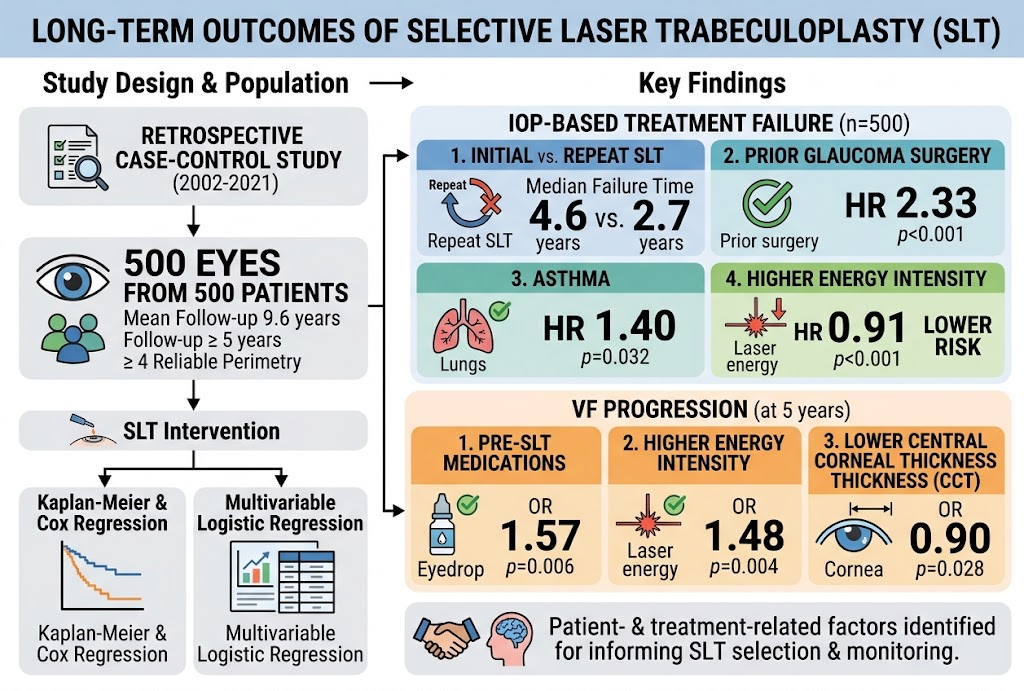
- SLT demonstrates a median treatment success duration of 4.6 years initially and 2.7 years upon repeat procedure.
- Risk factors for poor intraocular pressure (IOP) control post-SLT include repeat treatments, prior glaucoma surgery, asthma, and advanced glaucoma stage.
- Higher laser energy intensity correlates with better IOP control but paradoxically associates with increased visual field progression risk.
- Pre-existing medication burden and lower central corneal thickness predict higher risk of visual field deterioration after SLT.
Study Background
Glaucoma is a leading cause of irreversible blindness worldwide, primarily driven by progressive optic neuropathy related to elevated intraocular pressure (IOP). Selective laser trabeculoplasty (SLT) has emerged over the past two decades as an effective, noninvasive therapeutic option aimed at enhancing aqueous humor outflow via the trabecular meshwork. Despite widespread use, data on long-term outcomes of SLT, particularly its effect on sustained IOP control and visual field (VF) preservation, remain limited. Understanding factors that influence treatment durability and disease progression is critical for optimizing patient selection, procedural parameters, and follow-up strategies to mitigate vision loss risk in glaucoma populations.
Study Design
This retrospective case-control study analyzed 500 eyes of 500 patients who underwent SLT from 2002 through 2021, encompassing a mean follow-up period of 9.6 years. Patients were included if they had at least five years of follow-up and a minimum of four reliable visual field tests post-SLT, enabling robust longitudinal VF progression analysis. The primary endpoint was time to treatment failure based on IOP criteria: failure to achieve ≥20% IOP reduction or IOP ≥21 mmHg, medication escalation, or the need for additional glaucoma surgery. Kaplan-Meier survival methods quantified treatment persistence, while multivariable Cox proportional hazards regression modeled predictors of failure. Visual field progression was defined by concordant results using at least two of three validated methods—mean deviation slope, pointwise linear regression, and glaucoma rate index—at five years post-SLT. Logistic regression identified factors associated with VF progression.
Key Findings
The median survival time free from treatment failure after initial SLT was 4.6 years, decreasing to 2.7 years following repeat SLT, indicating diminishing returns with subsequent treatments. Multivariable Cox analysis revealed several independent risk factors for earlier treatment failure: repeat SLT (hazard ratio [HR] 1.49, p=0.008), history of prior glaucoma surgery (HR 2.33, p<0.001), comorbid asthma (HR 1.40, p=0.032), and moderate-to-advanced baseline glaucoma severity (HR 1.54, p<0.001). Notably, higher laser energy intensity during SLT correlated with a reduced risk of failure (HR 0.91 per unit increase, p<0.001), underscoring the importance of procedural factors in optimizing IOP control.
Among the 302 eyes with adequate visual field data, progression at five years was observed in a subset, and logistic regression identified predictors: higher pre-SLT medication count (odds ratio [OR] 1.57, p=0.006), increased laser energy intensity (OR 1.48, p=0.004), and lower central corneal thickness (OR 0.90 per unit thickness, p=0.028). These findings suggest that while higher energy may enhance IOP lowering, it might also contribute to a risk for VF progression, possibly reflecting underlying disease severity or treatment-related effects. Lower corneal thickness, a recognized risk factor in glaucoma, aligns with prior literature linking it to worse disease progression.
Expert Commentary
This study provides valuable long-term real-world evidence on SLT efficacy and safety. The prolonged median duration of IOP control after initial SLT reinforces its role as a frontline therapy. The decreased effectiveness in repeat procedures and among patients with prior surgery highlights a need for individualized treatment planning. The association of asthma as a comorbidity with increased failure risk merits further investigation, potentially related to systemic inflammation or corticosteroid use. The paradoxical association between higher laser energy and VF progression requires cautious interpretation—higher energy may reflect treatment intensification in refractory cases rather than a direct causal relationship.
Limitations include retrospective design and potential selection bias, though the large sample size and extensive follow-up strengthen confidence in the findings. Future prospective trials examining optimal energy dosing strategies and mechanistic studies into the interplay between laser parameters and optic nerve health would be beneficial. Incorporating patient-reported outcomes and quality-of-life measures could further enrich clinical decision-making evidence.
Conclusion
Selective laser trabeculoplasty offers durable IOP-lowering benefit for nearly five years on average in treatment-naive eyes but is less effective when repeated or performed in eyes with prior filtration surgery, advanced glaucoma, or systemic comorbidities such as asthma. Higher laser energy intensity improves IOP control but may be associated with elevated risk of visual field progression, particularly in eyes with thinner corneas and higher medication burdens pre-treatment. These insights support personalized SLT strategies and underscore the necessity of vigilant post-procedural monitoring to detect and address glaucoma progression promptly. Integrating clinical and procedural predictors enhances patient counseling and may optimize long-term vision preservation.
Funding and Registration
No specific funding was declared. The study is registered under PMID: 42586189 and published in the American Journal of Ophthalmology, August 2026.
References
1. Lee K, Morales E, Caprioli J. Long-term Outcomes of Selective Laser Trabeculoplasty on Intraocular Pressure Control and Visual Field Progression. Am J Ophthalmol. 2026; PMID:42586189.
2. Gupta D, et al. Selective laser trabeculoplasty in glaucoma management: a systematic review. Surv Ophthalmol. 2020;65(5):580–588.
3. Coleman AL, et al. Central corneal thickness and glaucoma risk: a review. Curr Opin Ophthalmol. 2021;32(2):103–109.
4. Girkin CA, et al. Effect of selective laser trabeculoplasty on visual field progression: implications and biological plausibility. J Glaucoma. 2019;28(11):1020–1025.