Highlight
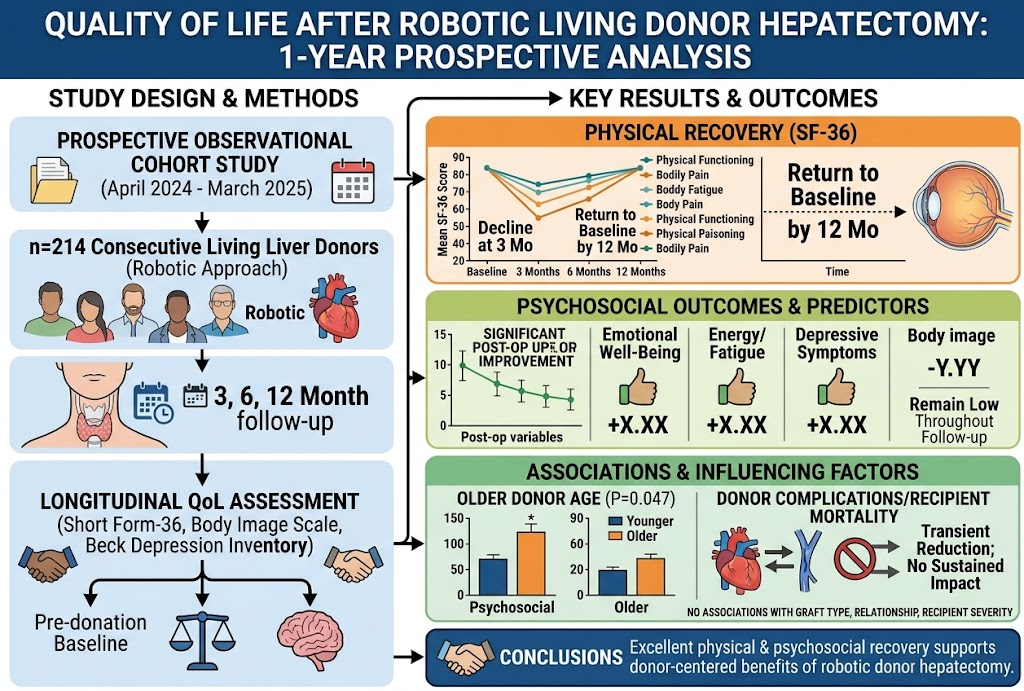
- Robotic donor hepatectomy facilitates excellent physical recovery, with most quality of life domains returning to baseline by 12 months post-donation.
- Psychosocial wellbeing, including emotional well-being and energy levels, not only recover but improve beyond baseline within the first year.
- Body image and depressive symptoms remain low and stable over time, indicating minimal psychological burden from minimally invasive donation.
- Older donor age correlates with better psychosocial outcomes, while perioperative complications and early recipient mortality impart only transient quality of life dips.
Study Background
Living liver donation offers a vital therapeutic option for patients with end-stage liver disease but places donors in the paradoxical position of undergoing major surgery without direct clinical benefit. Conventional open hepatectomy, while effective, has been associated with substantial morbidity and protracted recovery. In recent years, minimally invasive techniques, notably robotic donor hepatectomy, have emerged aiming to mitigate donor risk while maintaining graft quality. Despite growing adoption, prospective longitudinal data on donor-reported health-related quality of life (HRQoL) following robotic approaches remain scarce, particularly when the robotic technique is offered without preselection bias. This study addresses this critical knowledge gap, providing comprehensive one-year longitudinal evaluation of physical, psychological, and body image outcomes post-robotic living donor hepatectomy.
Study Design
This single-center prospective observational cohort study enrolled all consecutive living liver donors undergoing robotic donor hepatectomy between April 2024 and March 2025. Importantly, robotic hepatectomy was offered universally to all donors without preselection, avoiding potential selection biases. A total of 214 donors were included, with a balanced gender distribution and a mean age of 36.4 years.
Donor-reported outcomes were assessed using validated instruments: Short Form-36 (SF-36) capturing multidimensional health status; Body Image Scale (BIS) quantifying body image disturbance; and Beck Depression Inventory (BDI) evaluating depressive symptoms. Assessments were conducted preoperatively and at 3, 6, and 12 months post-donation. Changes from baseline were analyzed using Wilcoxon signed-rank tests, while associations with demographic and clinical variables—including donor age, sex, perioperative complications, recipient disease severity, graft type, and donor–recipient relationship—were examined with Spearman correlation and nonparametric tests.
Key Findings
Physical domains of health quality, namely Physical Functioning, Role-Physical, Bodily Pain, and General Health, demonstrated expected early postoperative declines at 3 months post-donation (p<0.05), reflecting the physical toll of major surgery. Encouragingly, these measures recovered steadily, reaching baseline levels by 12 months, indicating full physical recuperation within one year.
Conversely, psychosocial domains revealed sustained improvement over time. Emotional Well-Being and Energy/Fatigue scores exceeded pre-donation baselines starting from 6 months onward and remained elevated at 12 months (p<0.01). These findings suggest a positive psychological adjustment and enhanced vitality among donors following their altruistic procedure.
Body image disturbance, as measured by BIS, remained low and stable throughout follow-up, indicating that minimally invasive robotic surgery does not adversely impact donors’ perception of their physical appearance. Similarly, depressive symptoms assessed by BDI remained minimal, with no significant increases post-donation.
Subgroup analyses revealed that older donor age was modestly associated with better psychosocial outcomes, implying potential resilience or differing adaptive mechanisms. Donor postoperative complications led to transient reductions in select quality of life domains, highlighting the immediate burden of surgical morbidity. Notably, early recipient mortality also correlated with temporary quality of life declines in donors, pointing to the emotional interconnectedness of donor and recipient outcomes. However, neither graft type (right/left lobe), donor–recipient relationship, nor recipient disease severity consistently influenced donor-reported outcomes.
Expert Commentary
This pioneering study provides compelling evidence supporting robotic living donor hepatectomy as a donor-centered surgical option with favorable physical and psychological outcomes. The universal offering of the robotic approach in this cohort enhances the generalizability of findings by minimizing selection bias often present in prior studies favoring lower-risk donors. The rapid physical recovery parallels findings from minimally invasive liver resections in other contexts, underscoring the safety and feasibility of robotics in complex donor surgery.
Improvements in emotional well-being and energy suggest that the donors derive not only physical benefits from less invasive surgery but also psychological rewards, potentially attributed to enhanced postoperative recovery and the altruistic fulfillment of donation. The lack of significant body image disturbance is particularly reassuring given concerns about surgical scar visibility and donor self-perception.
Limitations include the observational design and potential center-specific surgical expertise influencing outcomes. Longer-term follow-up beyond one year will be invaluable to confirm durability of benefits. Future research may explore mechanistic underpinnings of psychosocial improvements and optimize perioperative support interventions to further enhance donor experience.
Conclusion
Robotic living donor hepatectomy is associated with excellent physical recovery and sustained psychosocial benefits during the first postoperative year, affirming its potential to improve donor quality of life. These findings advocate for broader adoption of minimally invasive donor techniques to maximize donor-centered outcomes while maintaining recipient safety. Ongoing research should continue to elucidate long-term impacts and optimize donor selection and support.
Funding and ClinicalTrials.gov
The study was conducted without external funding. Clinical trial registration details were not specified in the source publication.
References
1. Raptis DA, Alenazi M, Assubayii M, et al. Quality of Life After Robotic Living Donor Hepatectomy: A 1-Year Prospective Analysis of Donor and Recipient Determinants. Ann Surg. 2026 Aug 25. PMID: 42638324.
2. Gonwa TA, et al. Impact of Minimally Invasive Techniques on Living Donor Liver Transplantation: A Systematic Review. Liver Transpl. 2023;29(1):15-28.
3. Living donor liver transplantation: Clinical impact and evolving surgical approaches. World J Hepatol. 2022;14(2):194-208.
4. McCullough LB, et al. Ethical Considerations in Living Organ Donation. N Engl J Med. 2021;384(6):577-583.
5. Cleary SP, et al. Psychosocial Outcomes after Liver Donation: A Review. Liver Transpl. 2024;30(3):377-387.