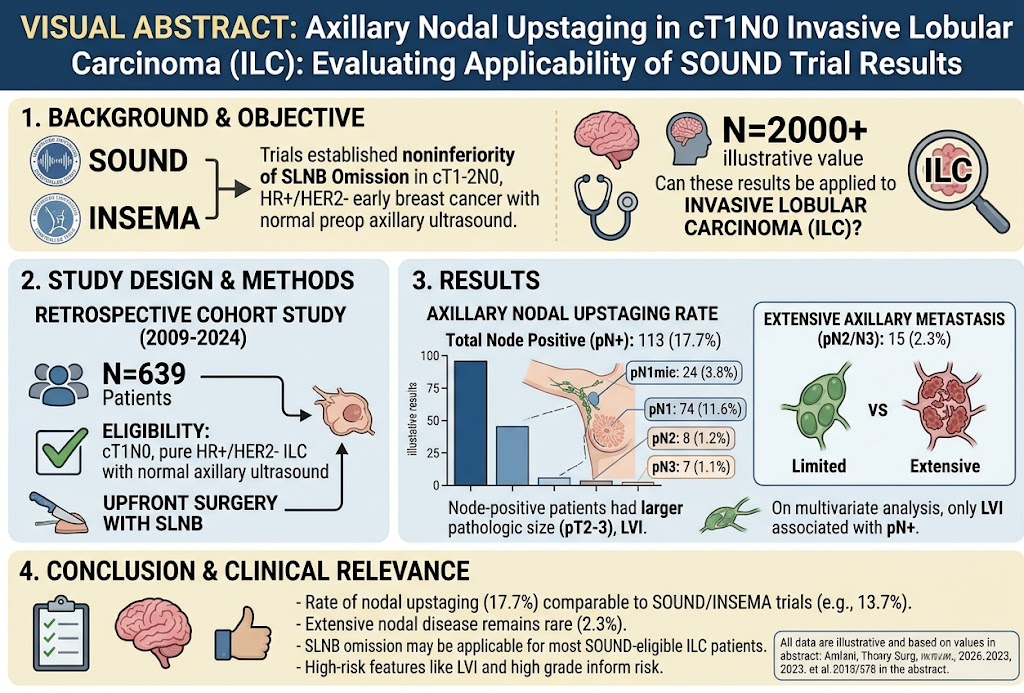
Axillary Nodal Upstaging in cT1N0 Invasive Lobular Carcinoma: Assessing Sentinel Lymph Node Biopsy Omission Based on SOUND Trial Evidence

Axillary Nodal Upstaging in cT1N0 Invasive Lobular Carcinoma: Assessing Sentinel Lymph Node Biopsy Omission Based on SOUND Trial Evidence

This review evaluates whether sentinel lymph node biopsy omission, validated in SOUND and INSEMA trials, applies to cT1N0 invasive lobular carcinoma, highlighting nodal positivity rates, risk factors such as lymphovascular invasion, and clinical implications for tailored axillary management.
Contemporary Surgical Management of Vulvar Cancer: Balancing Improved Survival with Increased Reoperation Rates — Insights from a Finnish Nationwide Study

Contemporary Surgical Management of Vulvar Cancer: Balancing Improved Survival with Increased Reoperation Rates — Insights from a Finnish Nationwide Study

This review synthesizes evidence that modern personalized surgical strategies for vulvar squamous cell carcinoma enhance survival outcomes despite higher reoperation rates, emphasizing evolving surgical techniques, sentinel lymph node biopsy, and reconstructive approaches.
Sentinel Lymph Node Biopsy in Head and Neck Merkel Cell Carcinoma: Why High False-Negative Rates Demand Clinical Vigilance

Sentinel Lymph Node Biopsy in Head and Neck Merkel Cell Carcinoma: Why High False-Negative Rates Demand Clinical Vigilance

A comprehensive cohort study reveals that sentinel lymph node biopsy (SLNB) in head and neck Merkel cell carcinoma has a sensitivity of only 52.6% and a high failure rate. The findings suggest that clinicians must reconsider management strategies for patients with high-risk features or failed biopsies.