Highlight
– EMS clinicians often fail to meet guideline-recommended manual ventilation parameters during pediatric respiratory arrest.
– Use of a real-time ventilation feedback device (VFD) significantly improves adherence to tidal volume, ventilation rate, and mask seal guidelines.
– Incorporating VFDs in prehospital settings has potential to elevate ventilation quality and outcomes for critically ill pediatric patients.
– Simulation-based randomized crossover design across multiple metropolitan EMS agencies validates generalizability of findings.
Study Background
Manual ventilation remains a cornerstone lifesaving intervention for children experiencing respiratory arrest in prehospital emergency settings. The quality of pediatric ventilation delivered by emergency medical services (EMS) clinicians is paramount, as inadequate ventilation can worsen hypoxia and compromise neurological outcomes. Despite established national and international guidelines specifying ventilation rate, tidal volume, and mask seal standards for pediatric patients, adherence to these parameters in the field is inconsistently reported and poorly characterized. Variability across EMS agencies and clinicians may contribute to suboptimal respiratory support during critical moments. This study addresses the unmet need to objectively measure pediatric ventilation quality in prehospital care and evaluate an intervention—namely a ventilation feedback device (VFD)—to improve adherence to recommended guidelines.
Study Design
This investigation employed a single-anonymized, randomized, crossover design involving EMS clinicians drawn from five distinct agencies across three metropolitan U.S. sites. Participants performed ventilation on a simulated 3-year-old toddler manikin representing a pediatric respiratory arrest scenario. Each clinician completed two sequential 2-minute simulated resuscitations separated by a 10-minute washout period, ventilating once with and once without real-time VFD feedback, in randomized order to minimize learning or fatigue bias. The EOLifeX VFD captured continuous objective data on ventilation rate, tidal volume, and mask leak. These key performance indicators were analyzed for adherence to age-based guidelines using generalized linear mixed-effects models with clustering by participants within sites.
Key Findings
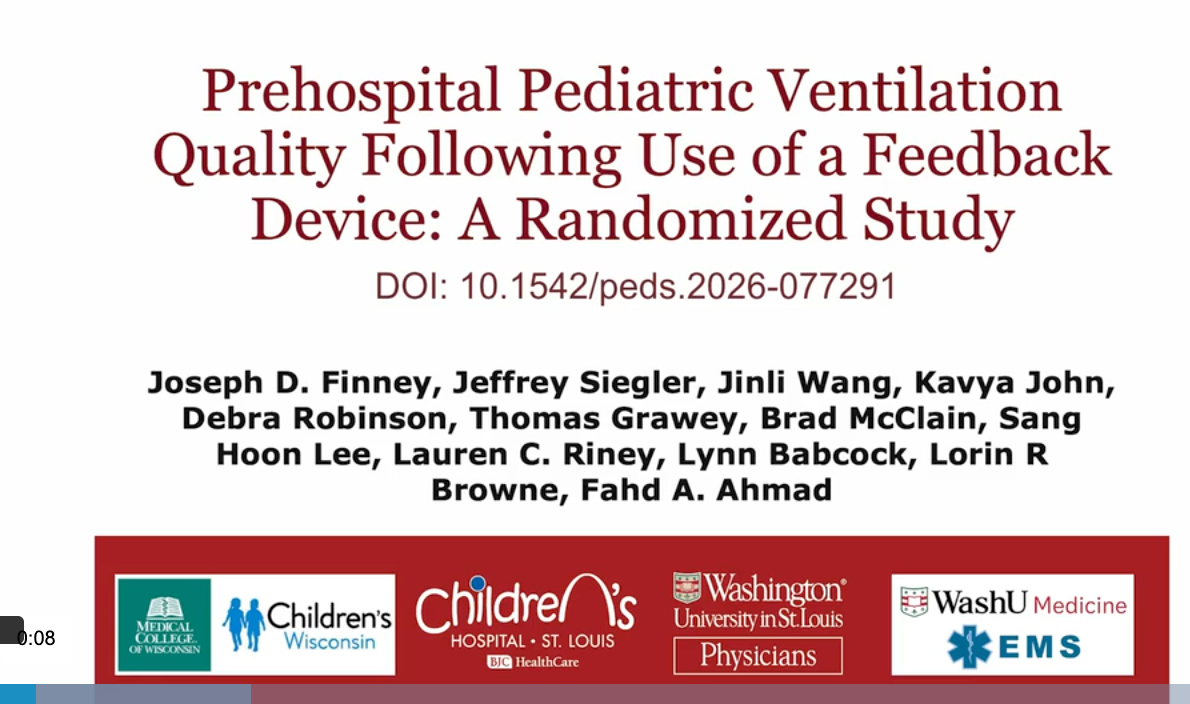
The study enrolled 123 EMS clinicians representing diverse prehospital agencies and geographical locations. Without feedback, only 16.2% of ventilations delivered tidal volumes within guideline-recommended ranges, while this improved markedly to 87.0% with real-time VFD feedback. Similarly, ventilation rate adherence increased from 65.0% without feedback to 88.6% with feedback. Mask leak—an important determinant of effective ventilation—was also reduced, with leaks under 30% occurring in 88.4% of breaths when using the VFD versus 80.0% without it. The improvements across ventilation parameters were statistically significant and clinically meaningful, indicating that real-time monitoring and feedback could substantially enhance EMS clinician performance during pediatric resuscitations.
Secondary analyses underscored the consistency of the VFD’s impact across sites and participant experience levels, suggesting broad applicability of the intervention. The crossover design ensured internal validity by controlling for intra-individual variability. While the simulated environment may not capture all complexities of field emergencies, it provides a rigorous controlled setting to assess technical performance and workflow integration of the device. No safety concerns were reported, consistent with the noninvasive nature of the feedback tool.
Expert Commentary
These findings align with growing evidence emphasizing the role of technological aids in improving manual resuscitation quality. Pediatric ventilation presents unique challenges due to smaller airway size, variable lung compliance, and precise volume requirements. Traditional training and experience alone often fail to ensure guideline adherence under stressful prehospital conditions. The VFD’s ability to provide instantaneous corrective cues addresses human factors limitations and cognitive overload during resuscitations.
Experts advocate further real-world trials to validate impact on patient-centered outcomes such as survival and neurological function. Integration within standard EMS protocols and training curriculums may be warranted if effectiveness is confirmed in clinical settings. Limitations include simulation-based methodology and short duration scenarios; however, the large multicenter sample and randomized crossover design support the robustness of results.
Conclusion
This study demonstrates that EMS clinicians frequently deviate from pediatric manual ventilation guidelines during respiratory arrest simulations, potentially compromising care quality. The implementation of a ventilation feedback device markedly improves compliance with recommended tidal volume, ventilation rate, and mask seal parameters. Incorporation of such real-time feedback technology in prehospital EMS practice offers a promising strategy to optimize pediatric ventilation quality, potentially improving resuscitation efficacy and clinical outcomes. Future studies should assess effects on patient morbidity and mortality, cost-effectiveness, and integration feasibility across diverse EMS systems.
Funding and Clinical Trials Registration
The study was supported by agency-specific EMS research funds. No clinical trial registration number is reported in the publication.
References
1. Finney JD, Siegler J, Wang J, et al. Prehospital Pediatric Ventilation Quality Following Use of a Feedback Device: A Randomized Study. Pediatrics. 2026 Oct 20; PMID: 42896864.
2. American Heart Association. Pediatric Advanced Life Support (PALS) Provider Manual. 2020.
3. Andersen LW, Berg KM, Saindon BZ, et al. Quality of cardiopulmonary resuscitation during in-hospital cardiac arrest. JAMA Cardiol. 2016;1(5):507-515.
4. Cazzato RL, et al. The role of feedback devices in pediatric resuscitation training: a systematic review. Resuscitation. 2020;151:27-34.