Highlights
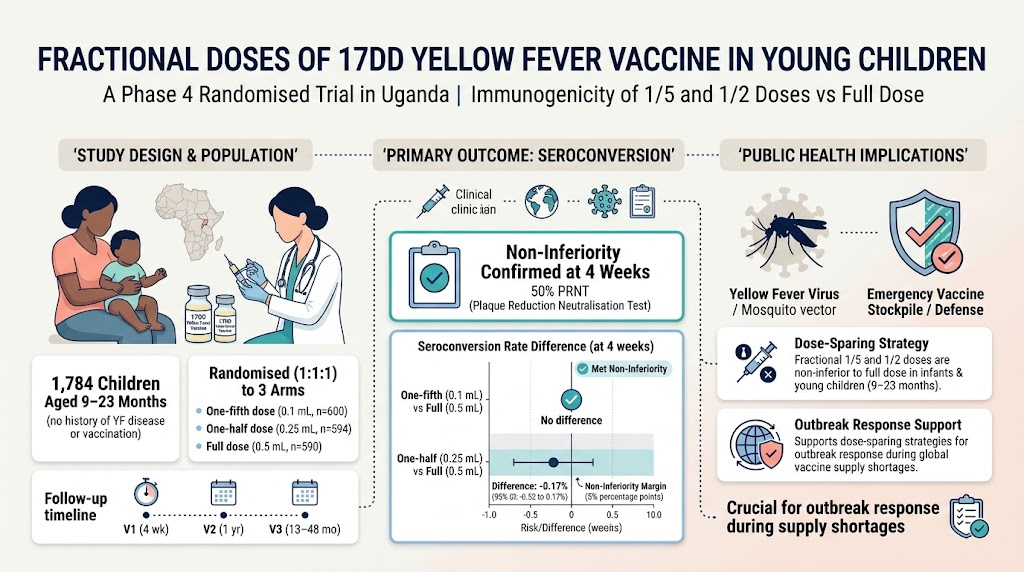
- Fractional doses (one-fifth and one-half) of 17DD yellow fever vaccine in children aged 9-23 months achieved non-inferior seroconversion compared with full doses.
- Both fractional doses demonstrated a favorable safety profile, with no increased adverse events compared to full dosing.
- Evidence supports fractional dosing as a viable strategy for outbreak response and vaccine supply optimization in pediatric populations.
- Co-administration with other routine vaccines such as pneumococcal conjugate vaccine does not impair yellow fever vaccine immunogenicity.
Background
Yellow fever (YF) remains a significant viral hemorrhagic fever endemic in parts of sub-Saharan Africa and South America, with vaccine-preventable morbidity and mortality. The 17DD live-attenuated yellow fever vaccine is a WHO-prequalified vaccine widely used in endemic regions. While the standard full dose of 0.5 mL confers long-term immunity, global vaccine shortages, especially during outbreaks, have prompted investigations into fractional dosing to stretch limited supplies. This issue is particularly pertinent for children under 2 years, a group with limited data regarding fractional dosing immunogenicity and safety profiles. Ensuring effective immunization strategies for this vulnerable age group is critical for sustaining disease control and outbreak response.Key Content
1. Evidence from the 2026 Uganda Phase 4 Trial on Fractional Doses in Young Children
Doshi et al. conducted a pivotal phase 4, single-blind, randomized clinical trial assessing the immunogenicity and safety of fractional (one-fifth [0.1 mL] and one-half [0.25 mL]) versus full (0.5 mL) doses of the 17DD YF vaccine in Ugandan children aged 9-23 months (PMID:42727590). Enrolling 1784 participants stratified by age cohorts (9-12, 13-18, and 19-23 months), the trial demonstrated that both fractional doses met non-inferiority criteria for seroconversion at 4 weeks post-vaccination, assessed via 50% plaque reduction neutralisation test (PRNT50). The difference in seroconversion rates compared to the full dose was negligible (one-fifth dose difference: 0; one-half dose difference: -0.17 with 95% CI -0.52 to 0.17). The favorable safety profile was confirmed by the absence of vaccine-related serious adverse events (PMID:39153293). Follow-up at 1 year and extended (up to 48 months) suggested durable immune responses, though with some waning typical for live-attenuated vaccines in pediatric populations.2. Immunogenicity and Safety Compared with Other Pediatric Fractional Dose Studies
Complementary research by Tu et al. (2023, PMID:37127047) evaluating fractional doses of the 17D-213 yellow fever vaccine in children aged 9-59 months found consistent immunogenicity profiles, supporting the dose-sparing approach. Similarly, adult and child trials in Kenya and Uganda (PMID:31984244) highlighted fractional dosing as a practical strategy during vaccine shortages. However, a study evaluating extremely low doses (500 IU) in infants aged 9-12 months did not meet non-inferiority (PMID:41544642), indicating age-dependent dose requirements. These findings highlight the importance of dose optimization tailored to pediatric immunological maturity.3. Co-administration and Vaccine Interference Concerns
Studies assessing co-administration with other routine vaccines, such as the 13-valent pneumococcal conjugate vaccine (PCV13), generally found no significant interference with yellow fever vaccine immunogenicity (PMID:39798436). This is important for Integrated Expanded Program on Immunization (EPI) schedules where multiple vaccines are delivered concomitantly. Observations from immunogenicity trials with meningococcal conjugate vaccines administered at 9 and 15 months show robust, non-inferior immune responses when co-administered with YF vaccine (PMID:40086461), supporting operational feasibility.4. Booster Doses and Duration of Immunity
Emerging evidence, including a Gambian phase 3 booster study (PMID:42276083), reports that neutralizing antibody titers can wane more rapidly in children than previously thought, with booster doses enhancing immunity particularly in those aged 4-9 years. Cohort studies in Brazil (PMID:40202994) also suggest that a booster may be needed in high-risk settings to maintain protection.5. Immunogenicity Mechanisms and Host Factors
Additional investigations into environmental enteric dysfunction and micronutrient status reveal that systemic inflammation and gut health may modulate vaccine immunogenicity (PMID:32997666), which has implications for vaccination strategies in resource-limited settings.Expert Commentary
The Uganda phase 4 trial (Doshi et al.) substantially fills the evidence gap for fractional YF vaccine dosing in children under 2 years, a critical population previously excluded from WHO fractional dose recommendations. The demonstration of non-inferior seroconversion and acceptable safety profiles supports fractional dosing as a strategic response during vaccine shortages—or in outbreak conditions—without compromising immunogenic protection. These findings align with previous adult and older child studies but specifically address immunogenicity nuances in early childhood, where immune ontogeny and vaccine antigen processing differ. The consistency of immunogenicity when fractional doses are used suggests that the antigenic threshold for seroconversion is met at reduced doses in young children, potentially due to their heightened vaccine responsiveness or the robustness of live-attenuated vaccine platforms. However, lower doses such as those at 500 IU highlight risks of suboptimal immunity in infants, emphasizing that fractional dosing must be carefully calibrated. Co-administration studies mitigate concerns regarding immunologic interference with concurrent EPI vaccines, supporting integrated vaccination programs that simultaneously deliver multiple antigens, thereby enhancing coverage and compliance. Notably, the waning immunity observed and the evidence supporting boosters invite reconsideration of the 2013 WHO position endorsing a single YF dose for lifelong protection, at least in pediatric populations in endemic zones. This underscores the importance of continued immunosurveillance and flexible vaccination policies. Limitations remain regarding long-term durability beyond the follow-up period and potential immunological impacts of repeated fractional dosing or in malnourished and immunocompromised children. Further research on these fronts is essential.Conclusion
The 2026 phase 4 randomized trial from Uganda robustly demonstrates that fractional doses (one-fifth and one-half) of 17DD yellow fever vaccine induce seroconversion rates non-inferior to the full dose in children aged 9–23 months, with no increase in safety concerns. This evidence supports revising vaccination strategies during vaccine shortages or outbreaks to include fractional dosing in young children, facilitating broader and more equitable immunization coverage. Complementary studies underscore the importance of appropriate dose calibration by age, reassurance about co-administration with other EPI vaccines, and recognition of the need for booster dosing in endemic settings. Continued surveillance and research into host factors affecting immunogenicity remain priorities. These insights collectively inform policy frameworks to optimize yellow fever control in pediatric populations, ensuring resilience against vaccine supply constraints and enhancing global health security.References
- Doshi RH et al. Immunogenicity of fractional one-fifth and one-half doses of 17DD yellow fever vaccine compared with full dose in children aged 9-23 months in Uganda: a phase 4, single-blind, randomised clinical trial. Lancet. 2026 Sep 11;408(10564):1571-1582. PMID: 42727590.
- Tu HM et al. Immunogenicity and safety of fractional doses of 17D-213 yellow fever vaccine in children: a substudy of a phase 4 trial. Lancet Infect Dis. 2023 Aug;23(8):965-973. PMID:37127047.
- Balmaseda A et al. Low-dose yellow fever vaccination in infants: a randomised, double-blind, non-inferiority trial. Lancet. 2026 Jan 31;407(10527):497-504. PMID:41544642.
- Grais RF et al. Yellow fever vaccination in healthy Gambian children to establish safety and immunogenicity of a booster dose: a phase 3 trial. Lancet Infect Dis. 2026 Oct;26(10):1070-1078. PMID:42276083.
- Staples JE et al. Immunogenicity of yellow fever vaccine co-administered with 13-valent pneumococcal conjugate vaccine in rural Gambia: A cluster-randomised trial. Vaccine. 2025 Feb 15;47:126712. PMID:39798436.
- Ladner JT et al. Immunogenicity of a single dose of the 17DD yellow fever vaccine in a cohort of adults and children in a non-endemic area. PLoS Negl Trop Dis. 2025 Apr 9;19(4):e0012993. PMID:40202994.