Highlight
• Sentinel lymph node biopsy (SLNB) without pelvic lymphadenectomy (PLND) in early-stage cervical cancer preserves patient quality of life (QoL).
• SLNB is associated with significantly less frequent and milder lower limb lymphoedema compared to PLND.
• Early postoperative complications are fewer and less severe following SLNB versus PLND.
• Patient-reported outcomes and objective assessments corroborate the morbidity benefits of SLNB in cervical cancer surgical staging.
Study Background
Cervical cancer remains a significant cause of morbidity and mortality worldwide, particularly when diagnosed at early stages, where surgical management can be curative. Lymph node status is a crucial prognostic factor influencing treatment strategy and survival outcomes. Traditionally, pelvic lymphadenectomy (PLND) has been the standard approach for nodal staging; however, it carries notable risks, including lymphoedema and surgical complications, which may adversely affect patients’ quality of life (QoL).
Sentinel lymph node biopsy (SLNB) has emerged as a less invasive alternative, aiming to accurately stage lymph nodes while minimizing morbidity. Previous studies, including the prospective SENTIX study (NCT02494063), have shown non-inferiority of SLNB alone compared with PLND regarding progression-free survival (PFS). This final analysis extends these findings by evaluating QoL, lower limb lymphoedema (LLL), and postoperative complication profiles, providing vital information on patient-centered outcomes.
Study Design
The SENTIX study is a prospective, multicentre, international clinical trial enrolling patients with early-stage cervical cancer characterized by tumor size ≤4 cm. Patients underwent SLNB using a standardized protocol with intraoperative frozen section analysis of sentinel lymph nodes (SLNs). Those with bilateral SLN detection and negative frozen sections (SLN group, n=594) did not receive further lymphadenectomy. Patients with unilateral or unsuccessful SLN detection underwent unilateral or bilateral PLND (PLND group, n=134). This design permitted direct comparison of morbidity, lymphoedema, and QoL between SLNB alone versus PLND.
Quality of life was measured using the European Organisation for Research and Treatment of Cancer Quality of Life Questionnaire C30 (EORTC QLQ-C30) at baseline and at 6, 12, and 24 months postoperatively. Lower limb lymphoedema was assessed both subjectively via patient-reported symptoms (S-LLL) and objectively (O-LLL) by circumferential limb measurements. Postoperative complications were evaluated and graded according to severity.
Key Findings
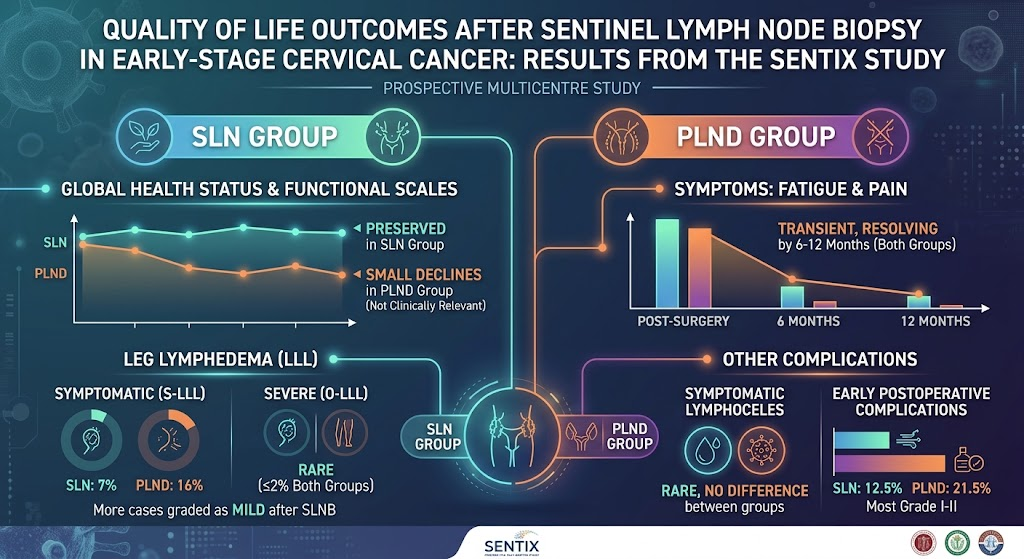
The analysis revealed that global health status and all major functional scales on the EORTC QLQ-C30 remained stable in the SLN group throughout the 24-month follow-up, indicating preservation of QoL metrics. In the PLND group, although small declines were observed in several functional domains, these did not meet the threshold for clinical relevance, suggesting only marginal impact on QoL.
Symptoms of fatigue and pain were commonly reported immediately after surgery in both groups but were transient and resolved by 6-12 months. This temporal pattern indicates effective recovery from surgical intervention within the first postoperative year.
Regarding lymphoedema, severe objective lower limb lymphoedema (O-LLL) was infrequent in both groups, with prevalence ≤2%. However, patient-reported lymphoedema (S-LLL) was significantly less frequent in the SLN group compared to the PLND group (7% vs. 16%, respectively), with reported cases generally milder following SLNB. This suggests that while objective measurements show low incidence overall, subjective experience favors the less invasive SLNB approach.
Symptomatic lymphoceles—fluid collections that can cause postoperative morbidity—were rare and did not differ significantly between groups. Early postoperative complications occurred less frequently in the SLN group (12.5%) compared to the PLND group (21.5%), reaching statistical significance (P=0.01). Most complications were mild (grade I–II), underscoring better surgical safety profiles with SLNB.
Expert Commentary
The SENTIX study’s comprehensive assessment of QoL and morbidity complements its prior evidence on oncologic safety, reinforcing the clinical value of SLNB in early-stage cervical cancer. Minimizing PLND’s morbidity without compromising oncologic outcomes addresses a critical unmet need in surgical oncology. These findings align with other datasets advocating less radical nodal staging to reduce downstream sequelae such as lymphoedema and decreased function.
Nevertheless, the study population had tumors ≤4 cm, an inclusion criterion critical to maintaining accuracy and safety of SLNB, and findings may not extend to more advanced or bulky tumors. Long-term follow-up beyond 24 months will further clarify durability of QoL benefits. Additionally, while subjective lymphoedema reporting is essential, correlating with objective metrics strengthens clinical interpretation.
Conclusion
The prospective multicentre SENTIX study establishes that sentinel lymph node biopsy in early-stage cervical cancer patients preserves quality of life, reduces frequency and severity of lower limb lymphoedema, and results in fewer early postoperative complications compared to pelvic lymphadenectomy. Given these patient-centered benefits alongside robust oncological outcomes, SLNB represents a preferable nodal staging strategy in appropriate early-stage cervical cancer cases, supporting its wider adoption in clinical practice.
Funding and ClinicalTrials.gov
The SENTIX study was registered under ClinicalTrials.gov identifier NCT02494063. Details regarding funding sources were not specified in the presented abstract but are available in the primary publication.
References
1. Kocian R, Koehler C, Di Martino G, et al. Quality of life outcomes after sentinel lymph node biopsy in patients with early-stage cervical cancer: Results from the prospective multicentre SENTIX study. Gynecol Oncol. 2026 Aug 10;212:106-115. PMID: 42574968.
2. Cibula D, Abu-Rustum NR, Dusek L, et al. Surgical staging in cervical cancer: A comprehensive review of lymphadenectomy and sentinel lymph node biopsy. Gynecol Oncol. 2018;151(1):200-206.
3. Plante M. Sentinel lymph node biopsy in cervical cancer: a modern approach to surgical management. Curr Oncol Rep. 2012;14(5):614-621.