Highlight
- Sentinel lymph node (SLN) biopsy in patients with preoperative atypical endometrial hyperplasia/endometrial intraepithelial neoplasia (AEH/EIN) reveals occult endometrial cancer in nearly half of cases.
- SLN biopsy is feasible and safe, though it modestly increases operative time.
- SLN status informs adjuvant treatment decisions, enabling chemotherapy escalation or omission based on nodal findings.
- Incorporation of SLN biopsy can refine risk stratification and personalize management in AEH/EIN patients.
Study Background
Atypical endometrial hyperplasia (AEH), now often referred to as endometrial intraepithelial neoplasia (EIN), represents a premalignant lesion of the endometrium with the potential to harbor or progress to endometrial cancer (EC). Total hysterectomy is the definitive treatment for most cases diagnosed preoperatively. However, occult EC is frequently identified on final pathology, posing challenges for appropriate staging and subsequent adjuvant management. Traditional surgical staging including lymphadenectomy carries morbidity risks, motivating evaluation of less invasive techniques. Sentinel lymph node (SLN) biopsy has been increasingly applied in endometrial cancer to accurately stage the disease while limiting surgical complications. However, its role in patients with preoperative AEH/EIN who have high rates of occult malignancy remains insufficiently defined. This study addresses the clinical utility of SLN biopsy in this population, focusing on feasibility, safety, detection of nodal metastasis, and impact on adjuvant therapy decisions.
Study Design
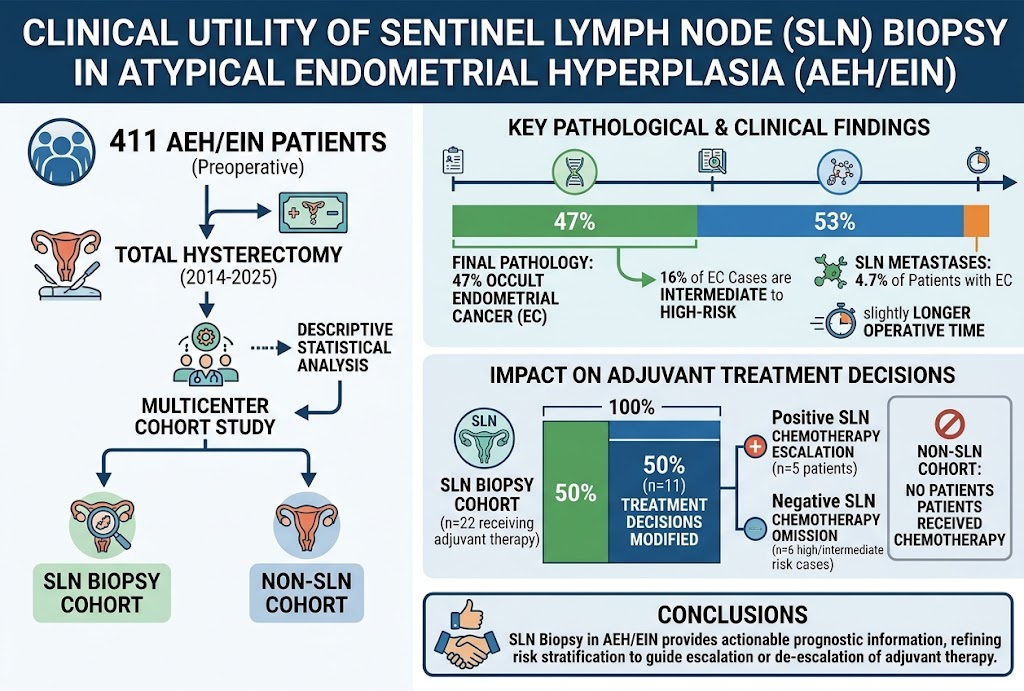
This retrospective, multicenter cohort study enrolled 411 women diagnosed preoperatively with AEH/EIN who underwent total hysterectomy between 2014 and 2025 across multiple institutions. Patients were stratified into those who received SLN biopsy during surgery and those who did not. Data on demographics, surgical parameters, pathology results including final histology and nodal status, and adjuvant treatments were extracted from prospectively maintained databases. The primary analysis compared operative details, pathological findings, and subsequent treatment decisions between groups. Descriptive statistics were used to elucidate clinical outcomes and treatment modifications attributable to SLN biopsy findings.
Key Findings
Final pathological evaluation revealed occult EC in 47% of the total cohort. Of these, 16% were classified as intermediate to high-risk cases according to current oncologic risk stratification schemas. SLN biopsy was associated with a slightly increased operative duration compared to surgery without nodal evaluation, reflecting the additional procedural steps of lymphatic mapping and node dissection. Importantly, SLN metastases were detected in 4.7% of patients with occult endometrial carcinoma, identifying a clinically relevant subset harboring nodal spread.
Adjuvant therapy decisions were significantly impacted by SLN biopsy findings. Within the SLN biopsy group, 22 patients received adjuvant therapy postoperatively. Among these, 11 patients (50%) had treatment modifications driven by nodal status: chemotherapy was escalated for five patients with positive SLNs, reflecting higher disease stage and need for intensified systemic treatment. Conversely, negative SLN status in six patients supported chemotherapy omission despite intermediate to high-risk features, demonstrating the potential to safely reduce overtreatment. In contrast, none of the patients in the non-SLN biopsy group received adjuvant chemotherapy, underscoring the role of SLN biopsy in uncovering higher-risk disease warranting systemic therapy.
No major intraoperative or postoperative complications attributable to SLN biopsy were reported, supporting its feasibility and safety in routine practice for AEH/EIN patients undergoing hysterectomy.
Expert Commentary
The study by Catozzo et al. offers valuable evidence supporting the integration of SLN biopsy into surgical management algorithms for patients with AEH/EIN. Given the high prevalence of occult EC discovered, SLN evaluation provides important staging information that was previously unavailable for this subgroup. Identification of nodal metastases, even in a small percentage, enables more precise prognostication and guides adjuvant therapy escalation to optimize outcomes. Equally important is the finding that negative SLN status allows safe de-escalation of chemotherapy in certain intermediate/high-risk patients, minimizing unnecessary toxicity.
These findings correspond with trends in gynecologic oncology favoring tailored surgical staging via SLN biopsy to balance comprehensive oncologic assessment against morbidity risks. Despite the retrospective design and potential selection biases, the multicenter nature and robust sample size add weight to the conclusions. Future prospective studies would benefit from evaluating long-term survival outcomes and validating this approach.
Conclusion
Sentinel lymph node biopsy in women with preoperative AEH/EIN undergoing hysterectomy is a safe, feasible procedure that substantially improves pathological staging by detecting occult endometrial carcinoma and nodal metastases. SLN status informs critical adjuvant treatment decisions, facilitating personalized, risk-adapted therapeutic strategies including chemotherapy escalation and avoidance. This approach holds promise for improving prognostic precision and optimizing clinical management in this heterogeneous patient population. Clinical guidelines should consider incorporating SLN biopsy for AEH/EIN to enhance individualized care pathways.
Funding and Clinical Trials
The study does not report external funding sources or clinical trial registration. Future investigations may benefit from prospective trial designs to further define clinical impact.
References
- Catozzo A, Garzon S, Renso M, et al. Clinical utility of sentinel lymph node biopsy in atypical endometrial hyperplasia: A multicenter cohort study. Gynecol Oncol. 2026 Jul 16;211:217-223. PMID: 42462287.
- Moore KN, Fader AN. The role of sentinel lymph node dissection in endometrial cancer: state of the art and future directions. Gynecol Oncol. 2022;166(2):420-429.
- NIH National Cancer Institute. Endometrial Cancer Treatment (PDQ®)–Patient Version. Available from: https://www.cancer.gov/types/uterine/patient/endometrial-treatment-pdq.
- Rossi EC, Kowalski LD, Scalici J, et al. A comparison of sentinel lymph node biopsy to lymphadenectomy for endometrial cancer staging (FIRES trial): a multicenter, prospective cohort study. Lancet Oncol. 2017 Mar;18(3):384-392.