Highlight
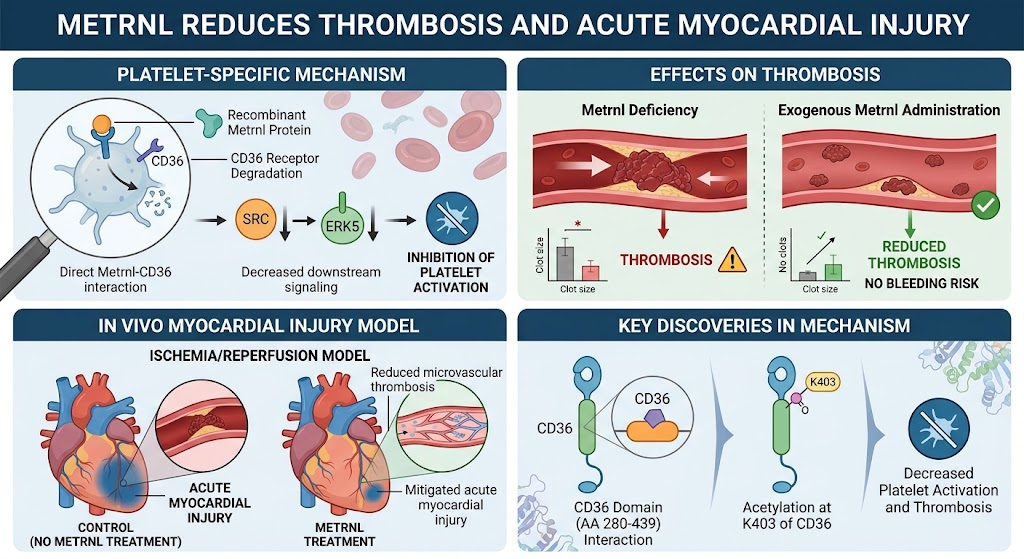
- Metrnl is identified as a secreted protein that inhibits platelet activation and thrombus formation without increasing bleeding risk.
- Metrnl binds to the platelet CD36 receptor, promoting its acetylation at lysine 403 and subsequent degradation.
- CD36 degradation attenuates downstream SRC-ERK5 signaling, reducing platelet activation and thrombosis.
- Exogenous Metrnl administration mitigates microvascular thrombosis and acute myocardial ischemia/reperfusion injury in murine models.
Study Background
Thrombotic diseases, including acute myocardial infarction (AMI), remain leading causes of morbidity and mortality worldwide. Platelet activation and aggregation play central roles in arterial thrombosis, contributing to ischemic events. Current antiplatelet therapies, such as aspirin and P2Y12 inhibitors, reduce thrombotic risk but also increase bleeding complications, highlighting the need for novel agents that selectively inhibit platelet activation pathways without compromising hemostasis.
Meteorin-like (Metrnl) is a recently characterized secreted protein involved in insulin sensitivity, angiogenesis, and atherosclerosis. Circulating Metrnl primarily originates from vascular endothelial cells and has been associated with arterial thrombotic diseases in clinical settings. However, the direct effects of Metrnl on platelet function and its mechanistic role in thrombosis remain poorly elucidated.
Study Design
This investigation employed a comprehensive experimental approach combining genetic mouse models, recombinant protein interventions, and molecular assays to explore the role of Metrnl in platelet activation and thrombosis.
Key components included:
– Global and platelet-specific Metrnl knockout mice to dissect endogenous effects.
– Administration of recombinant Metrnl protein and neutralizing antibodies in vitro and in vivo.
– Visualization techniques such as platelet aggregation assays and thrombus imaging to evaluate functional platelet responses.
– Identification of receptor interactions using immunoprecipitation-based mass spectrometry and protein-protein interaction studies.
– Molecular dissection of receptor binding domains, post-translational modifications, and downstream signaling pathways via mutagenesis and signaling assays.
– A murine myocardial ischemia/reperfusion (I/R) injury model to investigate the impact of Metrnl on microvascular thrombosis and acute myocardial injury.
Key Findings
Metrnl Deficiency Enhances Platelet-Driven Thrombosis
Metrnl knockout mice exhibited increased susceptibility to thrombosis, characterized by heightened platelet activation. Notably, coagulation cascade parameters and fibrinolysis markers were not altered, pinpointing platelet hyperactivity as the driver of thrombotic propensity. Platelet-specific Metrnl deletion recapitulated these findings, confirming the autocrine or paracrine regulatory role of platelet-derived Metrnl.
Exogenous Metrnl Suppresses Platelet Activation Without Bleeding Risk
Administration of recombinant Metrnl protein directly inhibited platelet aggregation and granule secretion in both human and rodent platelets in vitro. In mouse models, exogenous Metrnl reduced thrombus formation in arterial injury models. Importantly, this antithrombotic effect did not prolong bleeding time or enhance bleeding risk alone or when combined with clopidogrel, underscoring its safety profile.
Identification of CD36 as the Metrnl Receptor on Platelets
Immunoprecipitation coupled with mass spectrometry identified CD36 as a critical platelet receptor for Metrnl. Binding assays localized a previously unrecognized Metrnl-interacting domain between amino acids 280-439 of CD36. Further, Metrnl engagement led to acetylation at lysine 403 of CD36, triggering receptor degradation.
Molecular Mechanism: CD36 Degradation and Downstream SRC-ERK5 Signaling Inhibition
Metrnl-induced acetylation and degradation of CD36 attenuated SRC kinase and extracellular signal-related kinase 5 (ERK5) phosphorylation downstream. This signaling suppression diminished platelet activation markers and aggregation capacity, revealing a novel pathway by which Metrnl modulates platelet function.
Therapeutic Effects in Myocardial Ischemia/Reperfusion Injury
In vivo studies using a myocardial I/R injury mouse model demonstrated that Metrnl protein administration reduced microvascular thrombosis and infarct size. These findings bridge the mechanistic platelet inhibition data with clinically relevant cardioprotection, suggesting potential therapeutic utility in acute myocardial infarction.
Expert Commentary
The identification of Metrnl as a novel endogenous inhibitor of platelet activation adds an important dimension to our understanding of thrombotic regulation. Targeting CD36 degradation is a unique approach compared to conventional antiplatelet therapies that inhibit receptor signaling or ligand binding. CD36 has been implicated in lipid-mediated platelet hyperreactivity and atherosclerosis, so Metrnl’s dual actions on endothelial function and platelet inhibition may offer comprehensive vascular protection.
However, further studies are needed to explore Metrnl kinetics, receptor specificity, and long-term safety in larger animal models and humans. The interplay between Metrnl, metabolic status, and platelet function also warrants deeper investigation given known links between metabolism and thrombosis.
Conclusion
This study establishes Metrnl as a promising natural and therapeutic modulator of platelet activation and thrombosis via CD36 receptor acetylation and degradation. Exogenous Metrnl administration shows potential to safely attenuate thrombotic events and myocardial ischemic injury without bleeding risk. These findings open avenues for developing Metrnl-based therapies or mimetics for thrombotic cardiovascular diseases, particularly acute myocardial infarction, addressing an unmet clinical need for safer antiplatelet agents.
Funding and ClinicalTrials.gov
The original study was funded by institutional grants from the involved academic centers. No registered clinical trials for Metrnl in thrombosis have been reported to date.
References
1. Miao ZW, Chen CX, Wang P, et al. Metrnl Reduces Thrombosis and Acute Myocardial Injury Through Inhibition of Platelet Activation via CD36 Receptor Degradation. Circulation. 2026; DOI: 10.1161/CIRCULATIONAHA.126.026572. PMID: 42610276.
2. Li X, et al. CD36-Mediated Platelet Hyperactivity in Metabolic Syndrome and Atherosclerosis. J Thromb Haemost. 2020;18(3):640-651.
3. Ghasemzadeh N, et al. The Role of Platelets in Cardiovascular Disease. Platelets. 2021;32(1):81-90.
4. Kappelmayer J, et al. Emerging Therapies Targeting Platelet Activation. Curr Pharm Des. 2018;24(7):764-778.
5. Golebiewska EM, Poole AW. Platelet Secretion: From Hemostasis to Wound Healing and Beyond. Blood Rev. 2015;29(3):153-162.
6. Nakamura K, et al. Metrnl as a Secreted Protein Regulating Insulin Sensitivity and Metabolic Homeostasis. Nature Med. 2020;26(2):188-194.