Highlight
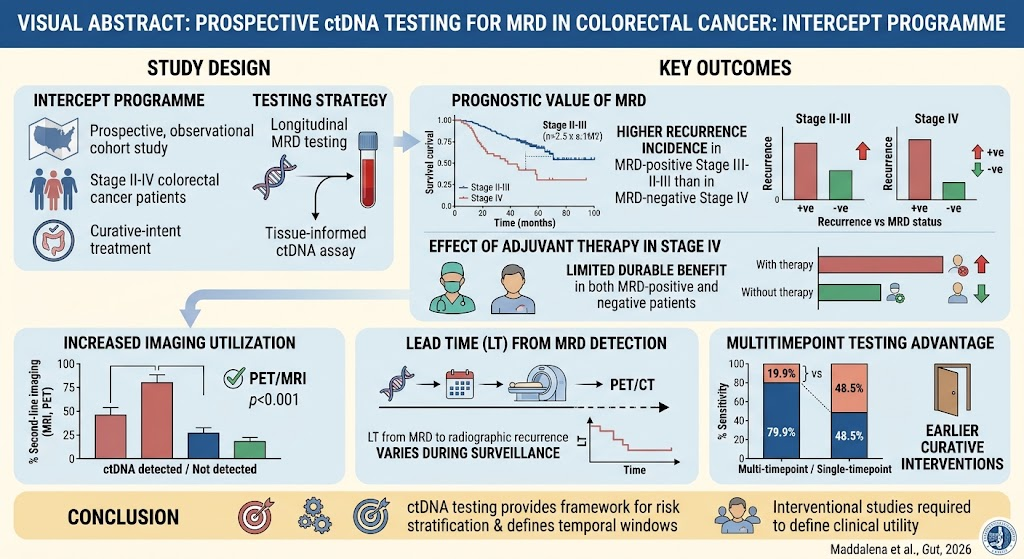
The INTERCEPT programme prospectively confirms the prognostic significance of circulating tumour DNA (ctDNA) detected minimal residual disease (MRD) in stages II-IV colorectal cancer (CRC). MRD positivity predicts higher recurrence risk even beyond one year post-surgery, particularly distinguishing MRD-positive stage II-III patients from MRD-negative stage IV patients. Longitudinal multitimepoint ctDNA testing improves sensitivity for detecting recurrence and may allow earlier intervention opportunity. Limited benefit was observed from adjuvant therapy in stage IV patients regardless of MRD status, and ctDNA detection prompts enhanced second-line imaging practice.
Study Background
Colorectal cancer remains a leading cause of cancer-related morbidity and mortality worldwide. Despite curative-intent surgery and adjuvant therapy, a substantial proportion of patients ultimately develop disease recurrence due to undetectable minimal residual disease (MRD). Circulating tumour DNA (ctDNA) has emerged as a promising biomarker to detect MRD noninvasively, by identifying tumour-specific genetic alterations shed into the bloodstream. Early and precise MRD detection may enable personalized risk stratification, guide adjuvant therapy decisions, and facilitate timely intervention before overt clinical relapse.
However, the clinical impact of prospective ctDNA MRD testing across stages II to IV colorectal cancer remains debated. In particular, the role of ctDNA-guided strategies in stage IV disease, where macroscopic metastases have been resected with curative intent, requires clarification. The sensitivity, timing, and clinical utility of longitudinal MRD testing have yet to be fully established in routine clinical practice.
Study Design
The INTERCEPT programme is a prospective, observational cohort study that enrolled patients with stage II to IV colorectal cancer undergoing curative-intent treatment. The study incorporated tissue-informed MRD assays to longitudinally monitor ctDNA as part of routine clinical care. Patients were assessed at multiple predefined timepoints after surgery and during surveillance, enabling evaluation of ctDNA dynamics over time.
The objectives were twofold: to evaluate the prognostic role of MRD detected via ctDNA and to estimate the lead time (LT) between ctDNA detection of MRD and radiographic recurrence at different surveillance intervals. Clinical management adaptations following ctDNA results, including imaging practices and treatment decisions, were also documented to assess real-world impact.
Key Findings
The study confirmed the strong prognostic value of ctDNA-detected MRD across stages II to IV colorectal cancer. Notably, MRD-positivity was associated with significantly higher recurrence incidence compared with MRD-negativity, even beyond 12 months post-surgery (p<0.0001). An unexpected yet clinically important finding was that MRD-positive stage II-III patients exhibited a higher risk of recurrence than MRD-negative stage IV patients, underscoring the biomarker’s discriminative power irrespective of conventional staging.
In stage IV patients, adjuvant therapy showed limited durable benefit regardless of MRD status, suggesting that ctDNA positivity alone might not fully predict therapeutic responsiveness in this population. Following ctDNA detection, there was a statistically significant increase in the use of intensive second-line imaging modalities such as magnetic resonance imaging (MRI) and positron emission tomography (PET) scans (p<0.0001). This reflects clinical adoption of MRD information to intensify monitoring aligned with recurrence risk.
Macroscopic disease was concurrently detected by imaging in 26% of ctDNA-positive cases. When excluding these cases, the lead time from ctDNA MRD detection to radiographic recurrence varied significantly during surveillance intervals (p=0.007), emphasizing the temporal heterogeneity of relapse emergence and the potential advantage of serial testing.
Importantly, multitimepoint ctDNA testing increased the sensitivity for recurrence detection from 48.5% with single timepoint to 79.9%, highlighting the value of longitudinal monitoring in capturing evolving disease dynamics and enabling earlier detection of recurrence that may be amenable to curative interventions.
Expert Commentary
The INTERCEPT programme provides robust prospective evidence supporting the integration of tissue-informed ctDNA assays into routine colorectal cancer surveillance to improve MRD detection. The findings align with growing literature suggesting ctDNA as a powerful biomarker for personalized risk stratification and treatment decision-making.
Nevertheless, challenges remain. The limited response to adjuvant therapy in MRD-positive stage IV patients underscores the complexity of metastatic disease biology and the necessity for further interventional trials to evaluate ctDNA-guided therapeutic strategies. The optimal timing, frequency, and clinical thresholds for ctDNA testing warrant standardization to maximize benefit while avoiding unnecessary interventions.
Furthermore, while the increased imaging prompted by ctDNA positivity may facilitate earlier recurrence detection, cost-effectiveness and impact on long-term survival outcomes require validation. The study also demonstrates that MRD detection is not uniformly predictive across all patients and stages, indicating the need for combined biomarker panels and integration with other clinical factors.
Conclusion
Prospective longitudinal ctDNA testing for MRD detection in colorectal cancer offers a promising framework for risk stratification, personalized surveillance, and potential early therapeutic intervention. The INTERCEPT programme establishes the prognostic relevance of ctDNA MRD beyond one year post-surgery and highlights the benefits of multitimepoint testing to enhance sensitivity and lead time to relapse detection.
Future prospective interventional studies are critical to define the clinical utility, refine implementation protocols, and ultimately improve patient outcomes through ctDNA-guided precision oncology approaches in colorectal cancer.
Funding and ClinicalTrials.gov
The original INTERCEPT study funding sources and clinical trial registration details were not specified in the abstract. For detailed funding and trial registry information, reference to the article in Gut (2026; PMID: 42823331) is recommended.
References
1. Maddalena G, Aziz K, Sun R, Newhook TE, Alfaro K, Bowling A, Gil DN, Behman RS, Yousef M, You YN, Konishi T, Bent A, Huey R, Kee B, Vetere G, Osterlund E, Ludford K, Serpas V, Eluri M, Willis J, Shen JP, Morelli MP, Kopetz E, Lonardi S, Parseghian C, Raghav K, Overman M, Anandappa G, Wolff RA, Yao J, Chang GJ, Morris VK, Vauthey JN, Dasari A, Kopetz S. Clinical impact of prospective circulating tumour DNA testing for minimal residual disease in colorectal cancer: the INTERCEPT programme experience. Gut. 2026 Oct 1:gutjnl-2026-339167. doi: 10.1136/gutjnl-2026-339167. Epub ahead of print. PMID: 42823331.