Highlight
- Bemnifosbuvir (NS5B polymerase inhibitor) combined with ruzasvir (NS5A inhibitor) demonstrated high pan-genotypic efficacy in treatment-naïve chronic hepatitis C patients.
- An 8-week once-daily regimen yielded sustained virologic response at 12 weeks post treatment (SVR12) rates of 90% in the intention-to-treat population and up to 98% in adherent patients.
- Treatment was well tolerated with no drug-related serious adverse events or discontinuations.
- Baseline NS5A resistance-associated substitutions (RASs) and compensated cirrhosis did not negatively impact treatment efficacy.
Study Background
Chronic hepatitis C virus (HCV) infection remains a global public health challenge despite advances in direct-acting antiviral (DAA) therapies. Although current regimens achieve high cure rates, challenges include treatment duration, complexity, cost, and resistance-associated substitutions (RASs) that may reduce efficacy. Pan-genotypic antiviral combinations that offer short, well-tolerated courses with retained efficacy in patients harboring baseline RASs and those with compensated cirrhosis are highly desirable. Bemnifosbuvir, an inhibitor of the HCV NS5B polymerase, combined with ruzasvir, an NS5A inhibitor, represents a dual-target DAA regimen under investigation. This Phase 2, single-arm study evaluated the efficacy and safety of an 8-week oral regimen of these agents across all HCV genotypes in treatment-naïve patients, addressing an unmet need for shorter, broadly effective treatments.
Study Design
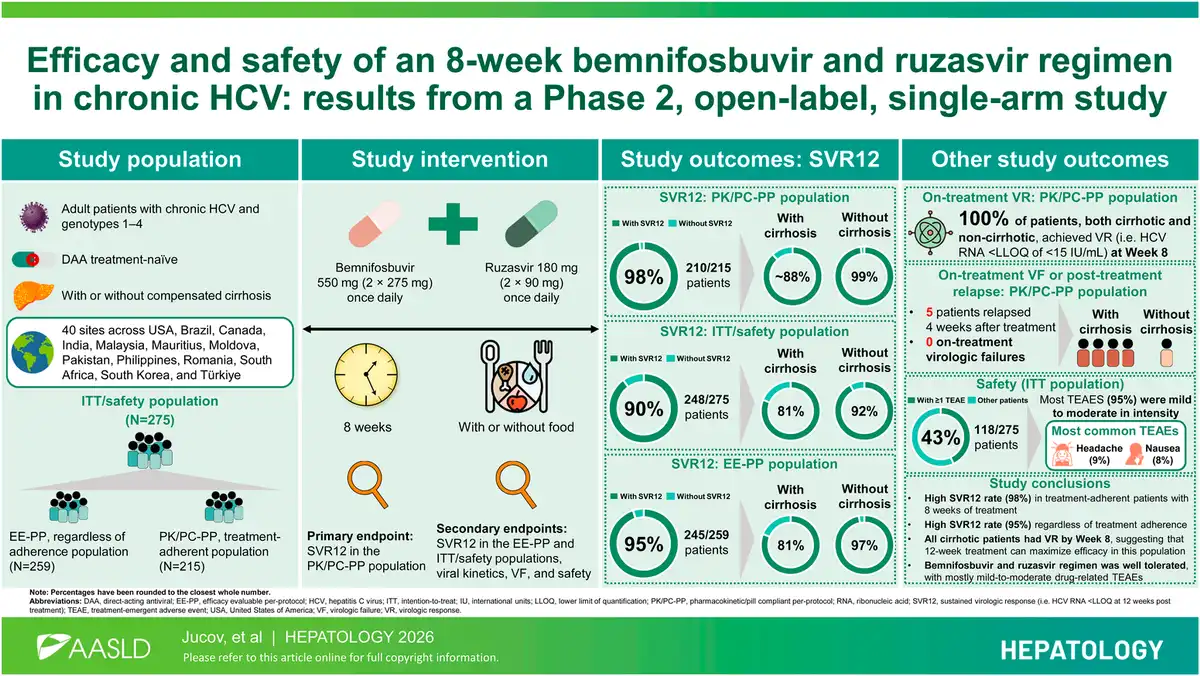
This was a multicenter, open-label, single-arm Phase 2 trial enrolling 275 treatment-naïve adults with chronic HCV infection of any genotype, including 13% with compensated cirrhosis. The regimen comprised bemnifosbuvir 550 mg and ruzasvir 180 mg administered orally once daily for 8 weeks. Patients were stratified by presence of baseline NS5A resistance-associated substitutions (RASs), present in 27% at baseline, and cirrhosis status.
Primary efficacy endpoint was sustained virologic response 12 weeks after completing therapy (SVR12) in the pharmacokinetic and pill compliant per-protocol (PK/PC-PP) population, which included patients with confirmed drug adherence and adequate drug levels. Secondary endpoints included SVR12 in the efficacy evaluable per-protocol population (EE-PP), which included all patients with available outcomes regardless of adherence, SVR24 (sustained virologic response 24 weeks post-treatment), and safety assessments in all patients receiving at least one dose (all dosed population).
Virologic failure was defined as post-treatment relapse or on-treatment breakthrough.
Key Findings
Out of 275 treated patients, 248 (90%; 95% CI: 86-93%) achieved SVR12 in the intention-to-treat (ITT) population. When focusing on the PK/PC-PP population (n=215), SVR12 increased to 98% (95% CI: 95-99%), highlighting excellent efficacy in adherent patients with confirmed drug exposure. The EE-PP population showed SVR12 of 95% (245/259; 95% CI: 91-97%). These high cure rates were consistent across all HCV genotypes included in the study, showing the pan-genotypic potential of this regimen.
Importantly, treatment efficacy was not diminished in the subset of patients harboring baseline NS5A RASs (27%) or those with compensated cirrhosis (13%), groups often considered at higher risk for treatment failure. Only five patients in the PK/PC-PP population experienced virologic failure characterized by post-treatment relapse; no on-treatment virologic breakthroughs were reported.
The 24-week post-treatment follow-up (SVR24) data, typically confirming the durability of viral clearance, supported the robust sustained response seen at 12 weeks.
Regarding safety, the regimen was well tolerated: no drug-related serious adverse events or treatment discontinuations due to adverse events were reported. The side effect profile was consistent with expectations for this class of antivirals, with no new safety signals identified.
Expert Commentary
This study demonstrates the potential of bemnifosbuvir plus ruzasvir as a simplified, potent, and well-tolerated dual DAA regimen that achieves high cure rates with a shortened 8-week therapy duration. The pan-genotypic efficacy and preserved response in those with baseline NS5A RASs and compensated cirrhosis are clinically significant, as these subgroups can be challenging with some currently available regimens.
While Phase 2 data are promising, Phase 3 randomized controlled trials are needed to confirm these findings, further evaluate comparative efficacy, and assess real-world effectiveness and safety in more diverse populations including those with decompensated liver disease or prior treatment failures.
Biologically, the complementary mechanisms of NS5B polymerase and NS5A inhibition provide a strong antiviral barrier to resistance, which may explain the high SVR rates observed even in the presence of preexisting RASs. Shortening treatment while maintaining efficacy could improve adherence, reduce cost, and increase patient access globally.
Limitations include the open-label, single-arm design lacking a comparator group, and relatively modest cirrhotic population. Nevertheless, the robust virologic outcomes and safety profile support further clinical development.
Conclusion
An 8-week oral regimen of bemnifosbuvir and ruzasvir offers a highly effective, pan-genotypic treatment option for treatment-naïve chronic hepatitis C patients. Its robust SVR12 rates across genotypes and in the presence of baseline resistance mutations, combined with excellent tolerability, highlight its promise as a simplified DAA combination. Pending confirmation in Phase 3 studies, this regimen could enhance hepatitis C management by shortening treatment duration and broadening effective therapeutic options.
Funding and Trial Registration
Details on study funding sources and clinical trial registration (e.g., ClinicalTrials.gov identifier) were not specified in the primary publication summary. Further information may be available in the full text of the study.
References
1. Jucov A, Conway B, Feld JJ, et al. Efficacy and safety of an 8-week bemnifosbuvir and ruzasvir regimen in chronic hepatitis C: Results from a Phase 2 study. Hepatology (Baltimore). 2026 Oct; PMID: 42826065.
2. Pawlotsky JM. Hepatitis C Virus Resistance to Direct-Acting Antiviral Drugs in Interferon-Free Regimens. Gastroenterology. 2016;151(1):70-86.
3. European Association for the Study of the Liver (EASL) 2020 Clinical Practice Guidelines on hepatitis C virus infection. J Hepatol. 2020 Apr;72(2):461-511.