Highlights
- Continuous creatinine changes within 48 hours of EVT independently predict 90-day functional outcomes and in-hospital mortality, even below standard CA-AKI thresholds.
- A dose-response relationship is observed, with 10% increases in creatinine associating with worse outcomes, emphasizing prognostic relevance of subthreshold renal changes.
- Intensive blood pressure lowering post-EVT may increase AKI risk, which correlates with poorer neurological recovery and higher stroke-related mortality.
- Contrast-enhanced multimodal brain imaging preceding EVT shows minimal impact on renal function, indicating procedural safety within studied parameters.
Background
Acute ischemic stroke (AIS) remains a leading cause of morbidity and mortality worldwide, with endovascular thrombectomy (EVT) as a cornerstone intervention for large-vessel occlusions. Despite dramatic improvements in cerebral reperfusion, complications such as contrast-associated acute kidney injury (CA-AKI) pose significant challenges — CA-AKI after EVT has been linked to worsened neurological outcomes and increased mortality. Traditional diagnostic thresholds for CA-AKI rely on dichotomous cutoffs (e.g., serum creatinine elevation ≥0.3 mg/dL or 1.5× baseline within 48 hours), potentially overlooking nuanced, graded renal impairment effects on prognosis.
The recent CAN-REST registry secondary analysis redefines renal risk assessment post-EVT by investigating continuous creatinine changes within 48 hours and their association with functional outcomes. Complementary evidence from randomized trials and observational studies examines factors impacting AKI development and renal safety following EVT, enriching our mechanistic understanding and informing clinical management strategies.
Key Content
Continuous Creatinine Change as a Prognostic Biomarker Post-EVT
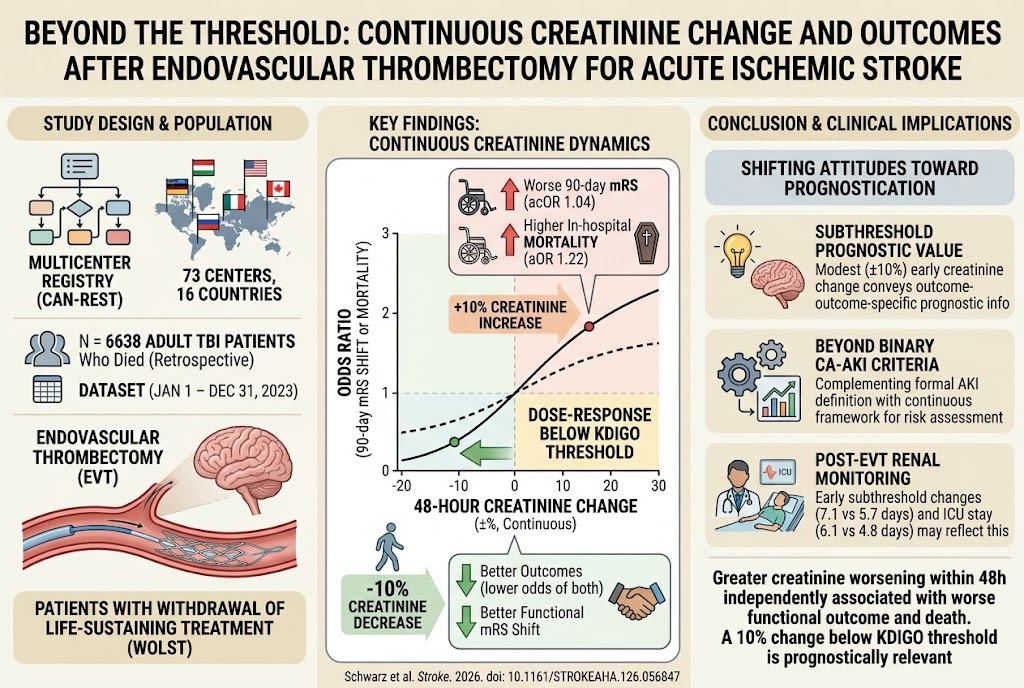
The CAN-REST registry (Schwarz et al., 2026) retrospectively analyzed 6638 adults treated with EVT across 73 centers worldwide. Early renal function changes were quantified as the natural logarithm ratio of 48-hour/baseline creatinine (ln[48-hour/baseline creatinine]). Contrasting the conventional binary CA-AKI definition, this approach assessed whether graded creatinine dynamics provide incremental prognostic value.
Multivariable logistic regression models, adjusted for prespecified covariates, revealed:
- A linear association (adjusted common odds ratio 1.48 per 1-unit log-ratio increase) between increasing creatinine and unfavorable 90-day modified Rankin Scale (mRS) shift.
- A nonlinear dose-response relationship with in-hospital mortality, stronger in magnitude than the functional outcome association.
- Notably, even a modest 10% creatinine elevation at 48 hours—below Kidney Disease: Improving Global Outcomes (KDIGO) CA-AKI thresholds—significantly increased odds of poor functional outcome (aOR 1.04) and death (aOR 1.22).
- Conversely, a 10% decrease in creatinine conferred a protective association with better outcomes.
Effect modification analyses indicated that baseline renal function did not significantly alter these associations.
Together, these findings support integrating continuous renal biomarkers into post-EVT risk stratification rather than relying solely on rigid CA-AKI cutoffs.
Impact of Post-EVT Blood Pressure Management on AKI and Outcomes
The OPTIMAL-BP trial secondary analysis (2026) evaluated how intensive blood pressure (BP) lowering after successful EVT affects AKI incidence and neurological outcomes in AIS patients. Patients were randomized to intensive (target systolic BP <140 mm Hg) or conventional (140–180 mm Hg) management for 24 hours.
Key results indicated:
- Higher AKI rates (13.6% vs. 6.4%) within 7 days in the intensive BP group, predominantly mild stage 1 AKI.
- AKI strongly associated with decreased 3-month functional independence (mRS 0–2) and increased stroke-related mortality.
- Early AKI within 2 days mirrored these trends, suggesting acute renal vulnerability linked to hemodynamic alterations.
These data underscore AKI as a significant marker of systemic hemodynamic fragility after EVT, cautioning aggressive BP lowering strategies that may exacerbate renal injury and worsen recovery.
Renal Safety of Contrast-Enhanced Multimodal Imaging Preceding EVT
In the DEFUSE 3 randomized trial population (2021), serum creatinine changes were evaluated in patients selected for EVT versus medical therapy using contrast-enhanced CT or MRI-based perfusion imaging.
Findings showed:
- No significant difference in 24-hour creatinine changes between EVT and medical arms.
- No difference between CT angiography/perfusion and MR selection methods regarding creatinine changes or AKI incidence.
- Overall low rates of contrast-associated kidney injury (4.4% EVT vs 2.2% medical; not statistically significant).
- Mean creatinine levels decreased slightly post-intervention, likely reflecting hemodilution or volume status changes.
These reassuring results validate the renal safety of multimodal imaging protocols guiding EVT candidacy, emphasizing procedural risk mitigation.
Expert Commentary
The CAN-REST analysis marks a pivotal advance by shifting from dichotomous AKI definitions towards nuanced continuous biomarker interpretation. This approach reveals that subtle renal dysfunction imperceptible by standard CA-AKI criteria still portends worse neurological and survival outcomes. It challenges clinicians and researchers to integrate continuous kidney injury markers into prognostic models and decision-making algorithms.
The mechanistic underpinnings likely involve subclinical tubular injury, renal hypoperfusion, or systemic inflammatory responses triggered during EVT and peri-procedural care. Early creatinine elevations may reflect hemodynamic instability, contrast nephrotoxicity, or underlying comorbidities not fully captured by baseline assessments.
The OPTIMAL-BP secondary analysis accentuates the delicate balance in managing post-EVT BP. Overaggressive reductions may precipitate renal hypoperfusion leading to AKI, increasing morbidity and mortality. Thus, individualized BP targets considering renal vulnerability may optimize outcomes.
Simultaneously, the DEFUSE 3 trial data provide reassurance that the contrast doses used in multimodal brain imaging prior to EVT are not major contributors to AKI, supporting current diagnostic practices.
Limitations include the observational CAN-REST design, potential confounding despite rigorous adjustment, and the need for prospective validation of continuous creatinine metrics. Furthermore, the impact of hydration strategies, contrast volume/type, and comorbid conditions warrant further detailed study. Patient heterogeneity across multiple centers introduces variability but enhances generalizability.
Current stroke and nephrology guidelines do not explicitly incorporate continuous creatinine changes in post-EVT care pathways. Future recommendations could evolve to include continuous biomarker thresholds to better identify at-risk patients and implement preventive interventions such as optimized hydration, tailored BP management, and renal protective pharmacotherapy.
Conclusion
Recent evidence demonstrates that continuous creatinine changes within 48 hours post-EVT provide incremental prognostic information beyond binary CA-AKI definitions, with measurable dose-response effects even at modest creatinine alterations. This paradigm shift enables refined risk stratification and underscores the clinical relevance of subthreshold renal changes on neurological recovery and survival.
Complementing these findings, blood pressure management intensity after EVT significantly influences AKI incidence and outcomes, highlighting the importance of balanced hemodynamic approaches tailored to individual renal risk. Meanwhile, multimodal contrast imaging appears safe regarding renal function.
Integrating continuous creatinine monitoring into clinical protocols may guide early nephroprotective strategies and improve stroke outcome predictions. Further prospective research should elucidate mechanisms, validate thresholds, and explore intervention efficacy to mitigate renal injury and enhance recovery after ischemic stroke treatment.
References
- Schwarz G, Cascio Rizzo A, Ambler G, et al. Beyond the Threshold: Continuous Creatinine Change and Outcomes After Endovascular Thrombectomy for Acute Ischemic Stroke. Stroke. 2026 Oct 1; PMID: 42817886. https://pubmed.ncbi.nlm.nih.gov/42817886/
- Yoshimura S, Suzuki K, Nagayama H, et al. Acute Kidney Injury After Intensive Blood Pressure Lowering Following Successful Endovascular Thrombectomy. Stroke. 2026 Sep;57(9):2719-2730. PMID: 42495732. https://pubmed.ncbi.nlm.nih.gov/42495732/
- Albers GW, Marks MP, Kemp S, et al. Renal Safety of Multimodal Brain Imaging Followed by Endovascular Therapy. Stroke. 2021 Jan;52(1):313-316. PMID: 33250038. https://pubmed.ncbi.nlm.nih.gov/33250038/