Highlight
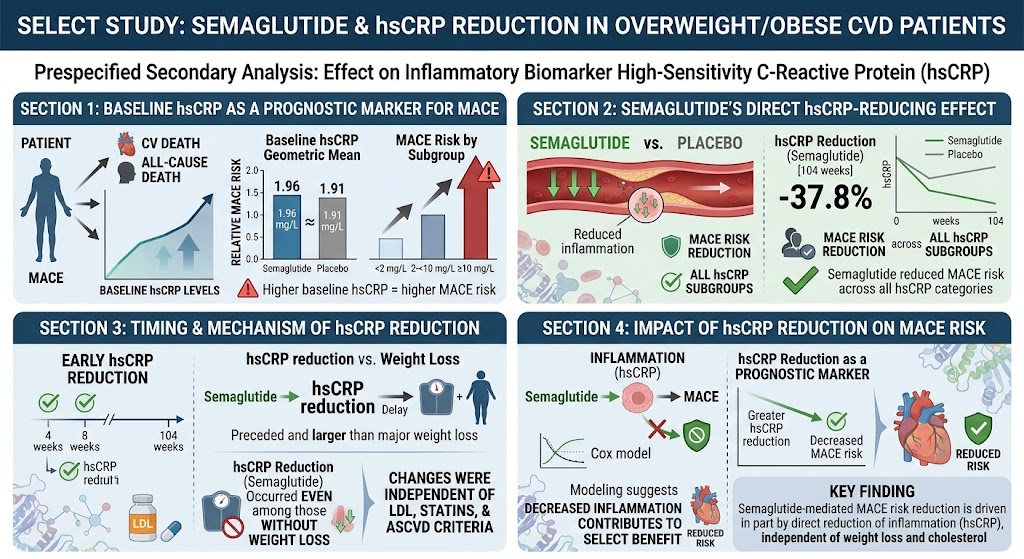
– Semaglutide reduces high-sensitivity C-reactive protein (hsCRP), an inflammatory biomarker linked to cardiovascular risk, in patients with established atherosclerotic cardiovascular disease and obesity but without diabetes.
– Baseline hsCRP predicts risk of major adverse cardiovascular events (MACEs) including cardiovascular and all-cause death.
– Semaglutide’s reduction of hsCRP occurs early and partly independent of weight loss, implicating inflammation reduction as a mediator of cardiovascular benefit.
– hsCRP decreases correlate with reduced MACE risk regardless of LDL cholesterol levels, statin use, or cardiovascular disease subtype.
Study Background
Atherosclerotic cardiovascular disease (ASCVD) remains the foremost cause of morbidity and mortality worldwide. While classical risk factors such as dyslipidemia, hypertension, and diabetes have been targeted extensively, the inflammatory component of atherosclerosis has emerged as a key pathogenic mechanism. High-sensitivity C-reactive protein (hsCRP) is a widely recognized biomarker of systemic inflammation and has prognostic value for cardiovascular events in both primary and secondary prevention settings, especially in patients with obesity-related chronic inflammation.
Obesity itself heightens cardiovascular risk by augmenting pro-inflammatory pathways, yet few interventions effectively modulate both weight and systemic inflammation concurrently. Glucagon-like peptide-1 receptor agonists (GLP-1 RAs), including semaglutide, have demonstrated weight loss and glycemic control benefits, and cardiovascular outcome trials in diabetic populations showed significant reductions in major adverse cardiovascular events (MACEs). However, the SELECT trial uniquely evaluated semaglutide in overweight or obese patients with established ASCVD but without diabetes, addressing the gap in evidence for anti-inflammatory effects in this subset.
Study Design
SELECT was a large, multinational, randomized, double-blind, placebo-controlled cardiovascular outcomes trial enrolling 17,604 patients with documented ASCVD and overweight or obesity (body mass index ≥27 kg/m²), excluding those with diabetes. Participants were randomized to subcutaneous semaglutide or placebo and followed for a mean duration of approximately 40 months.
The prespecified secondary analysis focused on evaluating the inflammatory biomarker hsCRP. Baseline hsCRP was measured, and serial changes were tracked over 104 to 208 weeks. The primary cardiovascular endpoint was the time to first MACE—a composite of cardiovascular death, nonfatal myocardial infarction, or nonfatal stroke. The analysis examined whether baseline hsCRP predicted MACE risk and the association between hsCRP changes, weight loss, and cardiovascular outcomes within the treatment groups, leveraging Cox proportional hazard modeling and stratified subgroup analyses.
Key Findings
Baseline hsCRP levels were comparable between semaglutide and placebo groups, with geometric means of 1.96 mg/L and 1.91 mg/L respectively. Elevated baseline hsCRP independently predicted higher rates of MACEs, including cardiovascular and all-cause mortality, across stratified subgroups categorized as hsCRP <2, 2 to <10, and ≥10 mg/L.
Semaglutide treatment resulted in a robust 37.8% reduction in hsCRP at 104 weeks, a decrement consistent across all baseline hsCRP strata. These inflammatory reductions preceded and were partially independent of substantial weight loss, with significant hsCRP declines detectable as early as 4 to 8 weeks, including in patients who did not achieve weight loss. This temporal dissociation suggests direct anti-inflammatory effects beyond weight-mediated pathways.
The cardiovascular benefits of semaglutide, manifested as reduced risk of MACEs, were observed across all hsCRP strata. Furthermore, greater reductions in the ratio of hsCRP to baseline levels correlated with lower MACE rates, supporting inflammation reduction as a mechanistic contributor to cardiovascular protection. Importantly, these effects were independent of LDL cholesterol levels, statin therapy, or ASCVD subtype, reinforcing that hsCRP modulation provides additive prognostic information.
Expert Commentary
The SELECT substudy extends previous findings from GLP-1 RA cardiovascular outcome trials by underscoring the critical role of inflammation in obese patients with established cardiovascular disease sans diabetes. The rapid lowering of hsCRP with semaglutide and its association with reduced MACE risk lends biological plausibility to inflammation as a mediator of cardiovascular benefit, complementing the agent’s weight loss and metabolic effects.
While the study’s strengths include its large sample size, randomized design, and rigorous biomarker assessment, some limitations merit consideration. The population excluded patients with diabetes, potentially limiting generalizability to diabetic cohorts already studied in prior trials. Further, although hsCRP is a validated surrogate of inflammation, it remains an indirect measure; more granular inflammatory profiling might elucidate underlying pathways.
These observations align with current cardiovascular guidelines acknowledging inflammation as a modifiable risk factor and support wider consideration of GLP-1 RAs for cardiovascular risk reduction in select non-diabetic patients with obesity and ASCVD.
Conclusion
The SELECT trial prespecified secondary analysis demonstrates that semaglutide significantly reduces the inflammatory biomarker hsCRP and that baseline hsCRP predicts MACE risk in a high-risk population of overweight or obese patients with ASCVD but no diabetes. Reductions in systemic inflammation with semaglutide correlate with diminished cardiovascular events, indicating that anti-inflammatory effects likely contribute to the drug’s cardiovascular benefit in this population.
These data underline the multifaceted therapeutic profile of semaglutide, combining weight loss, metabolic improvement, and inflammation attenuation, thereby broadening its clinical role beyond glycemic management. Continued research should explore inflammation-targeted mechanisms and extend these findings to diverse patient populations.
Funding and ClinicalTrials.gov Registration
The SELECT trial was registered at ClinicalTrials.gov under identifier NCT03574597. Funding sources were not specified in this summary but are detailed in the original publication.
References
- Plutzky J, Bogdański P, Colhoun HM, et al. Effect of Semaglutide on the Inflammatory Biomarker High-Sensitivity CRP in Patients With Established Cardiovascular Disease and Overweight or Obesity in SELECT: A Prespecified Secondary Analysis. Circulation. 2026 Aug 18; PMID: 42610271.
- Ridker PM, et al. Inflammation, statins, and cardiovascular risk reduction. Circulation. 2019.
- Marso SP, et al. Cardiovascular outcomes with liraglutide in type 2 diabetes. N Engl J Med. 2016.
- Libby P. Inflammation in atherosclerosis. Arterioscler Thromb Vasc Biol. 2012.