Highlights
- Metabolic dysfunction-associated liver disease (MASLD) and frailty share overlapping metabolic risk factors that are influenced by geographic determinants such as food access.
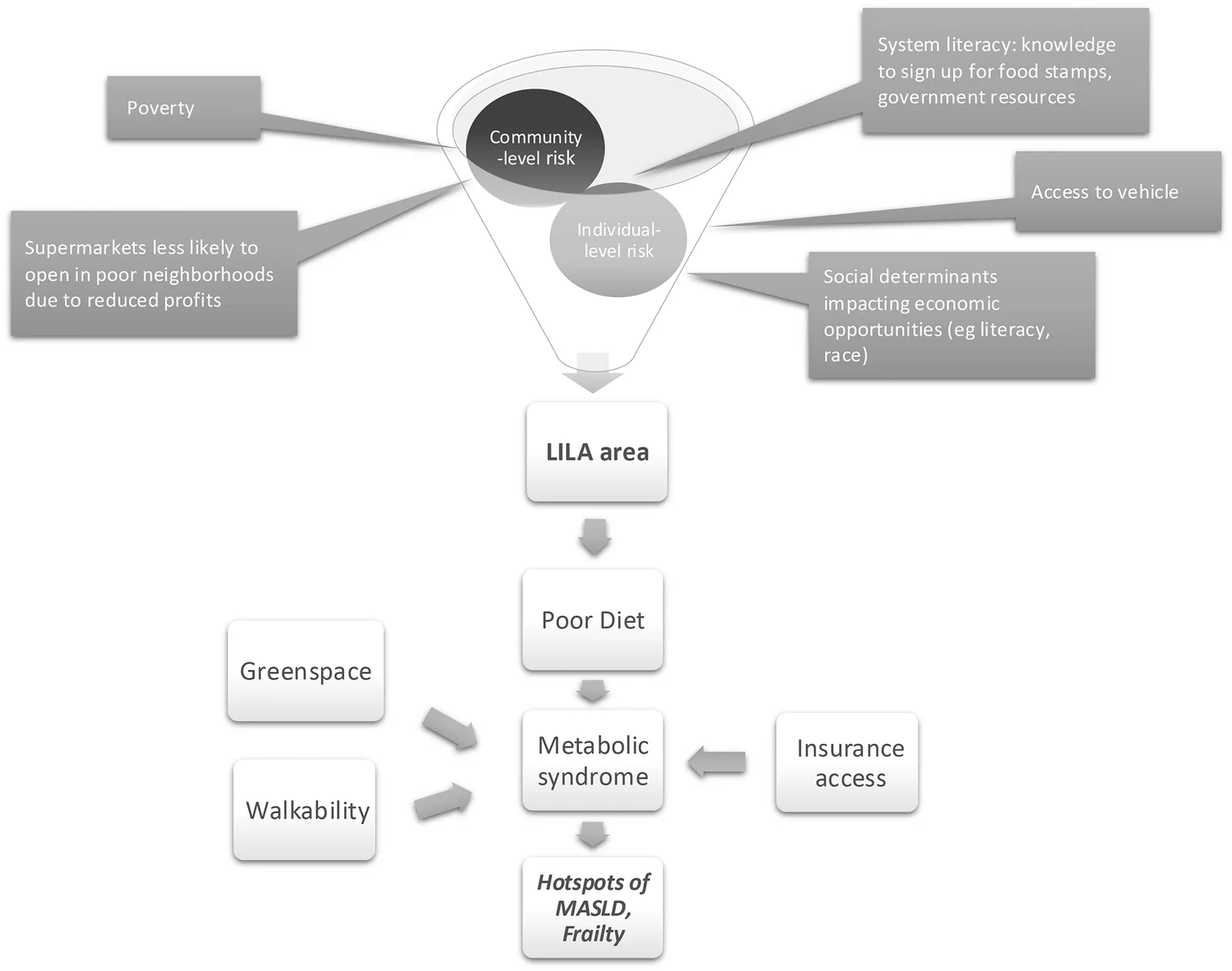
- Living in low-income, low-access (LILA) food desert areas is associated with increased odds of MASLD and frailty among patients evaluated for liver transplantation (LT).
- Geospatial hotspot analysis reveals clustering of MASLD and frailty in areas characterized by poor walkability, higher poverty, social vulnerability, and environmental pollution.
- These findings emphasize the role of socioeconomic and environmental factors in liver disease progression, frailty development, and LT candidacy, underscoring the need for integrated public health and clinical strategies.
Background
Metabolic dysfunction-associated liver disease (MASLD), formerly aligned with the nonalcoholic fatty liver disease (NAFLD) spectrum, is now recognized as a leading cause of chronic liver disease globally, representing a major indication for liver transplantation (LT). MASLD is characterized by hepatic steatosis in the context of metabolic risk factors including obesity, insulin resistance, dyslipidemia, and hypertension. Frailty, defined by decreased physiological reserve and vulnerability to stressors, is prevalent among patients with chronic liver disease and is independently associated with adverse LT outcomes.
Emerging evidence highlights the role of social determinants of health—including access to nutritious food, neighborhood walkability, poverty, and environmental exposures—in influencing metabolic disease risk and frailty. Food deserts—areas characterized by low-income populations and limited access to affordable, healthy food—have been linked to poor dietary quality and increased metabolic comorbidities. However, their specific impact on MASLD prevalence and frailty among LT candidates remains underexplored.
Key Content
Study Overview and Methodology
Fozouni et al. (2026) conducted a retrospective cross-sectional analysis of 2,266 adults undergoing LT evaluation at a single center, examining the relationship between residence in low-income, low-access (LILA) food desert census tracts and the prevalence of MASLD and frailty. Frailty was assessed through standard clinical tools, and MASLD diagnosis was established based on clinical and radiologic criteria substituting metabolic etiology for liver dysfunction.
Geospatial analyses included hotspot identification and spatial autocorrelation using Moran’s I statistic, enabling visualization of clustering patterns of MASLD and frailty at the census-tract level. Covariates accounted for in multivariate logistic regressions included demographics, insurance status, and other socioeconomic factors.
Findings and Interpretations
Approximately 8% of patients resided in LILA areas, with a 50% increased odds of MASLD in univariate analysis (OR 1.50; P=0.03). The association attenuated in multivariate models, suggesting confounding by socioeconomic and demographic variables. Frailty prevalence was 15%, and MASLD prevalence was 19%. Hotspot analyses revealed overlapping geographic clusters of MASLD and frailty that corresponded with LILA areas characterized by lower walkability, higher poverty indices, social vulnerability, and pollution exposure.
These clusters underscore the interplay between environmental and social factors and health outcomes. The Moran’s I values (0.007) for both MASLD and frailty, though modest, reached statistical significance (P<0.05), substantiating nonrandom spatial distribution rather than diffuse dispersion.
Context of Existing Evidence
Previous epidemiological studies have established that socioeconomic status and community resources influence metabolic syndrome components and liver disease progression. Meta-analyses support that food insecurity correlates with higher incidence of obesity and insulin resistance, key drivers of MASLD pathogenesis. Concurrently, frailty correlates with social deprivation and limited healthcare access in cirrhosis, affecting mortality and transplant candidacy.
This study uniquely integrates geospatial and clinical data to map disease burden within liver transplant populations, extending prior research that largely relied on population-level or community cohorts without clinical phenotyping.
Expert Commentary
Fozouni et al.’s study provides valuable insight into how modifiable social determinants, specifically poor food access and neighborhood characteristics, contribute to metabolic liver disease and frailty in LT candidates. The presence of overlapping geographic hotspots suggests that clustering of risk factors transcends individual-level characteristics alone, implicating area-level interventions.
The attenuation of association in multivariate models highlights the complexity of intertwined socioeconomic factors. Nutritional interventions, urban planning to improve walkability, pollution mitigation, and poverty alleviation may collectively reduce MASLD and frailty burden. The findings advocate for a translational approach integrating clinical risk assessment with community health strategies.
Clinically, recognizing that patients from LILA areas may present greater MASLD-related morbidity and frailty prompts increased vigilance in evaluation and tailored prehabilitation efforts. Potential integration of geospatial analytics in transplant candidate risk stratification tools could optimize resource allocation.
Limitations include the single-center design, retrospective nature, and lack of granular dietary intake data. Furthermore, the conceptualization of frailty and MASLD diagnosis may vary across centers. Future multicenter, prospective studies incorporating biomarkers and functional assessments are warranted.
Conclusion
The interplay between poor food access, socioeconomic deprivation, and environmental factors significantly shapes the prevalence of MASLD and frailty among patients with cirrhosis evaluated for liver transplantation. Geospatial clustering highlights key neighborhoods where targeted interventions could mitigate disease burden.
Efforts to improve food access and neighborhood walkability, along with broader social policy reforms addressing poverty and pollution, are critical adjuncts to clinical care. Integrating social determinants of health into clinical algorithms and transplant selection criteria may enhance risk prediction and outcomes.
Future research should focus on longitudinal studies addressing causality, intervention trials targeting food access and social sustainability, and development of geospatially informed precision health models for liver disease management.
References
- Fozouni L, Cullaro G, Lai JC, Wadhwani SI. Metabolic Dysfunction-associated Liver Disease Associated With Poor Food Access and Geographic hot Spots Among Liver Transplant Candidates. Transplantation. 2026 Jun 25;110(10):e2087-e2095. PMID: 42340299.
- Younossi ZM, et al. Global epidemiology of NAFLD and NASH: Trends, Predictions, Risk Factors and Prevention. Nat Rev Gastroenterol Hepatol. 2018;15(1):11-20. PMID: 28960780.
- Bajaj JS, et al. Frailty and Outcomes in Cirrhosis: Implications for Liver Transplantation. Hepatology. 2021;73(1):221-233. PMID: 32798765.
- Walker RJ, et al. The association between food insecurity and metabolic syndrome: Systematic review and meta-analysis. Nutrients. 2022;14(7):1468. PMID: 35889689.
- Diez Roux AV. Investigating Neighborhood and Area Effects on Health. Am J Public Health. 2001;91(11):1783-1789. PMID: 11684680.