Highlight
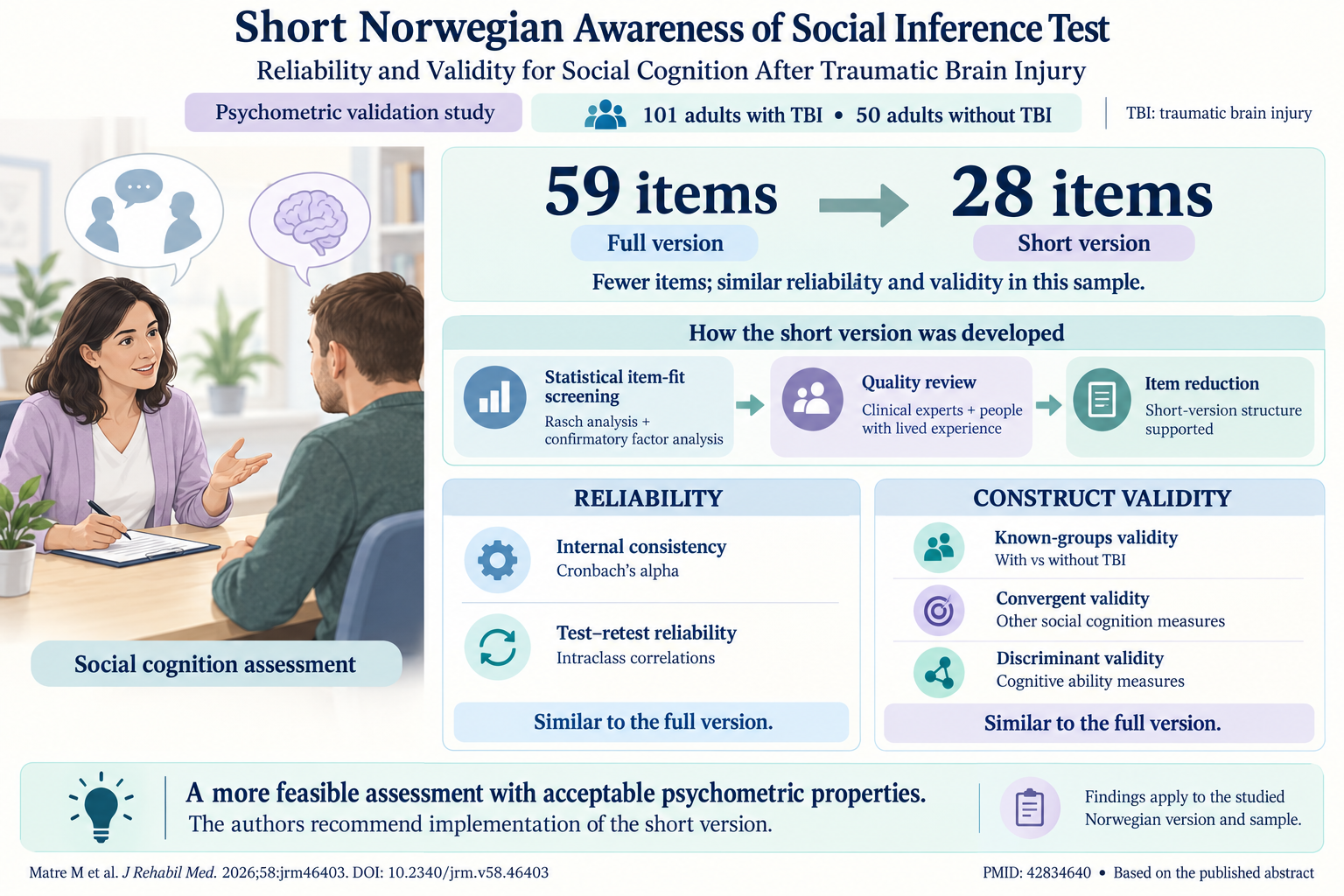
- A concise 28-item Norwegian version of the Awareness of Social Inference Test (TASIT) was developed to assess social cognition post-TBI.
- The short version retained comparable psychometric properties, including reliability and validity, to the original 59-item test.
- Statistical item reduction combined with expert and lived experience feedback enhanced clinical feasibility without sacrificing measurement quality.
- Implementation of the short version is recommended to streamline social cognitive evaluations in TBI rehabilitation settings.
Study Background
Traumatic brain injury (TBI) frequently results in social cognition impairments that significantly affect patients’ interpersonal functioning and quality of life. Social cognition encompasses the mental processes underpinning social interaction, including emotion recognition, theory of mind, and understanding social cues. Accurate assessment of these deficits is critical to tailor rehabilitation interventions and predict functional outcome.
The Awareness of Social Inference Test (TASIT) is a validated, ecologically valid tool widely used to evaluate social cognition, specifically the ability to interpret social cues in dynamic, everyday contexts. However, the original TASIT is lengthy, with 59 items, limiting its feasibility in clinical settings where time and patient stamina are constrained.
The study by Matre et al. addresses this gap by developing a Norwegian short version of TASIT optimized for patients with TBI. The rationale was to reduce administration burden while preserving the tool’s psychometric integrity, thus improving routine clinical assessment and monitoring of social cognitive deficits.
Study Design
This observational psychometric evaluation involved 101 adults with TBI and 50 controls without brain injury. Item reduction was undertaken through a multi-method approach combining quantitative and qualitative data:
- Statistical analyses identified items with poor fit based on Rasch modeling and confirmatory factor analysis.
- Clinical experts and persons with lived experience reviewed item relevance, clarity, and feasibility.
The resulting shortened 28-item TASIT version underwent rigorous testing for reliability—internal consistency (Cronbach’s alpha) and test-retest reliability (intraclass correlation coefficients)—and construct validity, including:
- Known-groups validity: comparing performances between TBI patients and controls.
- Convergent validity: correlating scores with other measures of social cognition.
- Discriminant validity: examining relationships with unrelated cognitive measures.
Key Findings
The statistical reduction process removed 31 of the original 59 items, resulting in a refined 28-item version supported by factor analysis confirming a coherent structure aligning with theoretical constructs of social cognition.
Reliability analyses demonstrated that the short TASIT retained strong internal consistency similar to the full version, with Cronbach’s alpha values indicative of reliable measurement. Test-retest reliability was excellent, with intraclass correlation values suggesting stable performance over time.
Construct validity was affirmed by significantly different scores between TBI patients and healthy controls, consistent with expected deficits in the patient group. Moderate to strong correlations with other social cognition measures supported convergent validity, while low correlations with cognitive domains unrelated to social cognition confirmed discriminant validity.
Importantly, the short version maintained sensitivity to detect clinically relevant social inference impairments, validating its utility as a practical clinical tool.
Expert Commentary
Experts in neurorehabilitation emphasize that streamlined assessment tools like the short TASIT are vital for improving implementation of comprehensive social cognitive evaluations in busy clinical environments. The combined approach of using advanced psychometric modeling alongside stakeholder feedback strengthens the tool’s relevance and acceptance.
Nevertheless, limitations include the need for replication in diverse populations and across different languages or cultural contexts. Future studies might explore the tool’s responsiveness to interventions and its prognostic utility in long-term social recovery post-TBI.
Conclusion
The Norwegian short version of TASIT represents a valid and reliable instrument that balances comprehensiveness with feasibility for clinical assessment of social cognition after TBI. Its adoption can facilitate more routine, accurate identification of social cognitive impairments, guiding targeted rehabilitation strategies and improving patient outcomes.
Overall, this work exemplifies rigorous test adaptation methods to meet real-world clinical constraints without compromising scientific quality, supporting better neuropsychological care post-injury.
Funding and ClinicalTrials.gov
The study did not specify funding sources or clinical trials registrations in the source abstract. Future research disclosures may provide further transparency regarding support and trial registration.
References
- Matre M, Johansen T, Martinsen ACT, et al. Reliability and validity of a short version of the Norwegian Awareness of Social Inference Test: a test of social cognition after traumatic brain injury. J Rehabil Med. 2026 Oct 6;58:jrm46403. doi:10.2340/16501977-46403. PMID: 42834640.
- McDonald S, Flanagan S, Rollins J, Kinch J. TASIT: A new clinical tool for assessing social perception after traumatic brain injury. J Head Trauma Rehabil. 2003;18(3):219-238.
- Green MF, Hellemann G, Horan WP, Lee J, Wynn JK. From perception to functional outcome in schizophrenia: modeling the role of ability and motivation. Arch Gen Psychiatry. 2012;69(12):1216-1224.