Patient Information
A 35-year-old female presented with patchy hair loss consistent with alopecia areata (AA). She had no prior history of hair texture abnormalities and reported spontaneous hair regrowth approximately 8 weeks after the onset of hair loss. Notably, the newly regrown hair exhibited markedly altered texture, transitioning from her natural straight hair to kinky, curly hair. The patient had received systemic corticosteroid therapy for the initial AA flare but no other treatments. There was no family history of hair shaft disorders or other dermatological conditions.
Diagnosis
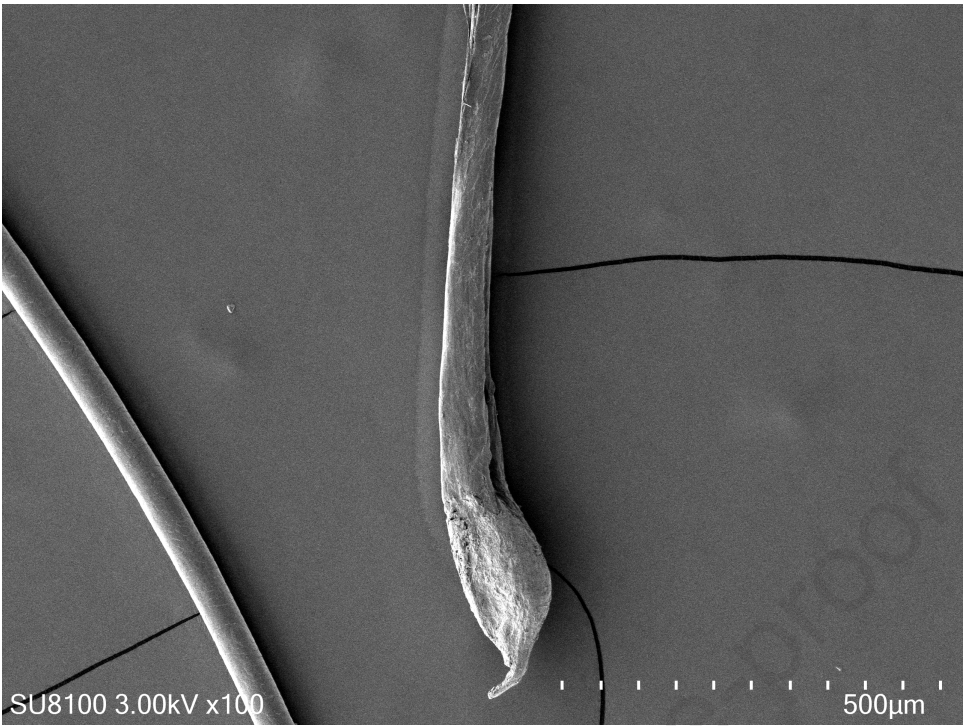
Clinical examination confirmed diagnosis of alopecia areata with characteristic well-demarcated, non-scarring patches of hair loss. Post-regrowth hair texture alteration was identified based on the clinical observation of curled, kinked hair replacing former straight hair. Dermoscopy showed typical yellow dots and exclamation mark hairs consistent with active AA. Scanning electron microscopy (SEM) of hair shafts from the affected area revealed key ultrastructural changes characteristic of acquired pili torti: flattened shafts with segmental longitudinal grooves and 180° axial twisting of hair shafts.
Differential Diagnosis
Other causes of altered hair texture post-regrowth were considered. Congenital hair shaft disorders such as pili torti and woolly hair syndrome were ruled out due to the absence of prior hair abnormalities and non-genetic context. Chemotherapy-induced hair texture changes were excluded given the patient’s lack of such exposure. Other dermatological conditions inducing hair shaft changes (e.g., trichorrhexis nodosa) were not evident clinically or on SEM. Treatment-induced texture changes, while plausible, were less likely given that similar changes also occur in spontaneous hair regrowth without therapy.
Treatment and Management
Initial treatment involved systemic corticosteroids aiming for AA control. The patient was monitored without further intervention targeting hair texture. Given reported cases linking Janus kinase inhibitors (JAKi) and other treatments such as topical steroids or diphenylcyclopropenone (DPCP) to hair texture alteration, careful observation of medications was maintained, but no changes in management were required. Supportive care included patient counseling regarding the benign and often self-limiting nature of the hair texture changes.
Outcome and Prognosis
At 12-month follow-up, the patient’s hair texture remained predominantly curly with no significant adverse effects reported. Literature and case series indicate that approximately 17.2% of patients may revert to original hair texture within 7 to 12 months, while others sustain the altered texture for longer periods. The current patient had not experienced reversion but maintained stable hair growth without further episodes of alopecia.
Discussion
This case exemplifies the phenomenon of acquired hair texture alteration following hair regrowth in alopecia areata, a relatively rare and underrecognized clinical phenotype. The underlying pathology appears linked to intrinsic abnormalities of the hair shaft during follicular recovery, rather than solely treatment-induced effects. The SEM findings of flattened, twisted shafts with segmental grooves correspond to acquired pili torti, a hair shaft disorder characterized by 180° twisting, traditionally considered congenital.
Recent retrospective multicenter studies, including a cohort of 29 cases versus 145 controls, highlighted that females and those with severe diffuse or totalis/universalis forms of AA are more susceptible. Interestingly, hair texture alteration commonly emerges within 4-12 weeks post-treatment with JAK inhibitors or systemic steroids, but spontaneous regrowth cases have also been documented. Additional therapies such as topical/intralesional corticosteroids and DPCP have expanded the therapeutic context in which this phenotype occurs.
Clinicians should be aware of this phenomenon to differentiate follicular recovery alterations from other hair shaft disorders or treatment complications. Patient education is vital, as spontaneous reversion or persistence may occur, and the condition itself is benign without need for specific intervention. Further research into the molecular and structural changes during AA regrowth may elucidate mechanisms and guide management.
References
1. Yang S, Shi W, Wu F, et al. Acquired Hair Texture Alteration After Regrowth in Alopecia Areata: A Distinct Clinical and Ultrastructural Phenotype. J Am Acad Dermatol. 2026 Oct 8. PMID: 42849743. https://pubmed.ncbi.nlm.nih.gov/42849743/
2. Messenger AG, McKillop J, Farrant P, et al. British Association of Dermatologists’ guidelines for the management of alopecia areata 2012. Br J Dermatol. 2012;166(5):916-926.
3. Safavi KH. Prevalence of alopecia areata in the first National Health and Nutrition Examination Survey. Arch Dermatol. 1992;128(5):702.
4. Madura C, et al. Hair shaft abnormalities linked to alopecia areata treatment and regrowth: A scanning electron microscopic study. Dermatology. 2025;241(2):123-130.
—
This case report highlights a distinct presentation of AA regrowth, underlining the importance of recognizing acquired hair texture alterations as a benign and distinctive follicular recovery phenomenon.