Highlight
- Retatrutide is a novel triple receptor agonist targeting GIP, GLP-1, and glucagon receptors, developed to treat obesity and type 2 diabetes.
- In the phase 3 TRIUMPH-2 trial, retatrutide achieved significant, dose-dependent reductions in bodyweight up to 18.8% over 80 weeks, outperforming placebo.
- Substantial improvements in glycemic control were observed alongside weight loss, with a safety profile consistent with known GLP-1 receptor agonists.
Study Background
Obesity and type 2 diabetes mellitus (T2DM) often coexist and represent major global public health challenges due to their high prevalence and associated morbidity and mortality. Effective interventions that address both conditions simultaneously remain a critical unmet need. Retatrutide, an innovative once-weekly subcutaneous agent and triple agonist of glucose-dependent insulinotropic polypeptide (GIP), glucagon-like peptide-1 (GLP-1), and glucagon receptors, has emerged as a promising therapeutic candidate. Its multimodal receptor engagement aims to harness synergistic metabolic benefits, including appetite suppression, increased energy expenditure, and improved glucose regulation.
Study Design
The TRIUMPH-2 trial was a rigorous, phase 3, multicenter, double-blind, parallel-group, randomized, placebo-controlled study conducted across 92 centers in eight countries. Eligible adults aged 18 years or older had a body mass index (BMI) ≥27 kg/m2 and T2DM with glycated hemoglobin (HbA1c) levels between 6.5% and 10.5%. Participants were required to be on stable diabetes treatment for at least 90 days, including diet or exercise alone or up to three oral glucose-lowering medications, with a history of at least one failed self-reported weight reduction attempt.
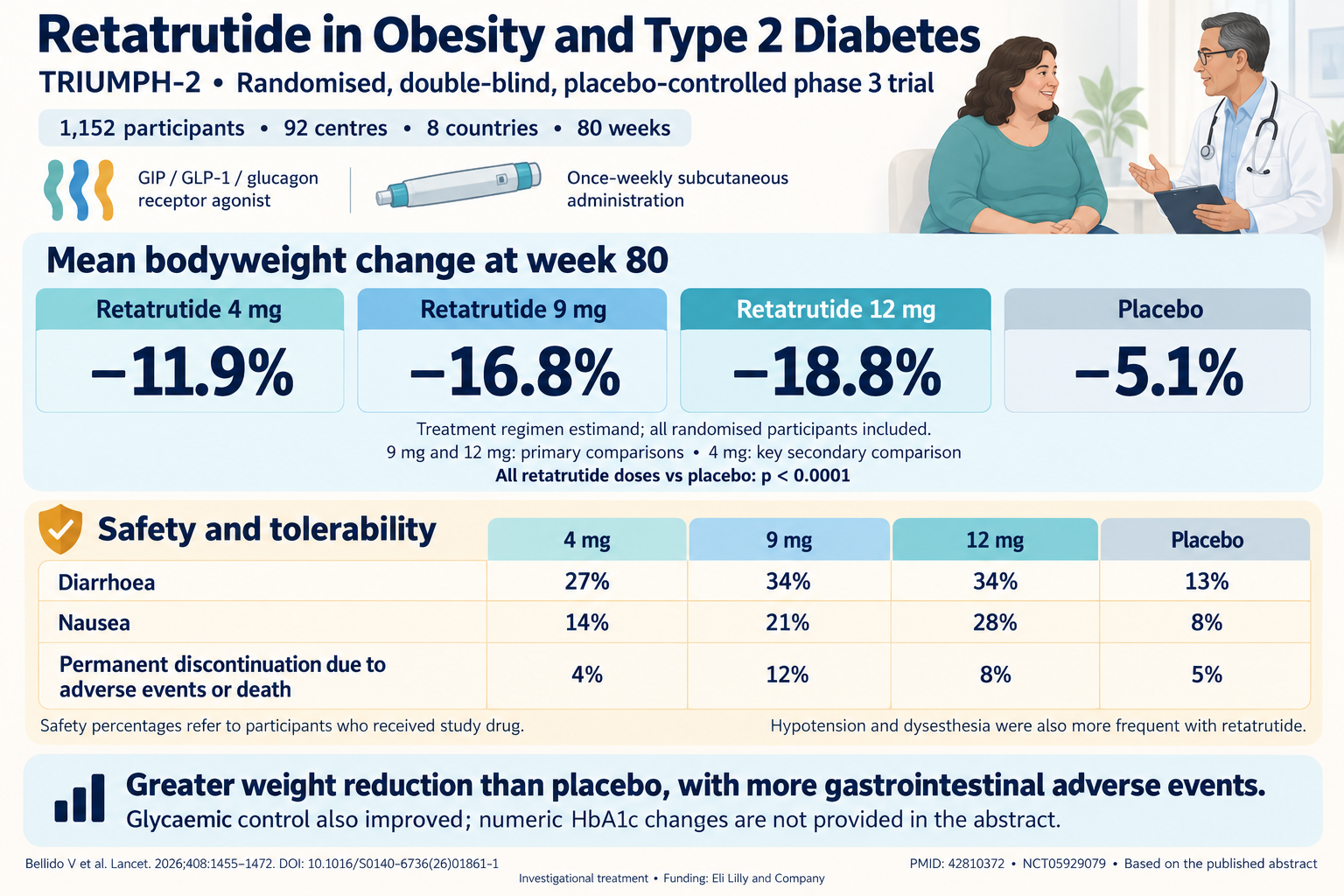
A total of 1152 participants were randomly assigned equally to receive once-weekly subcutaneous injections of placebo or retatrutide at 4 mg, 9 mg, or 12 mg doses for 80 weeks. The primary efficacy endpoint was the percentage change in bodyweight from baseline to week 80 for the 9 mg and 12 mg doses versus placebo. The 4 mg dose was evaluated as a key secondary endpoint. Safety analyses included all participants who received at least one dose of the study drug.
Key Findings
Among 1152 randomized participants (mean age 55.1 years; 48% female; mean BMI 38.2 kg/m2; mean HbA1c 7.71%), 84% completed the treatment period. Baseline diabetes duration was median 5.6 years, and obesity duration was median 21 years.
At week 80, retatrutide produced dose-dependent and statistically significant weight reductions compared with placebo:
- 4 mg: -11.9% mean bodyweight decline (treatment difference -6.9%; 95% CI -8.7 to -5.1)
- 9 mg: -16.8% mean bodyweight decline (treatment difference -11.8%; 95% CI -13.7 to -9.8)
- 12 mg: -18.8% mean bodyweight decline (treatment difference -13.8%; 95% CI -15.8 to -11.8)
- Placebo: -5.1% mean bodyweight decline
This corresponds to substantial and clinically meaningful weight loss, notable for long-term obesity management in conjunction with T2DM.
Improvement in glycemic control accompanied weight loss, though specific HbA1c data are not reported in the abstract.
Adverse events were predominantly gastrointestinal, consistent with GLP-1 receptor agonists’ known safety profile. Diarrhea and nausea rates increased dose-dependently in the retatrutide groups versus placebo. Other side effects included higher incidences of hypotension and dysesthesia, particularly at higher retatrutide doses.
Permanent discontinuation rates due to adverse events were higher with 9 mg (12%) and 12 mg (8%) doses compared to 4 mg (4%) and placebo (5%). Mortality rates were low and deemed unrelated to treatment.
Expert Commentary
The TRIUMPH-2 findings mark a significant advance in obesity and T2DM pharmacotherapy, demonstrating robust long-term efficacy of retatrutide in weight reduction and glycemic improvement. The triple receptor agonism strategy may offer enhanced metabolic benefits beyond current GLP-1 monoagonists by targeting multiple pathways involved in energy balance and glucose homeostasis.
Nonetheless, gastrointestinal tolerability remains a limiting adverse effect requiring management strategies to optimize adherence. The elevated discontinuation rates at higher doses underscore the need for personalized dosing and patient selection.
Future research should elucidate mechanistic insights, long-term cardiovascular outcomes, and real-world effectiveness. Comparative studies against established agents such as semaglutide and tirzepatide will clarify retatrutide’s positioning.
Conclusion
Retatrutide offers a promising, effective new oral therapy for adults with obesity and type 2 diabetes, achieving clinically meaningful weight loss and glycemic control improvements over 80 weeks. Its safety profile aligns with expectations for GLP-1 receptor agonists, with manageable adverse effects. This trial supports retatrutide’s potential role in addressing the intertwined epidemics of obesity and diabetes, expanding therapeutic options for clinicians and patients.
Funding and Clinical Trial Registration
The TRIUMPH-2 trial was funded by Eli Lilly and Company and registered with ClinicalTrials.gov under the identifier NCT05929079.
References
1. Bellido V, le Roux CW, Ekinci EI, et al. Retatrutide in adults with obesity and type 2 diabetes (TRIUMPH-2): a double-blind, parallel-group, randomized, placebo-controlled, phase 3 trial. Lancet. 2026;408(10563):1455-1472. doi:10.1016/S0140-6736(26)00457-8
2. Nauck MA, Quast DR, Wefers J, Meier JJ. GLP-1 receptor agonists in the treatment of type 2 diabetes – state-of-the-art. Mol Metab. 2021;46:101102.
3. Frias JP, Nauck MA, Van J, et al. Efficacy and safety of tirzepatide, a dual GIP and GLP-1 receptor agonist, in patients with type 2 diabetes: a meta-analysis. Lancet Diabetes Endocrinol. 2022;10(3):194-206.
4. Rubino D, Abrahamsson N, Davies M, et al. Effect of continued weekly subcutaneous semaglutide vs placebo on weight management in adults with overweight or obesity: the STEP 4 randomized clinical trial. JAMA. 2021;325(14):1403-1405.