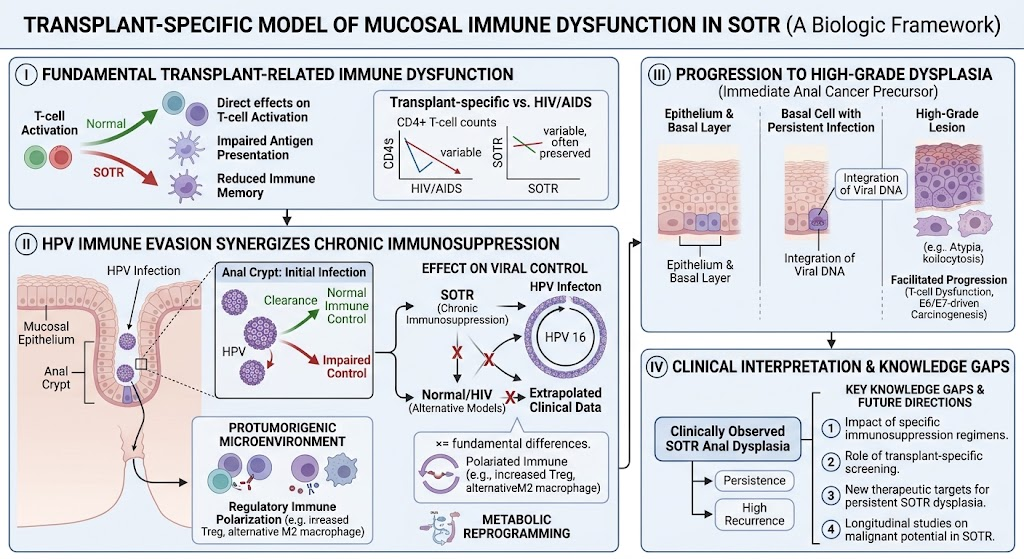
Highlight
- Solid organ transplant recipients (SOTRs) face an increased risk of HPV-associated anal cancer due to chronic immunosuppression.
- Transplant-related immune dysfunction fundamentally differs from HIV-associated immunosuppression, particularly in T-cell activation and antigen presentation.
- A transplant-specific model explains how HPV immune evasion and chronic immunosuppression promote a protumorigenic microenvironment fostering high-grade anal dysplasia.
- This framework identifies knowledge gaps and informs transplant-specific screening and therapeutic strategies for this vulnerable population.
Background: Clinical Context and Disease Burden
Solid organ transplantation is a life-saving intervention but necessitates lifelong immunosuppressive therapy to prevent graft rejection. These immunosuppressive regimens, while essential, impair host immune surveillance and control of viral infections, including human papillomavirus (HPV). HPV is a well-known etiologic agent in anogenital cancers, notably anal squamous cell carcinoma (SCC). The incidence of HPV-associated anal cancer is significantly elevated in immunocompromised populations such as HIV-infected individuals and SOTRs. However, unlike HIV infection, the immune defects induced by transplantation-related immunosuppression have distinct qualitative and quantitative features that influence HPV pathogenesis uniquely.
Epidemiological data demonstrate that SOTRs exhibit up to a 30-fold increased risk of anal cancer compared to the general population, with persistent anal HPV infection and recurrent anal dysplasia being common clinical challenges. Despite this increased risk, the natural history of anal HPV infection and progression from low-grade lesions to high-grade squamous intraepithelial lesions (HSIL) and invasive cancer in SOTRs remains poorly characterized. Present clinical management paradigms for anal dysplasia in SOTRs often rely on extrapolation from HIV-associated disease models, which may not fully capture the transplant-specific immune landscape.
Study Design and Population Context
This article provides a comprehensive review and proposes a novel theoretical model rather than presenting primary research data. It synthesizes current knowledge from HPV-driven carcinogenesis, HIV-associated anal disease, and transplant immunology literature to delineate the pathobiological mechanisms underpinning anal dysplasia in solid organ transplant recipients.
The population focus is on adult SOTRs under chronic immunosuppressive therapy, encompassing kidney, liver, heart, and lung transplant recipients. The immune alterations induced by standard regimens—usually based on calcineurin inhibitors, antiproliferatives, and corticosteroids—serve as a backdrop to explore their impact on mucosal immune regulation and HPV control.
Key Findings and Proposed Model
The authors conceptualize a transplant-specific model of mucosal immune dysfunction highlighting several convergent mechanisms by which chronic immunosuppression and HPV immune evasion synergize to promote persistent infection and dysplasia progression:
- Altered T-cell function: Immunosuppressants impair T-cell activation, proliferation, and differentiation, resulting in diminished cytotoxic CD8+ T-cell responses critical for HPV clearance and surveillance of dysplastic transformation.
- Impaired antigen presentation: Reduced function of dendritic cells and disrupted major histocompatibility complex (MHC) expression hamper effective HPV antigen recognition and adaptive immune priming.
- Immune regulatory polarization: The mucosal milieu in SOTRs may shift toward regulatory T-cell dominance and anti-inflammatory cytokine profiles, tipping the balance toward tolerance of infected and transformed cells.
- Metabolic reprogramming: Immunosuppressive drugs induce metabolic changes in immune cells that further diminish antiviral activity and sustain a microenvironment conducive to oncogenesis.
This multifaceted immune dysfunction creates a protumorigenic microenvironment characterized by persistent HPV infection, accumulation of oncogenic viral proteins, and facilitation of genomic instability and cellular transformation. Consequently, SOTRs often experience higher rates of persistence, recurrence, and progression of anal HSIL compared to non-immunosuppressed individuals.
Comparisons with HIV-associated Anal Disease
Although both HIV-infected individuals and SOTRs share increased anal cancer risk from impaired immunity, the mechanisms differ notably. HIV infection leads to profound CD4+ T-cell depletion, chronic immune activation, and microbial translocation, whereas SOTRs have targeted immunosuppression affecting T-cell activation and antigen presentation pathways without systemic viral infection. Hence, clinical management strategies derived from HIV studies may not be fully applicable, underscoring the need for transplant-specific risk stratification and interventions.
Expert Commentary and Clinical Implications
This conceptual framework advances our understanding of HPV-associated anal dysplasia in SOTRs, providing biological plausibility for clinical observations such as high recurrence rates post-treatment and challenges in lesion clearance. It also highlights the importance of transplant-specific screening protocols tailored to the unique immune environment.
Current guidelines for anal cancer screening and management in SOTRs are limited and often adapted from HIV or general population protocols. This model supports the rationale for enhanced surveillance, including high-resolution anoscopy and HPV genotyping, coupled with immunologically informed therapeutic approaches, possibly integrating immune modulation or therapeutic vaccines targeting mucosal HPV infection.
Future research should focus on longitudinal studies to delineate the natural history of anal HPV infection in SOTRs, immunophenotyping of mucosal immune cells, and clinical trials assessing the efficacy and safety of novel interventions within this population. Challenges in transplant immunosuppression adjustment to balance graft survival and cancer risk also warrant further exploration.
Conclusion
Solid organ transplant recipients are a high-risk group for HPV-associated anal dysplasia and cancer due to unique transplant-related mucosal immune dysfunction. The proposed transplant-specific model elucidates how chronic immunosuppression impairs antiviral immunity, synergizing with HPV immune evasion to drive persistent infection and lesion progression. This integrated framework offers critical insights to guide more effective screening, prevention, and treatment strategies designed for the transplant setting. Addressing these gaps is essential to reduce the burden of HPV-related anal neoplasia and improve long-term outcomes in this vulnerable population.
Funding and Clinical Trials
The article under discussion does not specify funding sources or active clinical trials. Future translational studies in this area should seek support from transplantation, oncology, and infectious disease research foundations. Clinicians are encouraged to consult clinicaltrials.gov for ongoing trials targeting HPV-related diseases in immunocompromised hosts.
References
1. Cachay ER, Mishra N, Vikram HR, Nagarakanti S, Alasfar S, Wu C, Anderson KS. HPV-associated Anal Dysplasia in Solid Organ Transplant Recipients: A Transplant-specific Model of Mucosal Immune Dysfunction. Transplantation. 2026 Aug 27; PMID: 42649556.
2. Park IU, Palefsky JM. Anal cancer prevention in HIV-positive men and women. Curr Opin HIV AIDS. 2010;5(1):82-8.
3. D’Souza G, Wiley DJ, Li X, et al. Incidence and epidemiology of anal cancer in the multicenter AIDS cohort study. J Acquir Immune Defic Syndr. 2008;48(4):491-9.
4. Rabkin CS, Biggar RJ, Goedert JJ. Cancer risk in children with AIDS. J Natl Cancer Inst. 1992;84(9):657-60.
5. Werness BA, Levine AJ, Howley PM. Association of human papillomavirus types 16 and 18 E6 proteins with p53. Science. 1990.
6. Suneja G, Silverberg MJ, Ssekasanvu J, et al. Impact of Host Immunity on Human Papillomavirus Infection and Associated Diseases Among Solid Organ Transplant Recipients. Curr Opin Infect Dis. 2017;30(1):68-75.
7. Skrip L, Warrener L, Boczar D, et al. Immunosuppressive Drug Regimens and the Risk of HPV-associated Malignancies in Solid Organ Transplant Recipients. Front Immunol. 2021;12:755964.