Highlight
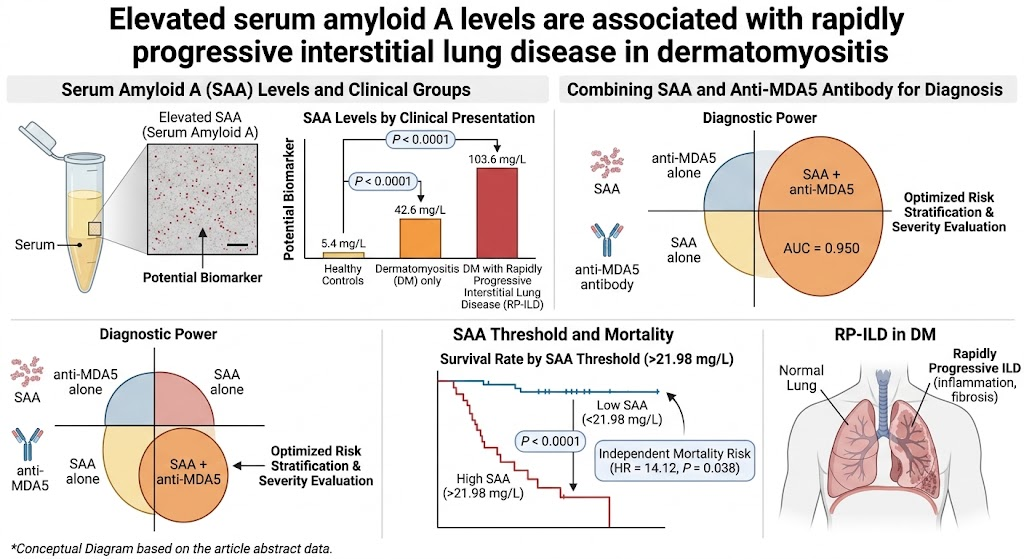
– Serum amyloid A (SAA) levels are significantly elevated in dermatomyositis (DM) patients, especially those with rapidly progressive interstitial lung disease (RP-ILD).
– Elevated SAA independently associates with the presence of RP-ILD and predicts higher mortality risk.
– Combined use of SAA and anti-MDA5 antibody testing enhances diagnostic accuracy for RP-ILD and facilitates better disease severity assessment.
– SAA threshold above 21.98 mg/L strongly correlates with poorer survival, underscoring its utility as a prognostic biomarker.
Study Background
Dermatomyositis (DM) is a systemic autoimmune disease characterized by muscle inflammation and distinctive skin manifestations. A particularly severe complication is rapidly progressive interstitial lung disease (RP-ILD), which precipitates a high mortality rate and complicates therapeutic management. Early identification of patients at risk for RP-ILD remains a clinical challenge due to the lack of effective and widely available biomarkers. Serum amyloid A (SAA), an acute-phase protein, has emerged in recent literature as a potential biomarker reflecting systemic inflammation and disease activity in various autoimmune conditions. Its role in predicting RP-ILD progression and mortality in DM patients, however, remains inadequately elucidated. This retrospective cohort study sought to investigate the association between elevated SAA levels and RP-ILD incidence and outcomes in DM, aiming to define a clinically relevant biomarker for risk stratification.
Study Design
This single-center retrospective cohort study measured SAA levels by scattering turbidimetry in patients diagnosed with dermatomyositis. A control group of healthy individuals was included for baseline comparison. The study examined the correlation between SAA and other serological markers via Spearman’s correlation analysis. Receiver operating characteristic (ROC) curve analysis defined optimal diagnostic thresholds for RP-ILD. The prognostic value of elevated SAA levels was evaluated using Cox proportional hazards models adjusted for confounders to identify independent mortality predictors. The study also assessed the diagnostic performance of combined SAA and anti-MDA5 antibody testing.
Key Findings
SAA concentrations were markedly higher in DM patients (mean 37.71 ± 6.93 mg/L) compared to healthy controls (5.42 ± 0.30 mg/L; P 21.98 mg/L was strongly predictive of poor survival outcomes, with significant differences in survival curves (P 21.98 mg/L independently predicted mortality (hazard ratio = 14.12; 95% CI: 1.16–171.33; P = 0.038), reinforcing its prognostic relevance.
Expert Commentary
These findings align with previous reports implicating acute-phase reactants as surrogates for immune activation in DM and other inflammatory myopathies. SAA may reflect ongoing lung injury and systemic inflammation that precedes clinical deterioration in RP-ILD, allowing timely intervention. While anti-MDA5 antibody is a well-known marker of RP-ILD risk, combining it with SAA measurement refines risk assessment given the high negative predictive value of conventional serology alone.
However, the study’s retrospective, single-center design and modest sample size limit generalizability, necessitating validation in larger, prospective cohorts. Variability in SAA assays and confounding inflammatory conditions may also affect specificity. Future research should clarify mechanistic links between SAA elevation and lung fibrosis progression, potentially establishing SAA as a therapeutic target.
Conclusion
Elevated serum amyloid A levels serve as a significant biomarker associated with rapidly progressive interstitial lung disease and mortality in dermatomyositis patients. The combined assessment of SAA and anti-MDA5 antibody markedly improves risk stratification and disease severity evaluation. These insights support the integration of SAA measurement into clinical workflows to identify high-risk individuals who may benefit from intensified monitoring and early therapeutic interventions.
Funding and ClinicalTrials.gov
The study details did not specify funding sources or clinical trial registrations. Future well-powered prospective studies are warranted to validate SAA’s prognostic role in dermatomyositis-associated RP-ILD.
References
1. Shih Y, Hu J, Huang J, Shao X, Wu C, Diao L, et al. Elevated serum amyloid A levels are associated with rapidly progressive interstitial lung disease in dermatomyositis: a retrospective cohort study. J Am Acad Dermatol. 2026 Aug 27; PMID: 42660429.
2. Fiorentino DF, Chung L, Christopher-Stine L, et al. The mucocutaneous and systemic phenotype of dermatomyositis patients with antibodies to MDA5. Arthritis Rheumatol. 2011;63(11):3645-3653.
3. Gono T, Sato S. Interstitial lung disease in patients with polymyositis and dermatomyositis. Expert Rev Clin Immunol. 2010;6(3):401-410.
4. Honda M, Kuwana M. Management of patients with anti-MDA5 antibody-positive dermatomyositis. Rheumatology. 2021;60(S5):v15-v22.