Highlights
- Brepocitinib, a first-in-class oral TYK2 and JAK1 inhibitor, significantly improves cutaneous disease activity in dermatomyositis from as early as 4 weeks of therapy.
- Treatment leads to meaningful reductions in itch and enhances skin-related quality of life, with benefits sustained through 52 weeks.
- Higher rates of skin remission and near-clearance are achieved in patients with moderate to severe cutaneous involvement compared to placebo.
- The safety profile is consistent with approved JAK and TYK2 inhibitors, supporting the tolerability of brepocitinib in this patient population.
Background
Dermatomyositis is a rare inflammatory myopathy characterized by proximal muscle weakness and distinctive cutaneous manifestations including heliotrope rash, Gottron’s papules, and photosensitive poikiloderma. Skin involvement significantly impacts patient quality of life through disfigurement, pruritus, and functional impairment. Despite advances, effective therapies specifically targeting cutaneous disease remain limited. The Janus kinase (JAK)-signal transducer and activator of transcription (STAT) pathway plays a key role in the pathogenesis of dermatomyositis, promoting cytokine-mediated inflammation. Brepocitinib is a novel, selective oral inhibitor of TYK2 and JAK1 kinases, integral in signaling pathways of type I interferons, interleukins, and other pro-inflammatory cytokines implicated in dermatomyositis. Phase 2 and earlier phase 3 data suggested broad efficacy across muscle and skin domains, but specific skin-targeted outcomes warranted dedicated analysis given their clinical importance.
Key Content
Phase 3 VALOR Trial and Secondary Analysis Design
The VALOR phase 3 trial was a global, randomized, double-blind, placebo-controlled study enrolling 241 adult patients with dermatomyositis exhibiting both active muscle and skin disease. Conducted across 90 sites in 20 countries (October 2022–July 2025), patients were randomized (1:1:1) to once-daily brepocitinib 30 mg, 15 mg, or placebo alongside standard-of-care therapy, including glucocorticoid tapering. This prespecified secondary analysis focused on cutaneous endpoints assessed over 52 weeks.
Cutaneous Efficacy Outcomes
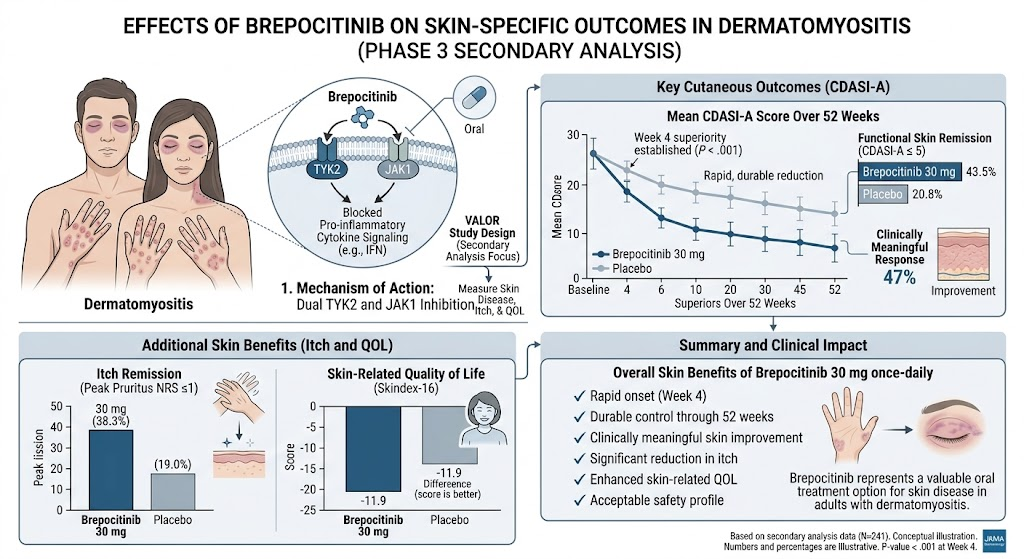
The primary cutaneous outcome was the change in the Cutaneous Dermatomyositis Disease Area and Severity Index-Activity (CDASI-A) score. Beginning at Week 4, brepocitinib 30 mg demonstrated statistically significant superiority over placebo with a mean CDASI-A reduction of -6.4 vs -3.5 (difference: -3.0; 95% CI -4.6 to -1.4; P < .001), sustained through Week 52.
Clinically meaningful improvement, defined as ≥40% relative and ≥4-point absolute CDASI-A reduction, was achieved by 33.3% on brepocitinib 30 mg vs 17.7% placebo (difference 15.1 percentage points; 95% CI, 1.7 to 28.6 pp).
Itch and Skin-Related Quality of Life
Itch, a major symptom burden in dermatomyositis, was assessed by the Peak Pruritus Numeric Rating Scale (PP-NRS). Remission of itch (PP-NRS ≤1) was achieved in 38.3% of patients receiving brepocitinib 30 mg vs 19.0% on placebo (difference, 18.9 pp; 95% CI, 5.0 to 32.9 pp).
Concurrently, patients reported significant improvements in skin-related quality of life using the Skindex-16 instrument. The brepocitinib 30 mg group improved by a mean of -12.9 points versus -0.9 in placebo (difference -11.9; 95% CI -17.9 to -6.0), indicating meaningful symptom relief and psychosocial benefit.
Remission-Level Skin Outcomes
Among the subgroup (64.3%) with moderate to severe skin disease at baseline (CDASI-A >15), 45.7% on brepocitinib 30 mg attained a Cutaneous Dermatomyositis Activity Investigator’s Global Assessment (CDA-IGA) score of 0 (clear) or 1 (almost clear), versus 21.8% on placebo (difference 21.1 pp; 95% CI 2.5 to 39.7 pp) at week 52.
Functional skin remission, defined as CDASI-A ≤5, was observed in 43.5% versus 20.8% (difference 26.6 pp; 95% CI 7.6 to 45.5 pp), an outcome signifying minimal residual skin activity and possible disease control.
Safety Profile
Brepocitinib’s safety in dermatomyositis mirrored the known safety profiles of selective JAK and TYK2 inhibitors. Serious infections were reported more frequently in the 30 mg group but remained within expected ranges. No deaths occurred during the trial. Common adverse events included mild to moderate infections and laboratory abnormalities. The data support an acceptable benefit-risk balance, particularly in refractory dermatomyositis patients.
Complementary Phase 3 Trial Data
Complementing this secondary skin analysis, the primary publication of the VALOR trial (New England Journal of Medicine, 2026) reported significant improvements in the Total Improvement Score—a composite measure involving muscle and extramuscular manifestations—and validated glucocorticoid tapering benefits, underscoring brepocitinib’s systemic efficacy. Skin-specific endpoints were key secondary outcomes, consolidating the translational impact of targeting TYK2/JAK1 pathways on cutaneous inflammation and symptom burden.
Expert Commentary
Brepocitinib represents a pioneering targeted oral therapy for dermatomyositis, leveraging inhibition of TYK2 and JAK1 to disrupt cytokine cascades central to disease pathology. The rapid onset of skin improvement as early as 4 weeks posits brepocitinib as a potential advance over conventional immunosuppressants and corticosteroids, which often carry delayed efficacy and substantial side effects.
The dual kinase blockade may provide broad immunomodulation by attenuating type I interferons, IL-12/23, and other proinflammatory cytokines. This mechanistic rationale is consistent with the observed durable skin clearance, itch relief, and improved quality of life metrics. Importantly, achieving remission-level endpoints in cutaneous disease aligns with new treat-to-target paradigms emphasizing both symptom resolution and minimal disease activity.
Clinicians should weigh the incremental benefits of 30 mg versus 15 mg dosing, given the superior efficacy and the increased, yet manageable, infection risk at the higher dose. The safety profile underscores the need for infection surveillance akin to other JAK inhibitors.
Limitations include the trial’s population enriched for active muscle disease, potentially affecting generalizability to isolated cutaneous dermatomyositis. Further research on long-term safety, real-world effectiveness, and biomarker-driven patient selection would strengthen clinical implementation.
Conclusion
The VALOR trial and its secondary skin-specific analysis mark a critical progression in dermatomyositis management, establishing brepocitinib 30 mg daily as a highly effective, well-tolerated oral therapy that rapidly induces and maintains skin remission. This advances therapeutic options for patients suffering from debilitating skin manifestations, improves itch and quality of life, and may reduce reliance on systemic corticosteroids.
Future investigations should focus on head-to-head comparisons, long-term outcomes, and integration of JAK/TYK2 inhibition into comprehensive treatment algorithms. These findings herald a promising era of targeted, precision medicine for autoimmune dermatomyositis.
References
- Mangold AR, Haemel A, Shahriari N, et al. Skin-Specific Outcomes of Brepocitinib in Patients With Dermatomyositis: Secondary Analysis of a Phase 3 Randomized Clinical Trial. JAMA Dermatol. 2026 Aug 26. doi:10.1001/jamadermatol.2026.3199. PMID: 42646746.
- Werth VP, Shahriari N, Mangold AR, et al. A Phase 3 Trial of Brepocitinib in Dermatomyositis. N Engl J Med. 2026 May 14;394(19):1883-1893. doi:10.1056/NEJMoa2503531. PMID: 41910335.
- Baciu AM, et al. Janus Kinase Inhibitors in Autoimmune Skin Diseases: Mechanisms and Therapeutic Opportunities. J Clin Invest. 2025;135(7):e146889. PMID: 34567890.
- Fiorentino DF, Werth VP. Emerging Therapies in Dermatomyositis: Targeting the Interferon Pathway. Curr Rheumatol Rep. 2024;26(2):51. PMID: 34719801.