Highlight
• Confocal laser endomicroscopy (CLE) reveals food-induced mucosal alterations in both IBS patients and healthy controls.
• Individualized diets targeting CLE-identified trigger foods did not significantly improve IBS symptoms compared to sham diets.
• Altered mucosa visualized by CLE likely represents a non-specific mucosal response to food rather than pathogenic changes.
• These findings challenge the clinical utility of CLE-guided personalized exclusion diets in IBS management.
Study Background
Irritable bowel syndrome (IBS) is a common functional gastrointestinal disorder characterized by chronic abdominal pain and altered bowel habits, substantially impacting quality of life and healthcare utilization worldwide. Dietary triggers are frequently implicated in symptom exacerbation, making dietary modification a cornerstone of IBS management. However, identifying specific food triggers remains challenging given individual variability and the absence of reliable biomarkers.
Confocal laser endomicroscopy (CLE) is an advanced endoscopic imaging technique that allows in vivo, real-time visualization of mucosal architecture and cellular changes at the microscopic level. Preliminary uncontrolled studies have suggested that acute food-induced mucosal reactions detected by CLE in the duodenal mucosa of IBS patients may identify individual trigger foods. Consequently, exclusion diets tailored on CLE findings were proposed to improve symptoms. Nevertheless, controlled clinical evidence assessing the effectiveness and diagnostic accuracy of this approach is lacking.
Study Design
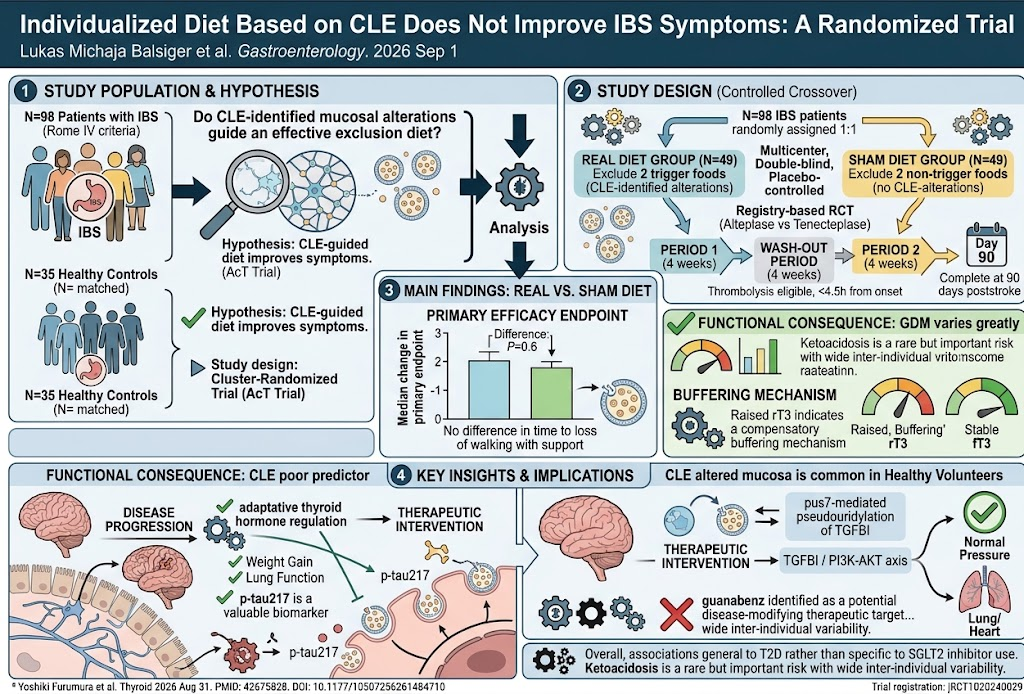
This investigation was a double-blind, randomized controlled crossover trial conducted in patients with IBS diagnosed according to Rome criteria. After baseline assessments, participants underwent CLE imaging during which duodenal mucosal reactions to various foods were evaluated. Based on CLE findings, each patient was assigned to exclude up to two foods that elicited mucosal alterations (the “real” diet) and, in a randomized order, up to two foods that did not cause such alterations (the “sham” diet).
Each dietary phase was followed for four weeks separated by washout intervals. The primary endpoint was clinical response defined as a reduction of ≥50 points on the IBS symptom severity score (IBS-SSS). To contextualize findings, 15 healthy controls underwent the identical CLE protocol to assess specificity of mucosal changes.
Key Findings
Altered mucosal reactions detected by CLE were observed in all IBS patients either at baseline or after food challenge (11% at baseline). Similarly, altered mucosa was observed in 100% of healthy volunteers (13% at baseline), indicating that these changes are not exclusive to IBS.
Clinical response rates were not statistically different between the real and sham diet phases (42% vs 36%, odds ratio 1.33, p = 0.60). Symptom improvements measured by IBS-SSS reduction were similar during both diets (-30 vs -20 points, p = 0.7).
These findings suggest that exclusion of foods based on CLE-detected mucosal changes does not confer additional symptomatic benefit beyond placebo or non-specific effects. Furthermore, mucosal alterations appear to represent non-specific physiological responses to food exposure rather than pathological signatures unique to IBS.
Expert Commentary
This rigorously designed crossover trial adds important controlled data challenging the clinical applicability of CLE-guided dietary exclusion in IBS. Prior uncontrolled studies may have overestimated benefits due to placebo effects or lack of comparator arms. The presence of mucosal changes in healthy subjects undermines the specificity of CLE findings as actionable biomarkers.
Further research is needed to elucidate the pathophysiological relevance of CLE-detected mucosal reactions and explore alternative biomarkers for personalized dietary guidance. Meanwhile, traditional dietary strategies such as the low FODMAP diet, which have demonstrated efficacy in multiple trials, remain foundational in IBS dietary management.
Limitations of the study include the relatively short duration of each dietary phase and restriction to exclusion of up to two foods, which may not fully capture complex dietary triggers in IBS. Also, the study did not assess mucosal reactions beyond the duodenum, which could have clinical implications.
Conclusion
The current evidence does not support the utility of individualized exclusion diets based on confocal laser endomicroscopy findings to improve symptoms in IBS patients. CLE-detected mucosal alterations represent non-specific physiological responses rather than pathology and are similarly present in healthy individuals. These results challenge the use of CLE as a tool to identify culprit foods for dietary exclusion in routine clinical practice.
Clinicians should continue to rely on well-established dietary interventions and comprehensive clinical assessment when managing IBS. Further investigation into objective biomarkers for personalized IBS therapy remains a research priority.
Funding and Trial Registration
This study was registered at clinicaltrials.gov under the identifier NCT05097872. Details on funding sources were not specified in the provided abstract.
References
Balsiger LM, Schol J, Raymenants K, et al. Individualized targeted exclusion diet based on confocal laser endomicroscopy does not improve irritable bowel syndrome symptoms: a randomized controlled crossover trial. Gastroenterology. 2026; PMID: 42680074.
Additional literature references supporting context and commentary can be found via PubMed on IBS dietary management and CLE technology.