Highlight
- Achalasia markedly increases the risk of esophageal squamous cell carcinoma with an odds ratio exceeding 9, independent of smoking and alcohol consumption.
- There is a moderate association between achalasia and esophageal adenocarcinoma, which diminishes after adjusting for gastroesophageal reflux disease.
- Interventions for achalasia such as myotomy or dilation correlate with an even stronger risk elevation for squamous cell carcinoma but not for adenocarcinoma after GERD adjustment.
- This large population-based study leverages comprehensive national registries across five Nordic countries over several decades, providing robust epidemiologic evidence.
Study Background
Achalasia is a rare esophageal motility disorder characterized by impaired relaxation of the lower esophageal sphincter and absent peristalsis, leading to functional obstruction. Clinically, it manifests with progressive dysphagia, regurgitation, and sometimes chest pain. Beyond symptomatic distress, achalasia patients have long been suspected to be at increased risk of esophageal cancer, especially squamous cell carcinoma (SCC), possibly due to chronic stasis and inflammation. However, prior studies addressing this risk were limited by small sample sizes and lack of adjustments for major carcinogenic confounders such as tobacco and alcohol use.
Esophageal adenocarcinoma (EAC) epidemiology relates primarily to gastroesophageal reflux disease (GERD) and Barrett’s esophagus. The potential impact of achalasia on EAC risk remains unclear, given the conflicting interplay between achalasia-induced hypomotility and the reflux-driven carcinogenesis pathway. This substantial multinational cohort study was designed to clarify the association of achalasia with the two major esophageal cancer histologies, adjusting for key confounders including smoking, alcohol, and GERD.
Study Design
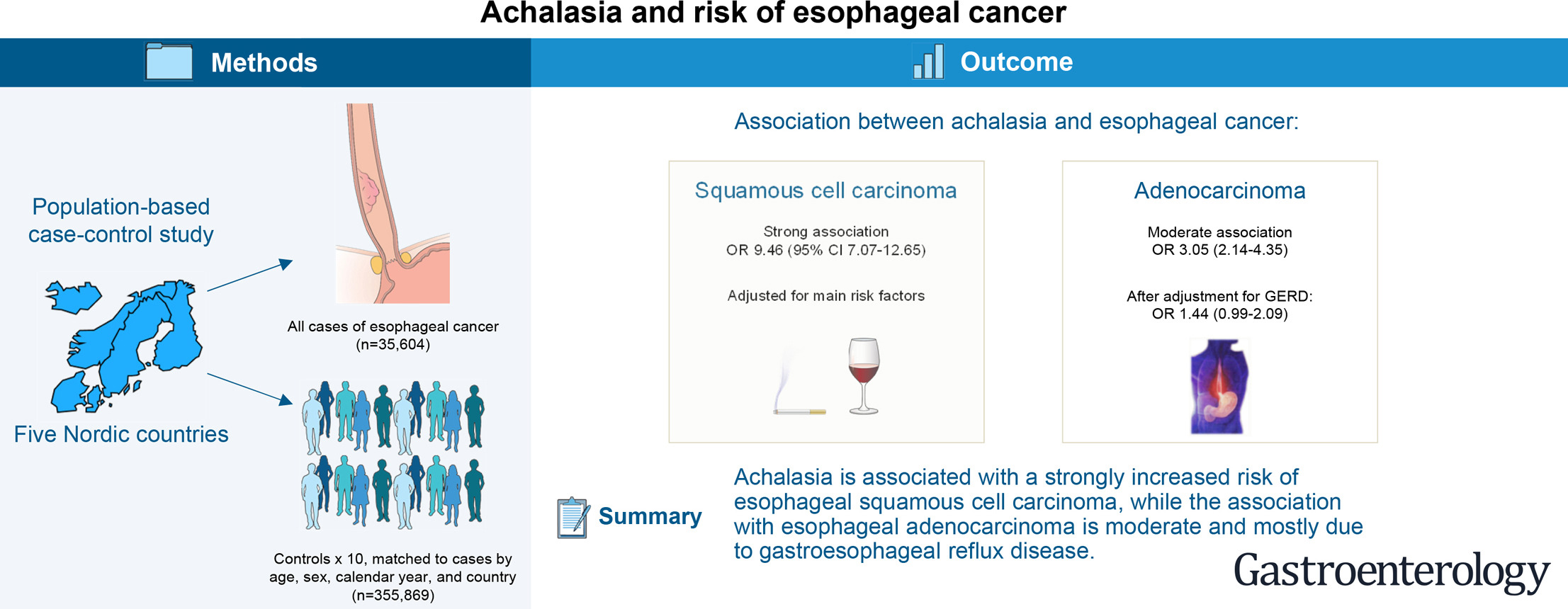
This was a large, population-based case-control study utilizing comprehensive national health registries across five Nordic countries (Denmark, Finland, Iceland, Norway, and Sweden) from 1987 to 2023. A total of 35,604 esophageal cancer cases were identified and matched to 355,869 controls at a ratio of 1:10 by age, sex, calendar year, and country. Data on history of achalasia, smoking, alcohol overconsumption, and GERD were retrieved from national health registries, ensuring reliable clinical capture.
Conditional logistic regression models were employed to estimate odds ratios (ORs) for esophageal cancer subtypes in relation to prior achalasia diagnoses. Analyses adjusted sequentially for smoking and alcohol to address known SCC risk factors and additionally for GERD to elucidate mechanistic pathways for EAC.
Key Findings
The study population included 137 individuals with achalasia among cases (96 SCC, 41 EAC) and 230 among controls (99 SCC, 131 EAC). The primary finding was a very strong association between achalasia and esophageal SCC: adjusted OR 9.46 (95% CI, 7.07-12.65). This indicates nearly a tenfold increased risk independent of smoking and alcohol exposure.
For esophageal adenocarcinoma, achalasia conferred a moderate risk elevation with adjusted OR 3.05 (95% CI, 2.14-4.35) before GERD adjustment. However, after including GERD in the model—a known major risk factor for EAC—the association attenuated substantially to OR 1.44 (95% CI, 0.99-2.09), rendering it not statistically significant. This suggests that any observed increased risk for adenocarcinoma in achalasia patients is largely mediated via concomitant GERD.
Further stratification by achalasia treatment revealed that patients who had undergone myotomy or pneumatic dilation exhibited an even stronger association with esophageal SCC (OR 16.33; 95% CI, 11.26-23.67), pointing to a possible influence of disease severity or intervention-related factors on cancer risk. No significant increased risk was found for adenocarcinoma after GERD adjustment in this treated group (OR 1.32; 95% CI, 0.76-2.30).
Expert Commentary
This study represents one of the most comprehensive epidemiologic investigations into the cancer risks associated with achalasia, leveraging large-scale, longitudinal data with robust confounder control. The findings confirm a strikingly increased risk for esophageal SCC that persists despite accounting for classical risk factors like smoking and alcohol, underscoring the intrinsic carcinogenic potential of achalasia pathology—possibly due to chronic food stasis, esophageal inflammation, and mucosal injury.
The modest link between achalasia and adenocarcinoma risk appears to be driven predominantly by overlapping gastroesophageal reflux disease, known to coexist or emerge post-achalasia intervention. This distinction is clinically important because surveillance and management strategies should be tailored accordingly, emphasizing vigilant SCC screening in achalasia patients.
Limitations include potential residual confounding from unmeasured lifestyle factors or disease severity markers. Also, registry-based diagnoses may differ in sensitivity and specificity across countries. Nonetheless, the multinational design enhances generalizability across diverse populations.
Mechanistically, chronic stasis-induced irritative injury favors squamous epithelial transformation, whereas reflux-driven Barrett’s esophagus underlies adenocarcinoma pathogenesis. Achalasia may indirectly increase reflux after treatment, explaining the attenuated adenocarcinoma risk upon GERD adjustment.
Conclusion
Achalasia confers a substantial and independent increase in the risk of esophageal squamous cell carcinoma, highlighting the need for careful cancer surveillance in this patient group. While achalasia is also associated with esophageal adenocarcinoma, this relationship appears to be mediated chiefly by coexistent gastroesophageal reflux disease. These distinctions inform risk stratification and surveillance strategies, emphasizing tailored approaches based on histological cancer risk profiles. Future investigations should explore optimal screening modalities and the impact of achalasia treatments on modifying cancer risk.
Funding and ClinicalTrials.gov
The original publication does not report specific funding sources or clinical trial registration data. The multinational registry-based study was conducted under the auspices of participating Nordic health authorities and academic institutions.
References
1. Leijonmarck W, Santoni G, Holmberg D, Spechler S, von Euler-Chelpin M, Birgisson H, Ness-Jensen E, Kauppila JH, Lagergren J. Achalasia and Risk of Esophageal Squamous Cell Carcinoma and Adenocarcinoma in a Multinational Study. Gastroenterology. 2026 Apr 20;171(3):481-488. PMID: 42019768.
2. Spechler SJ. Achalasia and esophageal cancer: the chicken, the egg, and the snake. Am J Gastroenterol. 2012;107(1):104-106.
3. Sharma P, Falk GW. Barrett’s esophagus and esophageal adenocarcinoma: pathogenesis and clinical management. Gastroenterology. 2023;164(1):8-17.
4. Boeckxstaens GE, Zaninotto G. Achalasia. Lancet. 2020;396(10260):839-851.
5. Lagergren J, Bergström R, Nyren O. Adult-onset achalasia and risk of esophageal cancer. N Engl J Med. 1999;341(24):1786-1790.
6. Katzka DA. Achalasia: clinical presentation and diagnosis. Clin Gastroenterol Hepatol. 2019;17(10):1820-1828.