Highlight
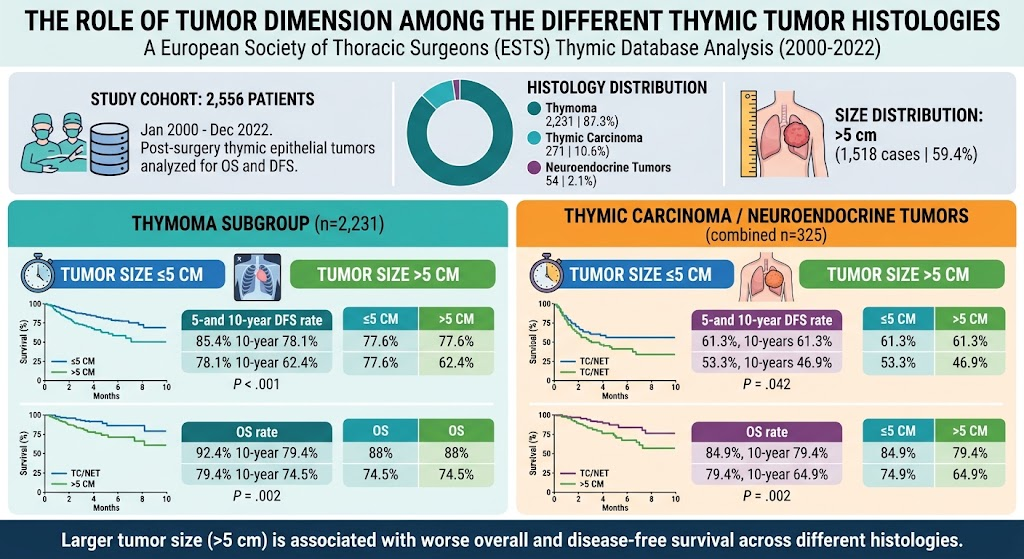
This comprehensive study from the European Society of Thoracic Surgeons (ESTS) thymic database establishes tumor size as a vital prognostic factor across different thymic tumor histologies. In over 2,500 patients, larger tumors (>5 cm) were consistently associated with worse overall and disease-free survival outcomes in thymoma, thymic carcinoma, and neuroendocrine tumors. These findings support the integration of tumor dimension into clinical risk assessment and tailored management strategies.
Study Background
Thymic epithelial tumors (TETs) are rare neoplasms arising from the thymus gland, encompassing thymoma, thymic carcinoma, and neuroendocrine tumors. Despite advances in surgical and systemic therapies, prognosis remains variable and is influenced by tumor histology, stage, and biological behavior. While tumor size has been intuitively linked to disease burden, its independent prognostic role across thymic tumor subtypes has lacked robust validation due to limited large-scale data.
The European Society of Thoracic Surgeons has compiled an extensive, multicenter database of patients undergoing surgical resection of TETs, enabling detailed analyses of clinicopathologic factors influencing survival. This study aimed to elucidate the prognostic significance of tumor dimension specifically within different histologic categories, providing data to refine risk stratification and inform clinical decision-making.
Study Design
This retrospective cohort study utilized clinical and pathologic data from the ESTS thymic database, encompassing cases from January 2000 to December 2022. Inclusion criteria comprised patients who underwent surgery for thymic epithelial tumors with complete tumor size measurements and histological classification.
The cohort included 2,556 patients categorized by histological subtype: thymoma (87.3%), thymic carcinoma (10.6%), and neuroendocrine tumors (2.1%). Tumor size was dichotomized at a 5 cm threshold (≤5 cm vs. >5 cm) for prognostic analyses.
Primary endpoints were overall survival (OS) and disease-free survival (DFS), analyzed using Kaplan-Meier estimations. Log-rank tests assessed statistical differences between size-based subgroups within each histology.
Key Findings
The study revealed clear prognostic implications of tumor size across all thymic tumor histologies.
Thymoma
Among thymoma cases (n=2,231), 59.4% had tumors larger than 5 cm. Patients with tumors ≤5 cm demonstrated significantly superior 5- and 10-year DFS rates of 85.4% and 78.1% compared to 77.6% and 62.4% in those with tumors >5 cm (P < .001). Similarly, OS was higher in the smaller tumor group at 92.4% and 79.4% versus 88% and 74.5% respectively (P = .002).
Thymic Carcinoma and Neuroendocrine Tumors
The combined subset of thymic carcinoma and neuroendocrine tumors (n=325) also exhibited worse outcomes with larger tumors. The ≤5 cm group had a consistent 5- and 10-year DFS of 61.3%, while the >5 cm group showed a decline from 53.3% at 5 years to 46.9% at 10 years (P = .042). OS followed a similar pattern with significant differences: 84.9% and 79.4% in the smaller tumor group versus 74.9% and 64.9% in the larger tumor cohort (P = .002).
Collectively, these data underscore tumor dimension as an independent prognosticator in TETs, reinforcing its predictive value for survival alongside established parameters like histologic subtype and stage.
Expert Commentary
These findings from the ESTS database contribute critical evidence supporting the prognostic relevance of tumor size. Historically, staging and management of thymic tumors have focused heavily on tumor invasiveness, histology, and resection completeness. The demonstration that tumor size independently stratifies survival even within histologically defined subgroups suggests that size should be integrated into preoperative risk models and postoperative surveillance protocols.
It is important to note potential limitations inherent in retrospective analyses, including selection biases and heterogeneity in surgical and adjuvant treatment approaches over two decades. However, the large sample size and rigorous histological verification enhance the generalizability of results.
Future research might explore biological mechanisms underlying the size-survival correlation, such as angiogenesis, tumor microenvironment, or molecular alterations driving aggressive tumor growth. Incorporation of tumor size into multivariate predictive tools could refine personalized treatment planning, particularly in borderline resectable or advanced cases.
Conclusion
The present large-scale European analysis confirms that tumor dimension significantly predicts both overall and disease-free survival across thymoma, thymic carcinoma, and neuroendocrine tumors. Incorporating tumor size into clinical evaluation complements histopathologic assessment and aids prognostic stratification. This evidence advocates for tumor size measurement to be a standard parameter influencing thymic tumor management decisions and long-term patient follow-up strategies.
Funding and Clinical Trials
No specific funding was reported for this analysis. The study utilized a well-established international surgical database rather than prospective clinical trial data.
References
- Chiappetta M, Lococo F, Ferrazzo T, et al. The role of tumor dimension among the different thymic tumor histologies: A European Society of Thoracic Surgeons thymic database analysis. Surgery. 2026 Aug;199:110510. PMID: 42648006.
- Detterbeck FC, et al. The IASLC/ITMIG Thymic Epithelial Tumors Staging Project: Proposal for the TNM staging system. J Thorac Oncol. 2014;9(10):S65–S72.
- Marulli G, et al. Prognostic aspects and treatment outcome in thymic epithelial tumors. Ann Thorac Surg. 2015;99(3):982–9.