Highlight
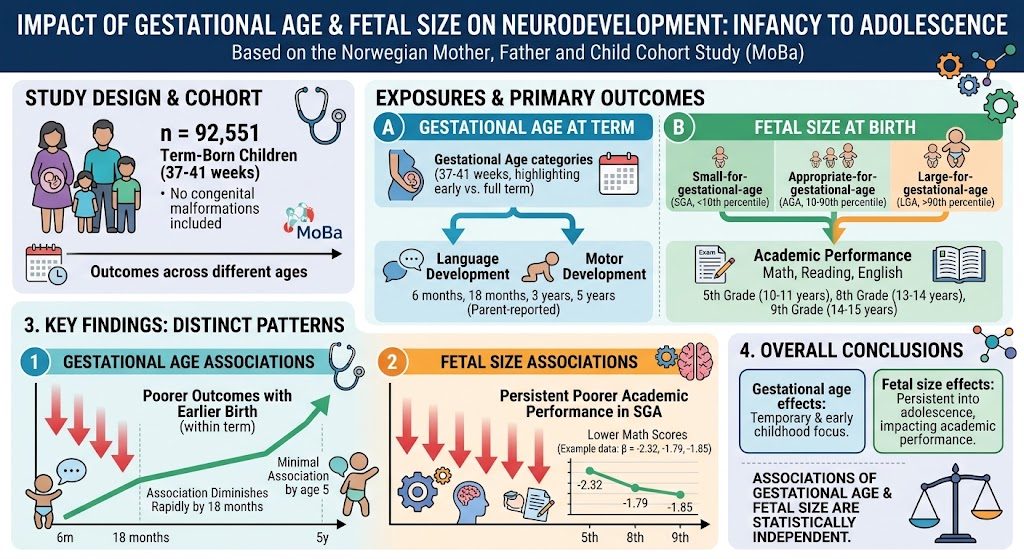
This large population-based Norwegian cohort study analyzed 92,551 term-born children to investigate how gestational age within the term window (37 to 41 weeks) and fetal size at birth independently relate to neurodevelopmental outcomes from infancy through adolescence. The key findings include: 1) Earlier term birth is associated with less favorable early language and motor development, but such effects attenuate rapidly by 18 months and are minimal by 5 years. 2) Small-for-gestational-age (SGA) status correlates with persistently poorer academic performance, particularly in math, that extends into adolescence. 3) Gestational age and fetal size each exert distinct and independent influences, underscoring their non-interchangeability in counseling about long-term neurodevelopment after term deliveries.
Background
The timing of delivery involves balancing the benefits of continued gestation against potential perinatal risks, particularly in term pregnancies. Traditionally, risks of adverse neurodevelopment are well-recognized in preterm infants (<37 weeks) and those with fetal growth restriction. However, ambiguity persists regarding whether subtle gestational age differences within the term range carry long-term neurodevelopmental implications and how these compare to the influence of fetal size. Clarifying these distinctions bears significant clinical importance for shared decision-making about timing of delivery and counseling on expected developmental trajectories.
Study Design
This study utilized data from the Norwegian Mother, Father and Child Cohort Study (MoBa), encompassing 92,551 singleton term-born children (37-41 weeks) without congenital malformations. Two exposures were defined: gestational age within term and fetal size categorized by birth weight percentiles for gestational age: small-for-gestational-age (SGA, <10th percentile), appropriate-for-gestational-age (AGA, 10-90th percentile), and large-for-gestational-age (LGA, >90th percentile). Neurodevelopmental outcomes assessed included parent-reported language and motor skills at 6 months, 18 months, 3 years, and 5 years, alongside nationally standardized academic test scores in Math, Reading, and English at 5th (10-11 years), 8th (13-14 years), and 9th grades (14-15 years).
Key Findings
Early childhood neurodevelopment: Children born earlier within the term window exhibited modest but statistically significant delays in language and motor development before 18 months. However, these differences diminished substantially by 18 months and were negligible by age 5, indicating transient early effects of gestational age fluctuations within term on developmental milestones.
Adolescent academic performance: In contrast, fetal size, specifically SGA status, was linked to persistent reductions in academic achievement across multiple subjects through adolescence. For example, SGA children scored significantly lower on national math tests at ages 10-11 (β = -2.32, 95% CI: -3.15, -1.49), 13-14 (β = -1.79, 95% CI: -2.52, -1.06), and 14-15 years (β = -1.85, 95% CI: -2.69, -1.02), with similar patterns observed for reading and English.
Independence of effects: Importantly, gestational age and fetal size demonstrated independent and non-overlapping associations with neurodevelopmental outcomes. This distinction suggests that these measures convey unique information about neurodevelopmental risk and should not be used interchangeably in clinical assessments or counseling.
Expert Commentary
These findings provide robust evidence that within the term period, fetal growth status is a more critical determinant of long-term neurodevelopmental outcomes than gestational age variations. This challenges some prevailing assumptions that minor differences in gestational timing among term births substantially impact long-term cognition. Mechanistically, fetal growth restriction may reflect sustained intrauterine stress or suboptimal nutrient supply, leading to altered brain development and connectivity persisting into adolescence. In contrast, early term delivery may temporarily affect neurodevelopmental markers but tends not to induce lasting deficits in otherwise healthy term infants.
Limitations include reliance on parent-reported early developmental assessments, which may introduce reporting bias, and the observational design, which cannot establish causality definitively. Nonetheless, the large sample size and linkage with standardized academic testing strengthen the validity of the conclusions.
Conclusion
This comprehensive analysis underscores that among term-born infants, fetal size at birth, particularly being small-for-gestational-age, is a more significant and enduring predictor of neurodevelopmental and academic outcomes than gestational age variations within term. Clinicians should consider both gestational age and fetal size as distinct and complementary factors when discussing neurodevelopmental prognosis and delivery timing with families. Further research is warranted to elucidate underlying biological mechanisms and evaluate interventions to optimize outcomes in SGA infants.
Funding
The study was conducted using the Norwegian Mother, Father and Child Cohort Study resources. Specific funding sources were not detailed in the abstract. No clinical trial registration was mentioned.
References
1. Zhao X, Quenby S, Brandlistuen RE, et al. The relationship between gestational age, delivery, and fetal size, and neurodevelopment outcomes from infancy to adolescence. Am J Obstet Gynecol. 2026 Aug 26; DOI: 10.1016/j.ajog.2026.08.026. PMID: 42648421.
2. Lundequist A, Østgård HF, et al. Impact of fetal growth restriction on neurodevelopment: Current evidence. Pediatrics. 2022;149(5):e2021052258.
3. American College of Obstetricians and Gynecologists. Timing of Elective Delivery at Term. Practice Bulletin No. 102. Obstet Gynecol. 2010 Aug;116(2 Pt 1):450-3.