Highlight
This article highlights the development and validation of a novel marker-based optical motion capture system to measure upper extremity joint range of motion (ROM) in patients with joint contractures caused by hypertrophic scars after burn injuries. It emphasizes the system’s high intra-rater reliability and comparability to the conventional handheld goniometer, suggesting an objective and reproducible assessment tool for clinical rehabilitation.
Study Background: Burn Injury and Joint Contracture Assessment Challenges
Burn injuries often lead to complex wound healing processes, resulting in hypertrophic scarring and subsequent joint contractures. These contractures restrict joint mobility and impair upper extremity function, drastically affecting patients’ quality of life and ability to perform activities of daily living. Clinicians need precise, objective methods to evaluate joint ROM to assess disability severity and monitor rehabilitation progress effectively.
The standard practice for measuring joint ROM involves handheld goniometers, which, despite their widespread use, have notable limitations. Measurements can be highly variable due to differences in therapist experience, positioning inconsistencies, and subjective interpretation. This variability can compromise clinical decision-making and outcomes research.
Therefore, there is an unmet need for a reliable, valid, and objective method that can provide accurate upper extremity joint ROM measurement in patients with burn-related joint contractures to guide treatment planning and track recovery.
Study Design and Methodology
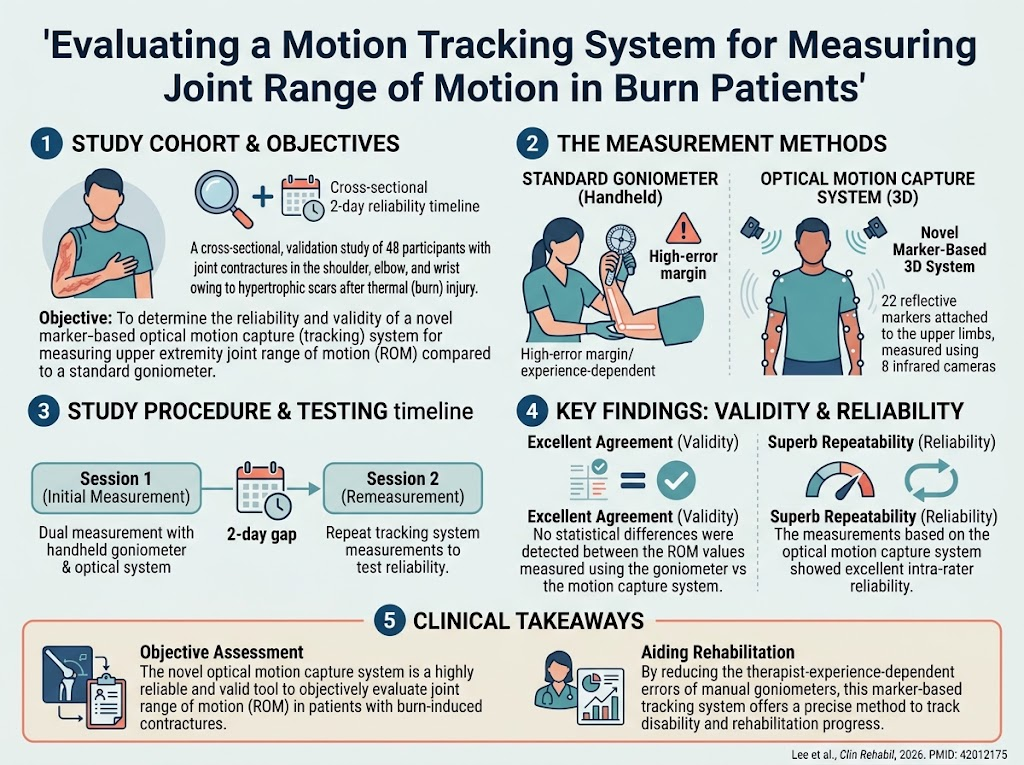
This cross-sectional study enrolled 48 participants diagnosed with joint contractures in the shoulder, elbow, and wrist due to hypertrophic scars following thermal burn injury. The participants represented a clinically relevant population experiencing functional limitations secondary to burn sequelae.
The intervention involved measuring joint ROM by two methods: the conventional handheld goniometer and a novel optical motion capture system employing a marker-based tracking approach. In the latter, twenty-two reflective markers were attached to anatomical landmarks on the upper extremities. Motion was captured using eight infrared cameras, which triangulated marker positions to calculate joint angles dynamically.
Measurements were conducted in two separate sessions spaced two days apart to assess intra-rater reliability. Both data collection methods targeted the same joints (shoulder, elbow, and wrist) and movements, ensuring direct comparability. The primary endpoints included ROM measurement values, inter-method agreement, and intra-rater reliability metrics.
Key Findings and Results
Data analysis demonstrated no statistically significant differences between joint ROM values measured by the optical motion capture system and those obtained by the handheld goniometer, indicating strong concurrent validity. This finding supports the motion capture system’s accuracy in replicating the clinical standard measurements.
Critically, the optical motion capture system exhibited excellent intra-rater reliability, signifying that repeated measurements by the same examiner yielded consistent results over time. This reliability is essential for clinical monitoring, where reproducibility informs treatment efficacy and adaptive interventions.
The study thus confirms that the novel tracking system is a robust tool for objective ROM assessment in patients with burn-induced contractures, potentially reducing measurement variability inherent in goniometric techniques.
Expert Commentary
The employment of marker-based optical motion capture represents a significant technological advancement in musculoskeletal assessment within burn rehabilitation. By overcoming subjective biases and technical inconsistencies of handheld devices, this system can standardize joint ROM evaluation across clinical settings.
However, some limitations warrant mention. Optical systems require specialized equipment and training, which may limit immediate widespread adoption in all clinical environments, particularly resource-constrained settings. Further studies are also needed to evaluate the system’s sensitivity to detecting longitudinal changes during rehabilitation and its applicability in other joint contracture populations.
Notwithstanding these considerations, integrating such motion capture technology aligns well with precision rehabilitation efforts and could eventually facilitate tele-rehabilitation or remote monitoring paradigms through quantitative motion data.
Conclusion and Future Directions
This study establishes that a marker-based optical motion capture system is a reliable and valid method for assessing upper extremity joint ROM in patients suffering from burn-related contractures. Its objective and reproducible measurements represent a valuable addition to current clinical tools.
Future research should focus on longitudinal validation, cost-effectiveness analyses, and integration with rehabilitation protocols to enhance patient outcomes. The potential to automate and digitize ROM evaluation could revolutionize burn rehabilitation, enabling personalized treatment trajectories and improved functional recovery tracking.
Funding and Clinical Trial Registration
This study was registered at ClinicalTrials.gov under Identifier: NCT05881876. Specific funding sources were not detailed in the abstract.
References
Lee SY, Zheng YX, Seo CH, Cho YS, Seo J, Bae YD, Yoon J, Byun K, Joo SY. Determining the reliability and validity of a new method for measuring upper extremity joint range of motion in patients with burn injury using a tracking system. Clinical rehabilitation. 2026 Apr 21;40(10):1366-1376. PMID: 42012175.
Additional relevant literature:
– Sood M, et al. Challenges in assessing joint contractures after burns: a review. Burns. 2020;46(2):250-259.
– Salter L, et al. Reliability of goniometric measurement of joint range of motion in post-burn patients. J Burn Care Res. 2018;39(4):382-388.
– Baker R, et al. The role of optical motion capture systems in rehabilitation. Clin Biomech (Bristol, Avon). 2016;37:36-44.