Highlight
- This randomized controlled trial assessed 3D-printed resin crowns (RCs) compared with monolithic zirconia crowns (ZCs) over 1 year in posterior single-tooth restorations.
- RCs demonstrated acceptable marginal and internal fit but showed significantly greater occlusal wear and a numerically higher but not statistically significant fracture rate compared to ZCs.
- Most fractures occurred in the most-posterior restored teeth, emphasizing location-related mechanical challenges.
- No significant differences were found in short-term periodontal outcomes or patient satisfaction between RC and ZC groups.
Study Background
Definitive posterior single-tooth crowns are a cornerstone of restorative dentistry to restore form, function, and aesthetics. Monolithic zirconia crowns (ZCs) are well-established for their strength, wear resistance, and biocompatibility, making them a preferred material for posterior restorations. However, increasing interest in additive manufacturing technologies has introduced 3D-printed resin crowns (RCs) as a potentially faster and cost-effective alternative with ease of customization.
Despite advances, there is limited robust clinical evidence comparing the long-term performance and mechanical durability of 3D-printed resin crowns versus conventional zirconia crowns when used definitively in posterior teeth. This is crucial given the high occlusal loads and wear challenges in this area. Key concerns include marginal adaptation critical for periodontal health and secondary caries prevention, mechanical fracture risk, and occlusal wear affecting longevity and opposing dentition.
Study Design
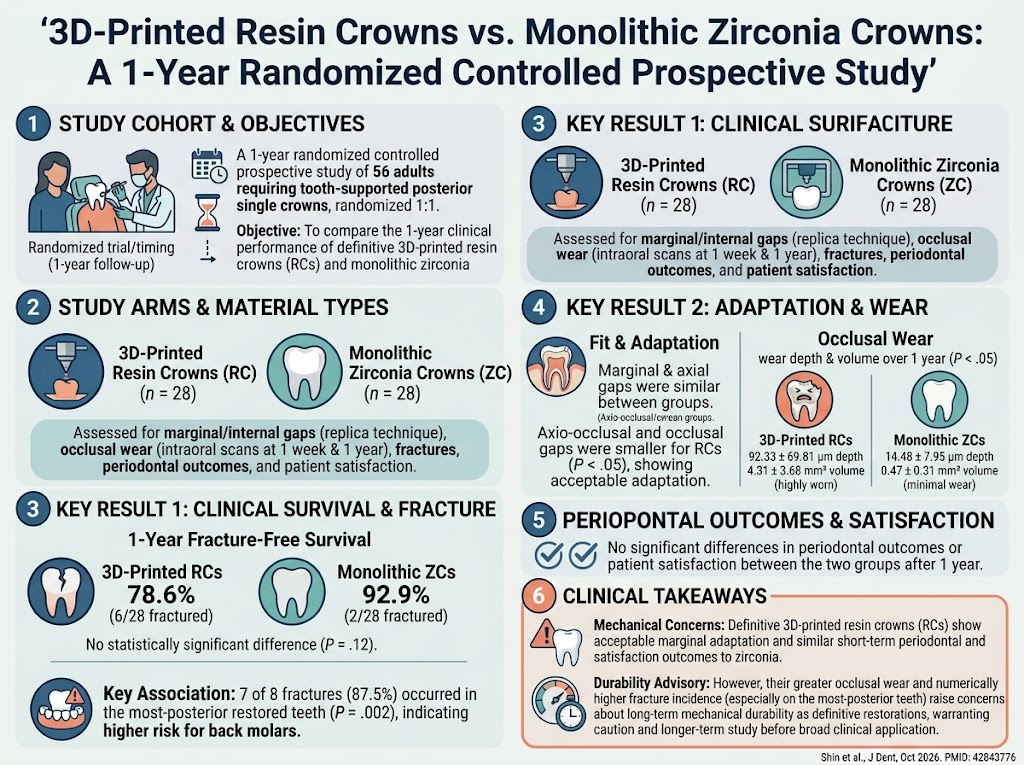
This prospective, randomized controlled study enrolled 56 adult patients requiring posterior single-tooth crowns. Participants were randomized 1:1 to receive either a definitive 3D-printed resin crown (RC) or a monolithic zirconia crown (ZC) on tooth-supported posterior teeth.
Before cementation, marginal and internal fit accuracy were quantitatively assessed using the replica technique, measuring the marginal, axial, axio-occlusal, and occlusal gap dimensions. Occlusal wear was objectively evaluated by analyzing intraoral digital scans acquired at 1 week and 1 year post-placement.
Clinical endpoints included crown fracture incidence, periodontal parameters, and patient-reported satisfaction. Survival analysis was performed using log-rank tests for fracture-free survival, and other outcomes were analyzed with Fisher exact or Mann-Whitney U tests.
Key Findings
Fracture Incidence and Survival: Over 1 year, 6 of 28 RCs fractured versus 2 of 28 ZCs, though this difference did not reach statistical significance (fracture-free survival 78.6% vs. 92.9%; P=0.12). Importantly, 7 of these 8 fractures occurred in the most-posterior teeth restored, demonstrating that posterior location significantly increased fracture risk (P=0.002).
Marginal and Internal Fit: Marginal and axial gaps showed no statistically significant difference between RCs and ZCs, indicating comparable adaptation quality. However, axio-occlusal and occlusal gap measurements were smaller for resin crowns (P<0.05), suggesting tighter occlusal interfaces in the RC group at baseline.
Occlusal Wear: Resin crowns exhibited significantly greater wear depth (92.33±69.81 μm) and volume (4.31±3.68 mm³) compared to zirconia crowns (14.48±7.95 μm depth; 0.47±0.31 mm³ volume) (P<0.05), which raises concern for mechanical durability and the potential impact on opposing dentition.
Periodontal Outcomes and Patient Satisfaction: Both groups demonstrated similar periodontal health over 1 year, with no significant differences in gingival inflammation or probing depths. Patient satisfaction scores regarding comfort, esthetics, and function were also comparable, implying acceptable clinical performance from a patient perspective.
Expert Commentary
The study provides pioneering clinical data on the short-term performance of 3D-printed resin crowns as definitive restorations. While the marginal fit of resin crowns appears clinically acceptable and comparable to zirconia, the data reveal a trade-off in mechanical resilience with increased wear and a trend toward more frequent fractures, especially in stress-prone posterior sites.
These findings reflect inherent material differences; resin polymers generally exhibit lower hardness and fracture toughness than densely sintered zirconia ceramics. The observed greater wear volume also suggests potential implications not only for crown longevity but for wear of opposing teeth, meriting further investigation.
Limitations include the relatively short 1-year follow-up and modest sample size, which may underpower fracture risk statistical analyses. Additionally, clinical protocols for resin crown fabrication and post-processing may evolve, potentially improving outcomes in the future. Longitudinal studies with larger cohorts and longer follow-up are essential to confirm these preliminary findings and establish best-use scenarios.
Conclusion
This 1-year randomized controlled trial demonstrated that definitive 3D-printed resin crowns provide acceptable marginal adaptation and periodontal compatibility comparable to monolithic zirconia crowns for posterior single-tooth restorations. However, the significantly greater occlusal wear and a higher yet statistically non-significant fracture incidence in resin crowns indicate caution in widespread definitive clinical application, particularly for molars subjected to high occlusal forces.
Clinicians should carefully select candidate teeth and consider continued monitoring when choosing resin crowns. Future studies are warranted to evaluate long-term durability, wear effects on opposing dentition, and optimization of 3D printing materials and techniques to enhance mechanical properties.
Funding and ClinicalTrials.gov
No specific funding or clinical trial registration information is reported in the original publication.
References
- Shin H, Oh KC, Kim JH. Evaluation of full-veneer crowns fabricated with 3D printing resin material for definitive prostheses: A 1-year randomized controlled prospective study. Journal of Dentistry. 2026 Oct 7:107097. PMID: 42843776.
- Ruse ND, et al. Marginal integrity of zirconia crowns: An overview. J Prosthodont. 2020;29(9):690-696.
- Kelly JR. Dental ceramics: current thinking and trends. Dent Clin North Am. 2004;48(2):527-40.
- Stawarczyk B, et al. Mechanical properties and wear of various dental polymers. Int J Prosthodont. 2013;26(3):202-7.