Highlight
- Graded exercise test (GXT) performance is not significantly different across menstrual cycle phases in physically active eumenorrheic women.
- Higher menstrual cramp severity during menses correlates with reduced exercise capacity, including lower peak power output and shorter time to exhaustion.
- Psychological factors such as affective valence, arousal, anxiety, and motivation fluctuate with menstrual cycle phases and influence exercise performance.
- Motivation levels tend to be lower during menses compared to the follicular phase, potentially affecting exercise engagement.
Study Background
The underrepresentation of women in sports science has historically limited understanding of how physiological and psychological factors intrinsic to the menstrual cycle affect exercise performance. Although cyclical fluctuations in hormones like estradiol and progesterone are known to impact physiological function, current evidence is inconsistent regarding their effects on objectively measured physical performance. Contradictory reports stem partly from methodological limitations, including insufficient hormonal verification and lack of attention to menstrual symptoms such as cramps and associated psychological states like mood or motivation. Given the importance of optimizing exercise regimens for women, particularly those who are physically active and eumenorrheic (having regular menstrual cycles without hormonal contraception), it is crucial to elucidate how menstrual phases and related symptoms influence both psychological responses and exercise capacity.
Study Design
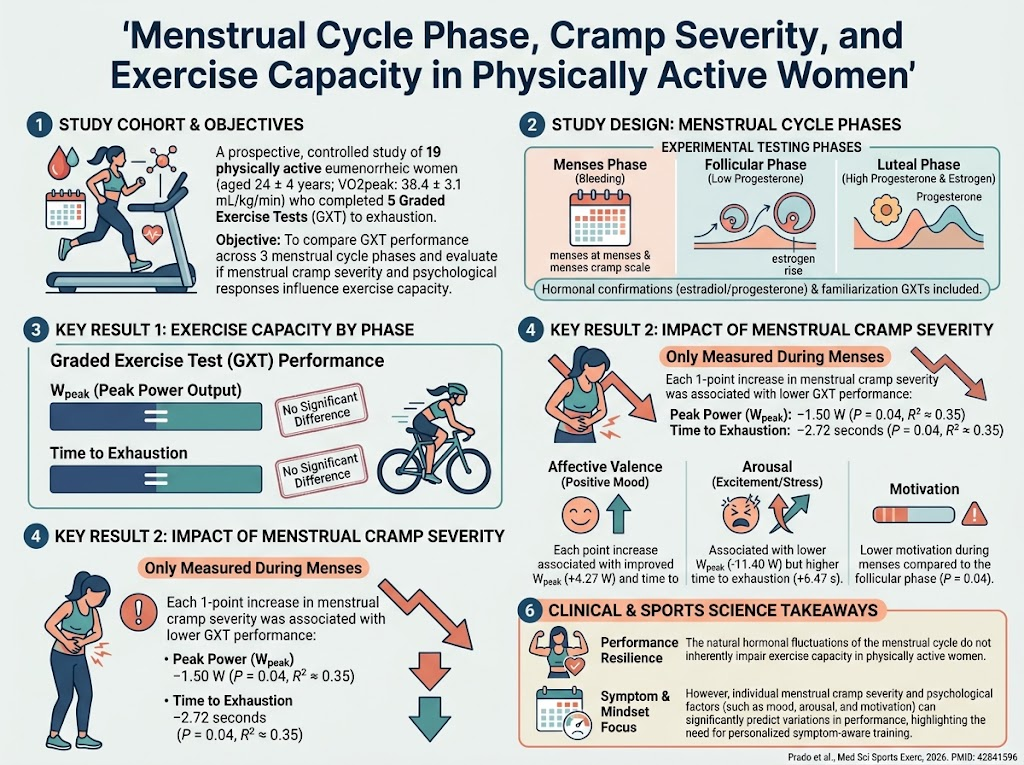
This observational repeated-measures study included 19 physically active eumenorrheic women aged 24 ± 4 years, with an average peak oxygen uptake (V̇O2peak) of 38.4 ± 3.1 mL·kg⁻¹·min⁻¹, indicating good aerobic fitness. Participants completed five graded exercise tests (GXTs): two for familiarization and three experimental sessions corresponding to key phases of the menstrual cycle — menses, follicular, and luteal phases. The primary endpoints were exercise performance metrics: peak power output (Wpeak) and time to exhaustion during GXT.
Secondary measures included estradiol and progesterone serum levels for hormonal confirmation of cycle phases, alongside psychological assessments such as affective valence (positive or negative mood), arousal (physiological alertness), anxiety, motivation, heart rate, rating of perceived exertion (RPE), and mood disturbance. Menstrual cramp severity was specifically recorded during the menses phase.
Key Findings
The principal analysis revealed no statistically significant differences in GXT performance—Wpeak and time to exhaustion—across the menstrual cycle phases (p > 0.05), in line with some recent literature suggesting stable physical capacity across the cycle in active women.
Notably, exploratory regression analyses uncovered clinically relevant associations:
– Each one-point increase in self-reported menstrual cramp severity during menses corresponded to a decrement in peak power output by approximately 1.50 W and a reduction in time to exhaustion by about 2.72 seconds (p = 0.04; R² ≈ 0.35). This suggests that cramping substantially impairs exercise performance during menstruation.
– Psychological variables correlated with performance outcomes across the cycle. Higher affective valence scores, indicating more positive mood states, were associated with enhanced Wpeak (+4.27 W) and longer time to exhaustion (+8.51 s), whereas elevated arousal levels correlated inversely with Wpeak (-11.40 W) but positively with time to exhaustion (+6.47 s) (p = 0.01–0.02; R² up to ~0.46). These nuanced findings suggest that the balance of psychological states might modulate how women perceive effort and perform physically.
– Motivation was significantly lower during menses compared to the follicular phase (p = 0.04), which may influence exercise adherence and subjective exercise experience during menstruation.
No significant changes were found in other parameters such as anxiety or heart rate across cycle phases.
Expert Commentary
This study contributes valuable insight into the complex interplay between menstrual physiology, symptomatology, and exercise performance. The absence of generalized performance variation across phases strengthens the argument that menstrual cycle phase alone may not warrant broad exercise prescription modifications in healthy, physically active women. However, the detrimental influence of menstrual cramps on performance highlights the need to account for symptom severity in both research and clinical practice.
Psychological factors emerge as critical determinants of exercise outcomes and subjective experience. The association between positive affect and improved performance aligns with behavioral medicine models emphasizing mood-driven motivation. Conversely, elevated physiological arousal may impair peak power, perhaps through increased fatigue or discomfort, while paradoxically prolonging exhaustion time, underscoring the complexity of psychophysiological interactions.
Limitations include the modest sample size and the focus on well-trained, eumenorrheic young women, which may limit generalizability to broader populations, such as those with menstrual disorders or sedentary lifestyles. Also, cramp severity was evaluated only during menses and relied on self-report, which could introduce bias. Future longitudinal or interventional studies incorporating objective symptom measurements and larger cohorts would bolster these preliminary findings.
Conclusion
The study demonstrates that menstrual cycle phase per se does not significantly alter graded exercise test performance in physically active eumenorrheic women. Nevertheless, menstrual cramp severity during menses is a critical factor negatively impacting exercise capacity. Additionally, psychological responses—including mood and motivation—vary with cycle phase and influence performance. These insights underscore the importance of individualized exercise guidance that considers menstrual symptoms and psychological state rather than menstrual cycle day alone. Further research is warranted to elaborate tailored strategies supporting female athletes and exercisers across their menstrual cycles.
Funding and Clinical Trials Registration
Details regarding funding sources or clinical trial registration were not reported in the source publication.
References
1. Prado RCR, Oliveira TN, Saunders B, et al. The Influence of Menstrual Cycle Phase and Cramp Severity on Psychological Responses and Exercise Capacity in Physically Active Eumenorrheic Women. Med Sci Sports Exerc. 2026 Oct 7. PMID: 42841596.
2. McNulty KL, Elliott-Sale KJ, Dolan E, et al. The Effects of Menstrual Cycle Phase on Exercise Performance in Eumenorrheic Women: A Systematic Review and Meta-Analysis. Sports Med. 2020;50(10):1813-1827.
3. Tenan MS, Hackney AC, Griffin L. Maximal force and tremor change with the menstrual cycle. Eur J Appl Physiol. 2016;116(1):49-56.
4. Palma SM, Lilje J, Kohn MR, et al. Psychological factors and menstrual cycle phase dependent fluctuations in performance and motivation. Sports Med Open. 2021;7(1):17.