Highlights
- Early-phase gynecologic oncology trials exhibit higher publication rates compared to late-phase trials.
- Late-phase trials report race/ethnicity data more frequently but enroll proportionally fewer racial and ethnic minority groups (REMGs).
- Ovarian cancer predominates among gynecologic oncology trials, with cervical and uterine cancers less frequently studied.
- Persistent gaps exist in enrollment equity and trial transparency, warranting targeted strategies to enhance inclusion and reporting.
Background
Gynecologic cancers, including ovarian, cervical, and uterine malignancies, represent a significant global health burden among women. Despite advances in treatment modalities, disparities in clinical trial representation and reporting compromise the generation of generalizable evidence and equitable healthcare delivery. Clinical trials are stratified by phase, with early-phase trials (phases I and II) primarily assessing safety and preliminary efficacy, and late-phase trials (phases III and IV) rigorously evaluating therapeutic benefit and establishing standards of care. Understanding trends in trial completion, publication, and the inclusion of racial and ethnic minority groups (REMGs) is crucial, as these factors influence both scientific progress and health equity in gynecologic oncology.
Key Content
Overview of Gynecologic Oncology Trials Landscape
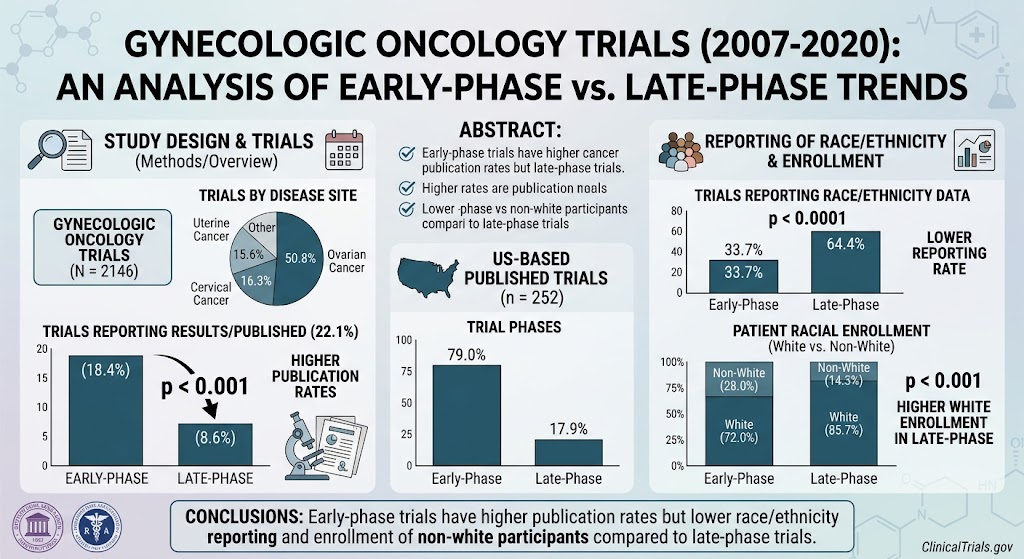
Between 2007 and 2020, among a total of 223,690 registered clinical trials, 2,146 (0.9%) focused on gynecologic oncology. Ovarian cancer trials constituted the majority (50.8%, n=1,092), followed by cervical (16.3%, n=350) and uterine cancers (15.6%, n=334). This distribution reflects the relative incidence and research prioritization of these malignancies but highlights a need for balanced trial efforts across gynecologic cancer types.
Trial Completion and Publication Rates by Phase
Overall, only 22.1% (n=474) of gynecologic oncology trials reported results or led to publication, indicating a substantial gap in dissemination. Early-phase trials showed significantly higher publication likelihood (18.4%) than late-phase trials (8.6%), a divergence possibly attributable to differences in study duration, complexity, or funding. Among U.S.-based trials with published results (n=252), early-phase constituted 79.0% (n=199) versus 17.9% (n=45) for late-phase trials.
Reporting and Enrollment of Racial and Ethnic Minority Groups
While late-phase trials were more diligent in reporting race/ethnicity data (64.4% reporting rate) compared to early-phase trials (33.7%), late-phase studies paradoxically enrolled a higher proportion of White participants (85.7%) relative to early-phase trials (72.0%), implying under-enrollment of REMGs in late-phase research. Early-phase trials demonstrated a comparatively higher inclusion of REMGs, possibly due to smaller sample sizes, single-center design, or targeted recruitment. However, the overall low reporting of demographic data remains a critical barrier to assessing and addressing disparities.
Factors Influencing Enrollment Disparities
Multiple factors contribute to REMG underrepresentation in late-phase trials, including systemic barriers such as lack of access to clinical trial centers, stringent eligibility criteria, socioeconomic determinants, historic mistrust, and insufficient community engagement. Late-phase trial complexity and regulatory demands may also hinder diverse recruitment. Conversely, early-phase trials, often conducted at academic centers with specialized recruitment, might facilitate higher REMG inclusion.
Implications for Clinical Translation and Health Equity
Disparities in REMG enrollment jeopardize the external validity of findings and risk perpetuating inequities in evidence-based gynecologic oncology care. Underrepresentation impedes the understanding of therapy efficacy and safety across diverse populations, potentially contributing to outcome disparities. Enhanced efforts to improve transparency in reporting and to implement inclusive recruitment strategies are imperative to ensure equitable research benefits.
Expert Commentary
This analysis underscores key challenges in gynecologic oncology clinical trials: a troublingly low overall publication rate and significant racial and ethnic disparity in participant enrollment. The higher publication propensity in early-phase trials may reflect more focused objectives and fewer resource constraints but raises concerns about the dissemination of pivotal late-phase trial data that directly inform clinical practice.
The paradox of better race/ethnicity reporting yet poorer REMG enrollment in late-phase trials suggests that reporting compliance alone is insufficient; active recruitment approaches tailored to minority populations are needed. Mechanistically, differences in tumor biology and treatment response among racial and ethnic groups demand rigorous and representative inclusion to refine personalized therapeutic strategies.
Regulatory bodies and research sponsors should incentivize equitable recruitment, transparency, and the integration of social determinants in trial design. Community partnerships, culturally competent outreach, and flexible protocol requirements may enhance minority inclusion. Additionally, publication bias and incomplete results reporting undermine cumulative knowledge and must be addressed through policy and educational interventions.
Conclusion
Gynecologic oncology clinical trials demonstrate distinct trends in publication and minority enrollment across early- and late-phase studies. Early-phase trials are more likely to be published and better enroll racial and ethnic minority participants but less frequently report race/ethnicity data. Conversely, late-phase trials show greater reporting but under-enroll minorities and have lower publication rates. These disparities highlight systemic gaps that constrain scientific rigor and equity in gynecologic oncology research.
Future research must elucidate barriers to publication and minority recruitment in late-phase trials, fostering interventions that promote transparency and inclusivity. Addressing these gaps is vital for ensuring that clinical trial evidence accurately reflects and benefits the diverse populations affected by gynecologic cancers.
References
- Richardson MT, Barry D, Steinberg JR, et al. Early-phase vs. late-phase clinical trials in gynecologic oncology: Trends in trial completion, reporting, and enrollment of racial and ethnic minority groups. Gynecol Oncol. 2026 Aug 21;212:181-187. PMID: 42628252.
- Unger JM, Vaidya R, Hershman DL, Minasian LM, Fleury ME. Systematic Review and Meta-Analysis of the Magnitude of Structural, Clinical, and Physician and Patient Barriers to Cancer Clinical Trial Participation. J Natl Cancer Inst. 2019 Jan 1;111(3):245-255. PMID: 30463924.
- Sacher AG, Tagawa ST, Deeken JF, et al. Racial and ethnic disparities in the enrollment of patients into clinical trials for lung, breast, and colorectal cancers. J Clin Oncol. 2018;36(8):779-786. PMID: 29332920.
- U.S. Food and Drug Administration. Enhancing Diversity in Clinical Trials — Eligibility Criteria, Enrollment Practices, and Trial Designs Guidance. 2020. Available from: https://www.fda.gov/media/127712/download.