Highlight
- Rehabilitation priorities for low back pain emphasize a biopsychosocial approach integrating physical, psychological, social, and work-related factors.
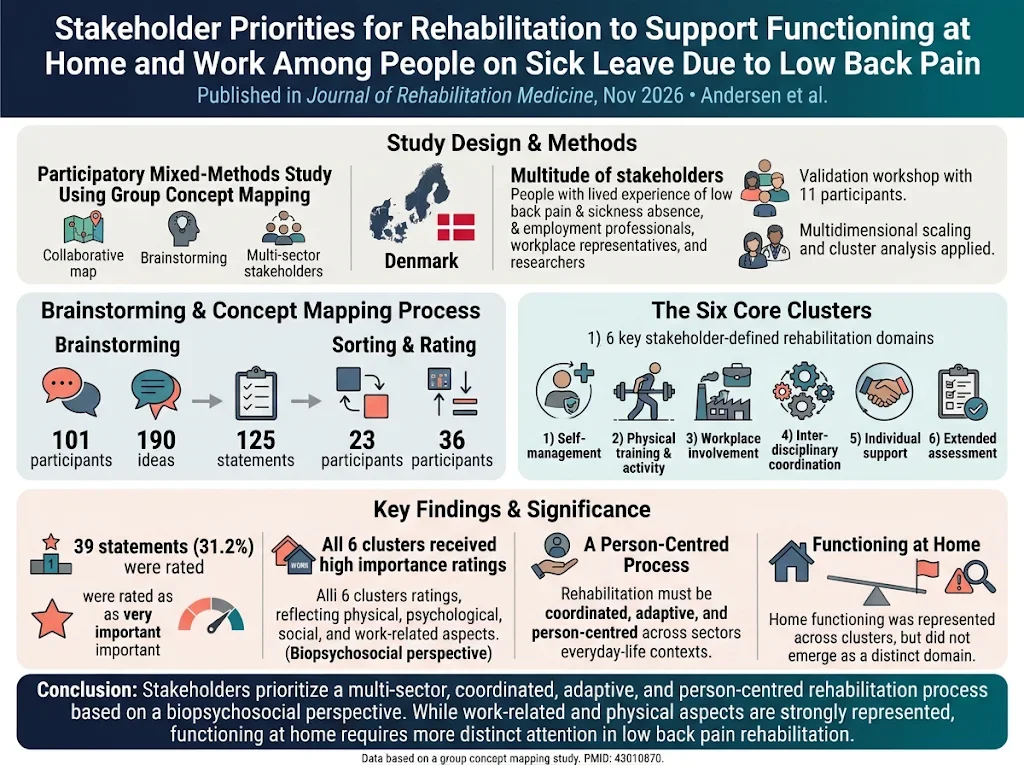
- Stakeholders identified six key clusters crucial to rehabilitation: self-management, physical activity, workplace involvement, interdisciplinary coordination, individual support, and extended assessment.
- Functioning at home, although implicitly addressed, was not distinctly identified as a standalone domain, indicating a need for greater focus in rehabilitation programs.
- Rehabilitation is conceptualized as a coordinated, adaptive, and person-centred process spanning multiple sectors and everyday life contexts.
Study Background
Low back pain (LBP) represents a leading cause of disability worldwide, frequently resulting in sick leave and diminished functioning in both workplace and home settings. Its multifactorial etiology encompasses physical, psychological, and social components, necessitating comprehensive rehabilitation approaches. Despite this, return-to-work rates and home functioning often remain suboptimal, and stakeholders’ diverse perspectives on rehabilitation priorities are insufficiently characterized. Understanding these priorities is crucial to designing person-centered, coordinated rehabilitation interventions that effectively support individuals’ functioning in daily life and work environments.Study Design
This investigation employed a participatory mixed-methods design using group concept mapping (GCM) conducted in Denmark. Participants included heterogeneous stakeholders with lived experience and professional involvement related to LBP and sickness absence: patients on sick leave due to LBP, healthcare professionals, workplace representatives, employment professionals, and researchers. The study unfolded through structured online sessions involving brainstorming, sorting, and rating of rehabilitation components, followed by a validation workshop. During the brainstorming phase, 101 participants generated 190 raw ideas, which were subsequently refined and synthesized into 125 distinct statements. Sorting and rating were subsequently completed by 23 and 36 participants, respectively. Analytical approaches included multidimensional scaling and hierarchical cluster analysis to organize and prioritize statements into meaningful conceptual clusters. Finally, 11 participants attended a face-to-face validation workshop to review and endorse the emergent conceptual structure.Key Findings
The study identified six conceptually distinct but interrelated clusters representing stakeholder priorities in rehabilitation for individuals on sick leave due to LBP: 1. Self-management: Emphasizes empowering patients with skills, knowledge, and strategies to independently manage symptoms, pain, and activities of daily living. This cluster reflects the importance of patient education, coping strategies, and fostering autonomy. 2. Physical training and activity: Encompasses therapeutic exercise, physical conditioning, and encouragement of general activity levels tailored to individual capacity, supporting both recovery and prevention. 3. Workplace involvement: Highlights the essential role of workplace engagement, including employer and occupational healthcare collaboration to facilitate graded return to work, workplace adjustments, and supportive policies. 4. Interdisciplinary coordination: Reflects the need for integrated care approaches bridging healthcare providers, employment services, and social support systems to ensure holistic rehabilitation. 5. Individual support: Addresses personalized assistance including psychological support, counseling, and social services to address multifaceted barriers to recovery. 6. Extended assessment: Covers comprehensive evaluations beyond standard clinical measures, incorporating psychosocial factors, work demands, and home environment contexts. Among the 125 statements, 39 (31.2%) were rated as very important by stakeholders. Each identified cluster received consistently high importance scores, indicating broad consensus regarding their relevance. An important observation was the diffuse representation of functioning at home across multiple clusters without emergence as a distinct domain. This suggests that while home functioning is recognized implicitly, explicit focus and targeted strategies to support functioning in the home environment are less developed in current rehabilitation paradigms.Expert Commentary
This study provides important patient and stakeholder-centered insights that align well with the biopsychosocial model of LBP management, reflecting contemporary best practice recommendations. The emphasis on interdisciplinary coordination and workplace involvement echoes calls in guidelines, such as those from the European guidelines for the management of LBP, to integrate occupational health with clinical care. The study’s methodology using group concept mapping is a strength, allowing synthesis of diverse perspectives into a structured framework, which can guide clinical practice, policy, and further research. Limitations include the relatively smaller participation in sorting/rating and validation phases compared to brainstorming, which may influence the representativeness of prioritization. Additionally, the lack of distinct focus on home functioning underscores a gap in rehabilitation research and practice. Future research should explore targeted interventions explicitly addressing home environment challenges to optimize functional outcomes.Conclusion
The rehabilitation priorities identified by stakeholders highlight the multifaceted nature of supporting people on sick leave due to LBP. Rehabilitation should adopt a biopsychosocial, coordinated, and person-centered approach that simultaneously addresses physical reconditioning, psychological empowerment, workplace integration, and comprehensive assessment. The finding that functioning at home is not distinctly conceptualized suggests a crucial area for enhancement in both research and clinical rehabilitation programs. Addressing this gap could contribute to more holistic recovery and sustained return-to-work outcomes. This study’s conceptual framework offers a valuable basis for developing tailored rehabilitation interventions and informing policy to better support individuals with LBP across both home and work contexts.Funding and Clinical Trials
The original article did not specify funding sources or clinical trial registry information.References
1. Hartvigsen J, Hancock MJ, Kongsted A, et al. What low back pain is and why we need to pay attention. Lancet. 2018;391(10137):2356-2367. doi:10.1016/S0140-6736(18)30480-X 2. European Guidelines for the Management of Low Back Pain. European Spine Journal. 2018. 3. Andersen KS, Ejlersen Wæhrens E, Vinther Nielsen C, Escorpizo R, Kaalund Bruun B, Sampedro Pilegaard M. Stakeholder priorities for rehabilitation to support functioning at home and work among people on sick leave due to low back pain: a group concept mapping study. J Rehabil Med. 2026 Nov 11;58:jrm46346. doi:10.2340/jrm.v58.46346. PMID: 43010870. 4. Main CJ, Shaw WS, Pransky G, et al. Employer policies and practices for the management of workers with musculoskeletal disorders: a scoping review. Disabil Rehabil. 2021;43(17):2392-2403.Specialty calculators
For clinical reference; use professional judgment.