Highlights
- The EMPIRICAL trial is the first large multicentre randomised controlled trial assessing empirical tuberculosis treatment (eTB-T) in infants living with HIV hospitalised with severe pneumonia across multiple African countries.
- No significant mortality benefit was demonstrated for empirical tuberculosis treatment compared to a microbiologically and clinically guided tuberculosis treatment initiation strategy over 12 months.
- A high proportion (46%) of infants in the non-empirical tuberculosis treatment groups eventually received tuberculosis treatment based on clinical or microbiological criteria, which may have attenuated differences between groups.
- Adverse events and serious toxicity rates were similar between empirical and non-empirical tuberculosis treatment groups, indicating acceptable safety profiles for prolonged tuberculosis treatment in this population.
Background
Severe pneumonia in infants co-infected with HIV remains a leading cause of morbidity and mortality in sub-Saharan Africa. Tuberculosis (TB), often difficult to diagnose in young children due to non-specific symptoms and paucibacillary disease, complicates management. The risk of TB is high in infants living with HIV, who are more susceptible to opportunistic infections including Pneumocystis jirovecii and cytomegalovirus (CMV). Current WHO guidelines recommend microbiologically or clinically guided initiation of TB treatment. However, delays or missed diagnoses contribute to high fatality rates. Whether empirical TB treatment at presentation improves survival in this vulnerable population has been uncertain.Key Content
Study Design and Population
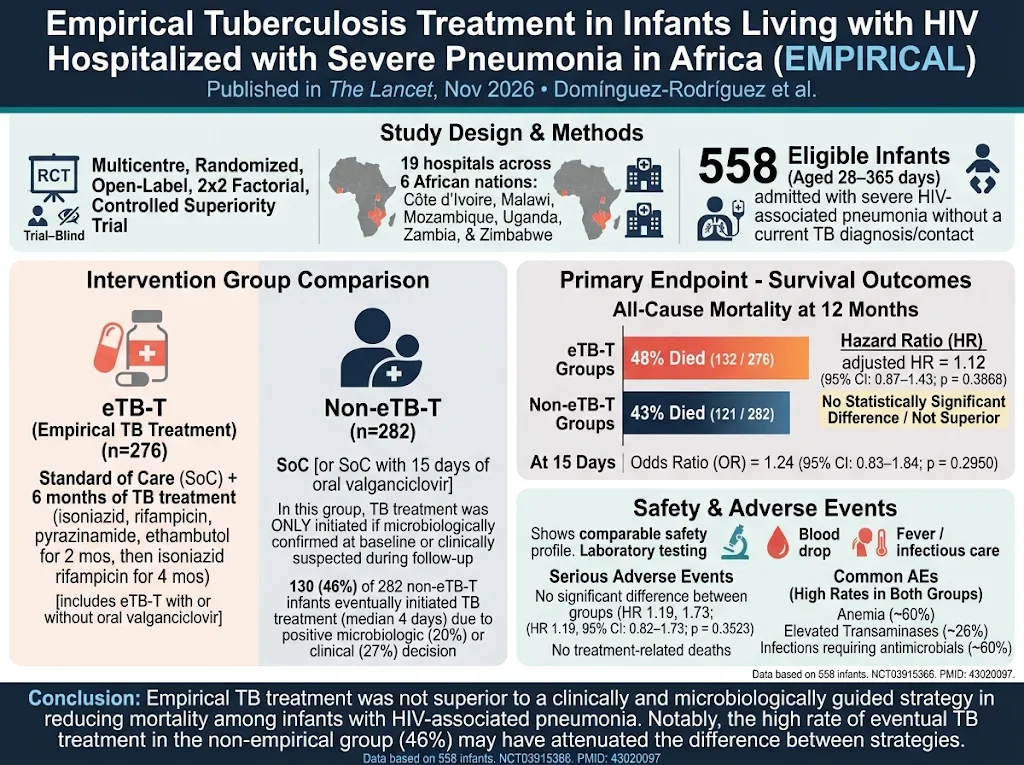
The EMPIRICAL trial was a multicentre, open-label, 2×2 factorial, randomised controlled superiority trial conducted from March 2020 to January 2024. Nineteen hospitals in Côte d’Ivoire, Malawi, Mozambique, Uganda, Zambia, and Zimbabwe enrolled infants aged 28 to 365 days hospitalized with severe HIV-associated pneumonia. Those with known TB diagnosis or contact were excluded. Enrolment totaled 563 infants; 558 eligible patients were analysed.Interventions
Participants were randomized (1:1:1:1) to one of four groups:- Standard of care (SoC): WHO-recommended antibiotics for bacterial pneumonia, plus cotrimoxazole and steroids for Pneumocystis jirovecii pneumonia.
- SoC plus 15 days oral valganciclovir targeting cytomegalovirus infection.
- SoC plus 6 months empirical tuberculosis treatment (HRZE for 2 months, followed by isoniazid and rifampicin for 4 months).
- Combination of SoC, valganciclovir, and empirical tuberculosis treatment.
Diagnostics and Clinical Management
At recruitment, samples were collected for TB testing, including Xpert MTB/RIF Ultra on nasopharyngeal aspirates and stool samples, and urine lipoarabinomannan assay. Patients in the non-eTB-T arms were initiated on TB treatment if microbiological tests returned positive or if clinical suspicion arose during follow-up, per standard practice.Primary Endpoint
All-cause mortality at 15 days and 360 days was the primary endpoint. Mortality was assessed using flexible parametric survival models adjusting for covariates. Missing data imputed by chained equations.Findings
- Of 276 infants in the eTB-T arms, 48% died within 12 months; of 282 infants in the non-eTB-T arms, 43% died (adjusted hazard ratio [aHR] 1.12, 95% CI 0.87–1.43; p=0.39).
- At 15 days, odds ratio for death in the eTB-T group was 1.24 (95% CI 0.83–1.84; p=0.30), indicating no early mortality benefit.
- Among non-eTB-T infants, 46% eventually commenced TB treatment at a median of 4 days post enrolment, either due to positive microbiological findings (20%) or clinical decision (27%).
- No significant interaction between valganciclovir and eTB-T was observed (aHR 1.19, 95% CI 0.73–1.95; p=0.48).
- Serious adverse events and common toxicities such as elevated liver transaminases (~26%), anemia (~59-60%), and infectious diseases requiring antimicrobials (~58-62%) occurred at similar rates between groups. No deaths were treatment-related.
Comparative Evidence on Valganciclovir
A parallel report from the EMPIRICAL trial evaluated empirical valganciclovir use for CMV, finding potential early mortality benefit at day 15 (aHR 0.60, 95% CI 0.41–0.87; p=0.0063), though 12-month mortality difference was not statistically significant. This contrasts with the lack of benefit observed for empirical TB treatment.Contextual Epidemiology
Global burden studies highlight the persistent high mortality from lower respiratory infections in infants, particularly in sub-Saharan Africa. TB remains a major cause of childhood pneumonia-associated hospitalization and death, especially in HIV-coinfected populations. Pneumococcal co-infections in children with culture-confirmed TB further complicate clinical presentation and management.Expert Commentary
The EMPIRICAL trial is a landmark study addressing an important clinical question in a difficult-to-diagnose, high-mortality population. The absence of mortality benefit from universal empirical TB treatment challenges assumptions that early broad therapy saves lives in this setting. Several factors may account for these findings:- The high proportion of non-eTB-T infants eventually treated for TB likely diluted between-group differences, potentially underpowering the trial to detect a modest benefit.
- Current microbiological techniques, though limited in pediatric populations, enabled relatively rapid identification and treatment initiation in standard care arms, representing real-world best practice.
- Initiating prolonged TB therapy empirically exposes infants to potential drug toxicities; safety data from EMPIRICAL reassuringly indicate comparable adverse event rates.
- Co-infections, including CMV and pneumococcal pneumonia, complicate the clinical picture and may be more impactful than TB in acute severe pneumonia mortality.
Conclusion
The EMPIRICAL trial provides robust evidence that empirical TB treatment does not reduce mortality compared to microbiologically and clinically guided treatment among infants living with HIV hospitalised with severe pneumonia in Africa. High rates of eventual TB treatment initiation in non-empirical arms limit definitive conclusions on potential benefit. Safety profiles of extended TB treatment are acceptable in this population. Future research should refine rapid diagnostic tools for pediatric TB and explore integrated management of co-infections to improve outcomes.References
- Domínguez-Rodríguez S, Tagarro A, Moraleda C, et al. Empirical tuberculosis treatment in infants living with HIV hospitalised with severe pneumonia in Africa (EMPIRICAL): a multicentre, randomised, open-label, 2 × 2 factorial, controlled superiority trial. Lancet. 2026;408(10568):2109-2124. PMID: 43020097.
- Moraleda C, Domínguez-Rodríguez S, Tagarro A, et al. Empirical treatment with valganciclovir in infants living with HIV and hospitalised with severe pneumonia in Africa: a multicentre, open-label, factorial, randomised, controlled, superiority trial. Lancet. 2026;408(10568):2097-2108. PMID: 42468541. <liVos T, Lim SS, Abbafati C, et al. Global burden of 288 causes of death and life expectancy decomposition, 1990-2021: a systematic analysis for the Global Burden of Disease Study 2021. Lancet. 2024;403(10440):2100-2132. PMID: 38582094.
- Le Roux DM, Zar HJ. Role of Streptococcus pneumoniae in hospitalization for acute community-acquired pneumonia associated with culture-confirmed Mycobacterium tuberculosis in children: a pneumococcal conjugate vaccine probe study. Pediatr Infect Dis J. 2010;29(12):1099-1104. PMID: 21155174.
Specialty calculators
For clinical reference; use professional judgment.