Highlight
A large international cohort study redefines mitral regurgitation (MR) severity thresholds specifically for transthyretin amyloid cardiomyopathy (ATTR-CM), revealing that conventional guideline cutoffs underestimate MR in this population due to restrictive low-flow physiology.
Validated quantitative MR metrics better predict mortality and heart failure hospitalization risks.
The study proposes a novel composite MR grading scheme outperforming current guideline definitions in clinical prognostication.
Study Background
Transthyretin amyloid cardiomyopathy (ATTR-CM) is an increasingly recognized cause of restrictive cardiomyopathy characterized by extracellular deposition of transthyretin amyloid fibrils in myocardial tissue. ATTR-CM leads to heart failure with preserved or mildly reduced ejection fraction, restrictive low-flow hemodynamics, and progressive myocardial dysfunction. Mitral regurgitation (MR) is a common valvular complication in ATTR-CM, but its severity assessment remains challenging. Conventional semi-quantitative echocardiographic grading schemes, established primarily in other cardiac contexts, may underestimate MR severity in ATTR-CM because of the distinctive restrictive physiology which limits forward and backward flow, thus complicating volume-based measures of MR.
Accurate MR evaluation is critical since its severity correlates with adverse clinical outcomes, including mortality and heart failure hospitalizations. Therefore, there is an unmet need to establish disease-specific MR thresholds better aligned with ATTR-CM pathophysiology and risk stratification.
Study Design
This was a multicenter international cohort study involving 1101 patients with newly diagnosed ATTR-CM from 8 centers across 4 countries. Patients were divided into a derivation cohort (n=722) and an external validation cohort (n=379). All patients underwent standardized transthoracic echocardiography with blinded core laboratory analysis to quantify MR severity using multiple metrics: vena contracta width, effective regurgitant orifice area (EROA), regurgitant volume (RV), and regurgitant fraction (RF).
Endpoints included all-cause mortality and time to first heart failure hospitalization (HFH), with a median follow-up of approximately 25 months. MR severity thresholds were derived via spline analysis to determine risk-related breakpoints and externally validated. The predictive performance of these disease-specific thresholds was compared with established guideline definitions from the American Heart Association/American College of Cardiology (AHA/ACC), the European Society of Cardiology/European Association for Cardiothoracic Surgery (ESC/EACTS), and the American Society of Echocardiography (ASE).
Key Findings
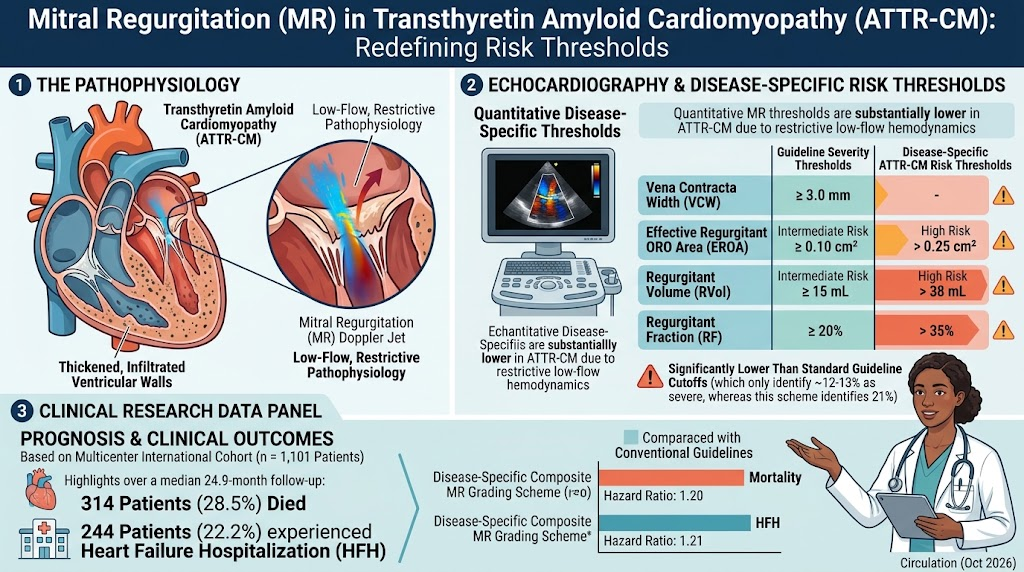
During follow-up, 314 patients (28.5%) died, and 244 patients (22.2%) experienced HFH, confirming the serious prognosis of ATTR-CM with MR involvement. All MR metrics independently predicted the risk of mortality and HFH with statistical significance (all P<0.05).
The spline-derived MR thresholds delineated three risk categories: low, intermediate, and high. Intermediate risk was indicated at vena contracta width ≥3.0 mm, EROA ≥0.10 cm², RV ≥15 mL, and RF ≥20%. High risk corresponded to EROA >0.25 cm², RV >38 mL, and RF >35%. These cutoffs were substantially lower than those recommended by current guidelines (approximately threefold lower in many parameters), emphasizing the unique low-flow restrictive conditions in ATTR-CM.
The composite MR grading scheme combining multiple quantitative parameters reclassified a higher proportion of patients as having severe MR (21%) compared to guideline-based grading (approximately 12%-13%). This new classification improved prognostic discrimination for mortality and HFH at both 12 and 24 months in derivation and validation cohorts.
After adjusting for confounders, only the composite grading scheme retained strong predictive power for all-cause mortality (hazard ratio [HR] 1.20, 95% confidence interval [CI] 1.07–1.36) and HFH (HR 1.21, 95% CI 1.05–1.38), outperforming existing guideline definitions.
Expert Commentary
This landmark study provides compelling evidence that MR severity assessment in ATTR-CM must account for disease-specific hemodynamic constraints. Traditional guideline cutoffs derived from predominantly degenerative or primary MR populations may fail to capture the clinical risk posed by even mild to moderate MR in the restrictive, low-flow ATTR-CM context.
By validating lower MR severity thresholds and a composite grading scheme integrating multiple echocardiographic parameters, the authors offer a practical and more accurate framework to risk-stratify patients. These findings have critical implications for clinical decision-making, especially regarding timing of interventions targeting MR and managing heart failure in ATTR-CM.
Limitations include the observational design and reliance on echocardiographic measures, which are inherently dependent on image quality and operator expertise. Nonetheless, the large sample size, international multicenter collaboration, blinded core lab analysis, and external validation strengthen the generalizability and robustness of the conclusions.
Conclusion
In ATTR-CM, conventional guideline thresholds for MR severity substantially underestimate clinical risk due to restrictive myocardial physiology and low-flow states. Lower, disease-specific quantitative MR thresholds identify patients at intermediate and high risk more accurately.
A novel composite MR grading scheme outperforms current guideline definitions in predicting mortality and heart failure hospitalization, supporting its integration into clinical workflow and risk models for ATTR-CM.
Future research should explore how this refined MR assessment influences treatment decisions and long-term outcomes, including the role of emerging amyloid therapies and valvular interventions.
Funding and Clinical Trials
This study was registered at ClinicalTrials.gov with identifier NCT06836011. Funding sources and detailed disclosures are provided in the original publication.
References
Hauptmann L, Kronberger C, Schwarting SK, et al. Definition and Prognosis of Mitral Regurgitation in Transthyretin Amyloid Cardiomyopathy: A Multicenter International Cohort Study. Circulation. 2026 Oct 13. PMID: 42866868.
American Society of Echocardiography. Recommendations for the Evaluation of Native Valvular Regurgitation. J Am Soc Echocardiogr. 2017.
Gillmore JD, Maurer MS, Falk RH, et al. Nonbiopsy Diagnosis of Cardiac Transthyretin Amyloidosis. Circulation. 2016.
Krämer J, Hein S, Münch J, et al. Impact of Mitral Regurgitation in Patients with Transthyretin Amyloidosis. JACC Cardiovasc Imaging. 2020.