Highlight
This long-term follow-up study evaluates differences in clinical efficacy, survivorship, and reoperation rates between periacetabular osteotomy (PAO) alone and PAO combined with open femoral head-neck junction osteochondroplasty (OCP) in patients with symptomatic acetabular dysplasia over a mean 10-year period. Key findings include similar improvements in clinical outcome scores, significantly reduced reoperation rates in the combined procedure cohort, and trends toward lower conversion to total hip arthroplasty (THA) with combined treatment.
Study Background
Hip dysplasia is a developmental disorder characterized by insufficient coverage of the femoral head by the acetabulum, leading to joint instability, pain, and increased risk of early secondary osteoarthritis. Periacetabular osteotomy, a well-established surgical intervention, reorients the acetabulum to improve femoral head coverage and biomechanics, thus delaying or preventing osteoarthritic progression. However, residual or concomitant femoroacetabular impingement (FAI) due to abnormal femoral head-neck morphology is increasingly recognized as a contributor to persistent symptoms and surgical failure after PAO.
Recent efforts have incorporated open femoral head-neck junction osteochondroplasty during PAO to address cam-type deformities and reduce mechanical impingement. While this combined surgical approach is conceptually compelling, robust long-term data comparing outcomes to PAO alone remain limited. Understanding whether concurrent OCP improves survivorship, reduces reoperations, or impacts clinical outcomes is essential for optimizing treatment strategies.
Study Design
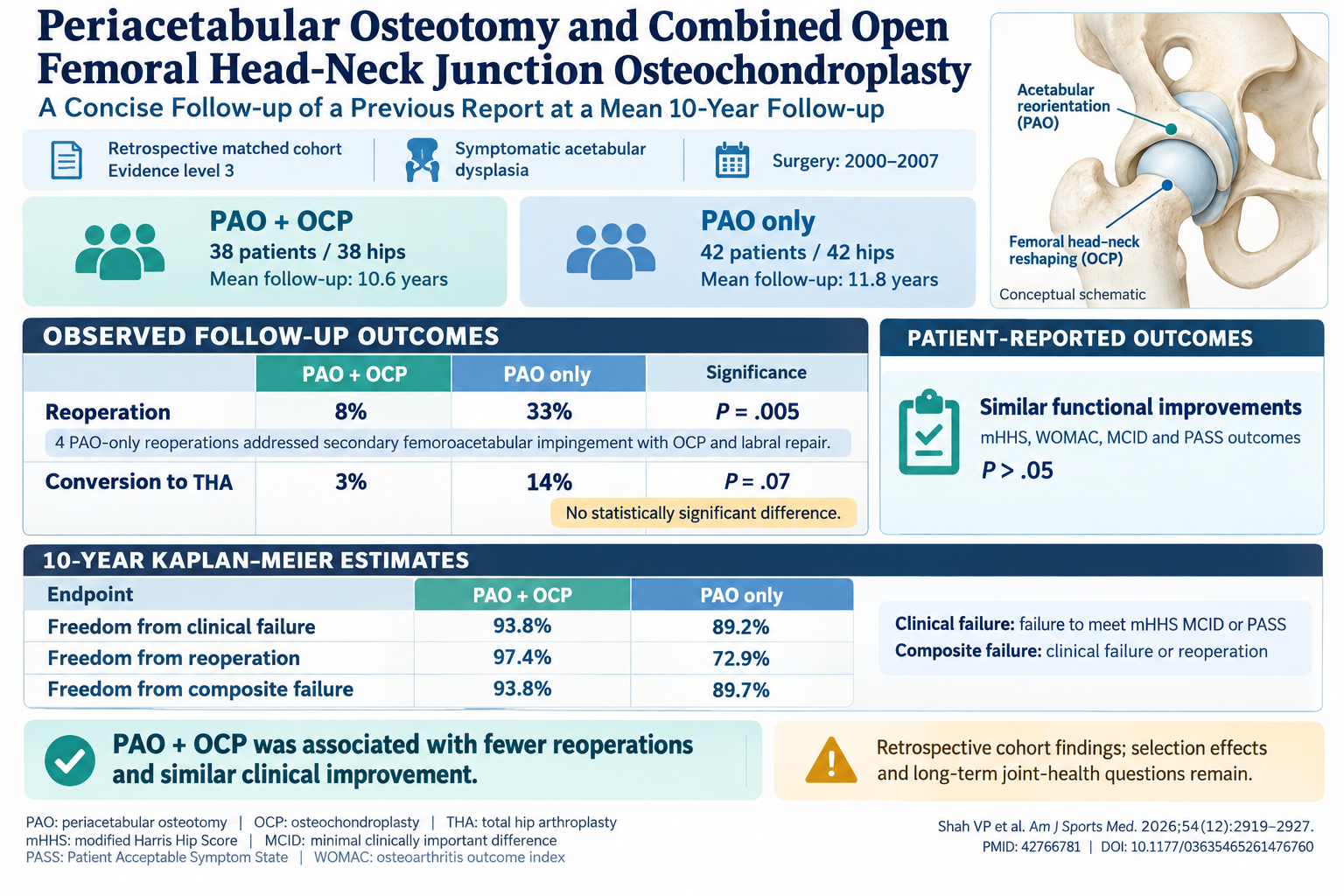
This Level 3 evidence retrospective cohort study reviewed 80 hips in 80 patients who underwent PAO between 2000 and 2007. Thirty-eight patients received PAO combined with open femoral head-neck junction osteochondroplasty (PAO+OCP), while 42 matched controls underwent isolated PAO.
Inclusion criteria targeted symptomatic acetabular dysplasia with or without associated femoral head-neck abnormalities requiring intervention. Outcomes were evaluated at a mean follow-up of approximately 10 years (PAO+OCP: 10.6 years, PAO-only: 11.8 years).
Primary clinical outcomes included the modified Harris Hip Score (mHHS) and Western Ontario and McMaster Universities Osteoarthritis Index (WOMAC). Failure definitions encompassed clinical failure (not achieving the minimal clinically important difference or patient acceptable symptom state), reoperation, conversion to total hip arthroplasty (THA), and a composite of these endpoints.
Key Findings
Both cohorts achieved significant and comparable improvements in mHHS and WOMAC scores from baseline, without significant between-group differences in rates of clinical failure (failure to meet MCID or PASS thresholds).
Critically, the PAO-only group exhibited a significantly higher reoperation rate of 33% compared to 8% in the PAO+OCP group (P = .005). Most reoperations in the PAO-only group were attributable to secondary femoroacetabular impingement, necessitating osteochondroplasty and labral repair.
Conversion to THA was numerically higher in the PAO-only cohort at 14% versus 3% in the PAO+OCP group, although this trend did not reach statistical significance (P = .07).
Kaplan-Meier survivorship analysis demonstrated robust 10-year survival from clinical failure (93.8% for PAO+OCP vs 89.2% for PAO-only), reoperation (97.4% vs 72.9%), and composite failure (93.8% vs 89.7%), highlighting superior durability regarding surgical revision with the combined approach.
Postoperative radiographic assessments indicated no deleterious effects on joint alignment or progression of osteoarthritis attributable to the addition of OCP. Complication rates were comparable and low in both groups.
Expert Commentary
This study reinforces the concept that unrecognized or untreated femoral head-neck deformities significantly contribute to persistent symptoms and surgical failures after PAO for hip dysplasia. By addressing cam-type impingement concurrently with PAO via OCP, surgeons can better restore joint congruity and biomechanics.
While both PAO and PAO+OCP yield substantial and durable symptomatic relief, the pronounced reduction in reoperation rates with combined treatment suggests that strategic osteochondroplasty mitigates the need for subsequent interventions related to residual impingement.
Limitations include the retrospective design and inherent selection biases, although matched controls improve comparability. Longer follow-up beyond 10 years is warranted to confirm effects on osteoarthritis progression and hip preservation. Additionally, prospective randomized trials would strengthen the evidence base.
Conclusion
In this comprehensive 10-year follow-up study, combined periacetabular osteotomy with open femoral head-neck junction osteochondroplasty demonstrates equivalent clinical outcomes but substantially lowers reoperation rates compared to PAO alone in patients with symptomatic acetabular dysplasia. These findings support routine evaluation and management of femoral head-neck morphology during PAO to optimize long-term joint preservation and patient satisfaction.
Future investigations should focus on long-term joint survivorship, patient-reported quality of life, and defining indications for combined surgery to further refine hip preservation strategies.
Funding and Clinical Trials
This study was sourced from previously published clinical data without new funding disclosures or clinical trial registrations reported.
References
Shah VP, O’Connor KP, Harris M, Nepple JJ, Pascual-Garrido C, Clohisy JC. Periacetabular Osteotomy and Combined Open Femoral Head-Neck Junction Osteochondroplasty: A Concise Follow-up of a Previous Report at a Mean 10-Year Follow-up. Am J Sports Med. 2026 Sep 21;54(12):2919-2927. PMID: 42766781.