Highlight
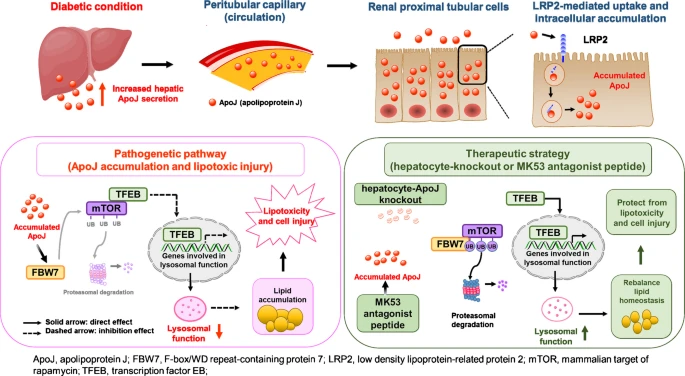
This study uncovers the pathological role of liver-derived apolipoprotein J (ApoJ) in diabetic kidney disease (DKD) through its accumulation in renal tubular cells. Elevated ApoJ disrupts TFEB-mediated lipid homeostasis, promoting renal lipotoxicity and fibrosis. Hepatocyte-specific ApoJ deletion or pharmacologic blockade with the ApoJ antagonist MK53 ameliorates these effects, offering a novel therapeutic avenue for DKD.
Study Background
Diabetic kidney disease is a major complication of type 2 diabetes mellitus, driving progressive renal dysfunction and contributing significantly to morbidity and mortality worldwide. One recognized pathogenic mechanism in DKD is ectopic lipid accumulation within renal tubular epithelial cells that induces lipotoxicity, inflammation, and fibrosis. However, the molecular mediators linking systemic metabolic dysregulation to renal lipid accumulation remain incompletely understood.
Apolipoprotein J (ApoJ), also known as clusterin, is a multifunctional molecular chaperone abundantly secreted by the liver and regulated by glucose metabolism. Prior evidence suggests ApoJ’s involvement in systemic metabolic regulation, but its specific role in diabetic renal injury had not been elucidated. Understanding whether circulating ApoJ directly influences renal lipid metabolism and injury in DKD could open new therapeutic possibilities.
Study Design
The investigators conducted a multifaceted study combining clinical association, in vitro cellular models, and multiple in vivo mouse models. The clinical correlation was assessed by measuring circulating ApoJ levels in 201 individuals with type 2 diabetes and analyzing their relationship with renal function indices. This was complemented by proteomic analyses to identify signaling pathways modulated by ApoJ.
Functional validation was performed through gain- and loss-of-function experiments in the human proximal tubular epithelial cell line HK2, tissue-specific ApoJ knockout mice, and murine DKD models. Interventional studies using the pharmacological ApoJ antagonist MK53 examined therapeutic potential. Key molecular endpoints included assessment of mTOR ubiquitination, mTOR-TFEB interactions, lipid accumulation, autophagy activity, renal fibrosis, and functional kidney impairment.
Key Findings
Clinical associations: Circulating ApoJ levels were significantly elevated in patients with type 2 diabetes and positively correlated with markers of renal dysfunction, indicating a potential pathogenic link.
In vivo observations: Murine DKD models showed increased ApoJ accumulation in renal tubules concomitant with lipid deposition and structural kidney injury. Hepatocyte-specific deletion of ApoJ abolished circulating ApoJ and its renal accumulation, markedly attenuating diabetic renal damage.
Mechanistic insights: Proteomic and cellular analyses revealed that ApoJ inhibits FBW7-mediated ubiquitination of mTOR, leading to increased mTOR stability and enhanced interaction with transcription factor EB (TFEB). Under nutrient excess conditions, this disrupts TFEB-mediated lipid autophagy pathways in HK2 cells, causing lipid imbalance and promoting renal fibrosis.
Therapeutic intervention: Pharmacological treatment with MK53, an ApoJ antagonist, reactivated the TFEB-autophagy axis, restored renal lipid homeostasis, and reduced fibrosis and functional impairment in diabetic mice.
Safety and translational relevance: No significant off-target adverse effects of MK53 were reported, supporting its potential as a targeted treatment strategy for DKD.
Expert Commentary
These findings illuminate an important liver-to-kidney signaling axis mediated by ApoJ that exacerbates diabetic renal injury. The study’s use of human clinical data coupled with sophisticated mechanistic and genetic mouse models strengthens its translational significance. By clarifying how ApoJ interferes with mTOR ubiquitination and TFEB-dependent autophagy, the research identifies a novel molecular checkpoint amenable to pharmacologic modulation.
Current treatments for DKD primarily focus on glycemic and blood pressure control, with limited options directly targeting intrarenal lipotoxicity and fibrogenesis. This study suggests that modulating ApoJ activity could fill a therapeutic gap. However, larger clinical studies and long-term safety assessments of ApoJ antagonists are warranted before clinical adoption.
Conclusion
The study establishes that liver-derived ApoJ trans-accumulates in the kidney, disrupting TFEB-mediated lipid homeostasis and exacerbating renal injury in diabetes. Genetic ablation of hepatic ApoJ or pharmacological inhibition with MK53 reverses these deleterious effects. Targeting the ApoJ-mTOR-TFEB axis represents a promising new therapeutic strategy for diabetic kidney disease, with potential to prevent progression of renal dysfunction in affected patients.
Future research should focus on clinical trials to evaluate ApoJ antagonism in human DKD and explore combinatory approaches with existing therapeutic regimens.
Funding and ClinicalTrials.gov
The study was supported by institutional and governmental research grants, as referenced in the original publication. No registered clinical trials are currently associated with MK53 for DKD treatment, highlighting the need for formal clinical development.
References
Duan S, Qin N, Pi J, Huang CP, Sun P, Huang Q, et al. Liver-to-kidney apolipoprotein J trans-accumulation exacerbates diabetic renal injury by disrupting TFEB-mediated lipid homeostasis. Diabetologia. 2026 Jul 17;69(10):2938-2956. PMID: 42467084.
Additional literature on DKD pathophysiology and apolipoproteins can be found in relevant nephrology and endocrinology journals.