Highlight
- SAR443820, a selective RIPK1 inhibitor, was evaluated for safety and efficacy in ALS, but showed no clinical benefit over placebo.
- The trial included 305 participants from 13 countries, randomized to 24 weeks of SAR443820 or placebo treatment.
- The primary outcome, change in ALS Functional Rating Scale Revised (ALSFRS-R), showed no significant difference between groups at 24 weeks.
- SAR443820 treatment was associated with increased adverse events, especially elevated hepatic enzymes and higher treatment discontinuation rates.
Study Background
Amyotrophic lateral sclerosis (ALS) is a progressive neurodegenerative disease characterized by motor neuron loss, leading to muscle weakness, disability, and eventual mortality. Despite modest advances, treatment options remain limited and largely symptomatic, with riluzole and edaravone as the few approved disease-modifying agents. Receptor-interacting protein kinase 1 (RIPK1) is implicated in regulating inflammatory signaling and programmed cell death pathways which may contribute to ALS pathophysiology. SAR443820 is a selective, orally bioavailable RIPK1 inhibitor capable of penetrating the central nervous system. Preclinical evidence suggested potential neuroprotective effects through inhibition of necroptosis and inflammation. The HIMALAYA trial was designed to evaluate the safety, tolerability, and efficacy of SAR443820 in adults with ALS, addressing the unmet need for novel targeted therapies.
Study Design
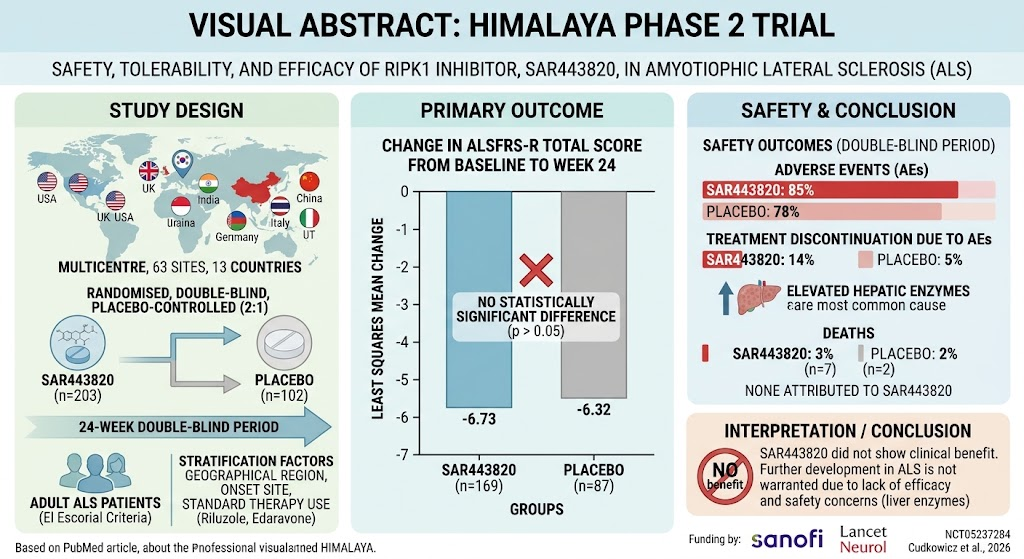
The HIMALAYA study was a multicenter, randomized, double-blind, placebo-controlled phase 2 trial conducted across 63 sites in 13 countries, including Belgium, Canada, China, France, Germany, Italy, Japan, the Netherlands, Poland, Spain, Sweden, the UK, and the USA. Eligible participants were adults aged 18 to 80 years with a diagnosis of ALS consistent with the revised El Escorial World Federation of Neurology criteria (possible, clinically probable, clinically probable laboratory-supported, or clinically definite ALS).
Participants were randomized in a 2:1 ratio using a stratified block design and interactive response technology to receive either 20 mg of SAR443820 orally twice daily or matching placebo for 24 weeks. Randomization was stratified by geographical region, ALS onset region, and concomitant use of riluzole, edaravone, or the combination therapy sodium phenylbutyrate and taurursodiol. The study was double-blind, masking participants, caregivers, investigators, and outcome assessors.
The primary endpoint was the change in the ALS Functional Rating Scale Revised (ALSFRS-R) total score from baseline to week 24 in participants with available data at both time points. Safety analyses included all participants who received at least one dose of study drug.
Key Findings
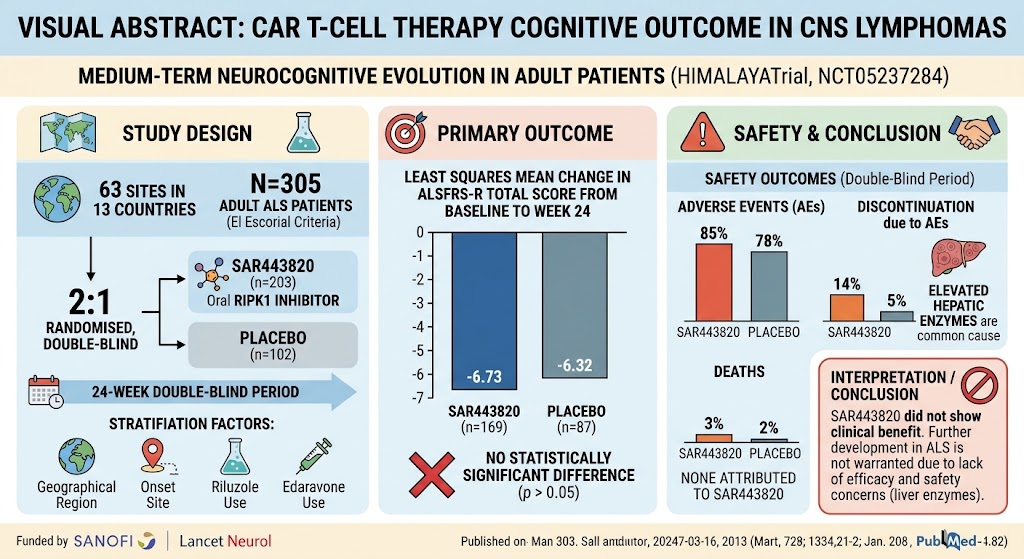
From April 2022 to July 2023, 397 individuals were screened, and 305 were randomized to SAR443820 (n=203) or placebo (n=102). Six participants were excluded from the primary efficacy analysis due to missing baseline ALSFRS-R scores. The mean age was 56.9 years, and 60% were male.
The least squares mean change in ALSFRS-R from baseline to 24 weeks was -6.73 (95% CI -7.48 to -5.98) in the SAR443820 group and -6.32 (95% CI -7.36 to -5.27) in the placebo group. The between-group difference was -0.41 (95% CI -1.71 to 0.88), indicating no statistically significant or clinically meaningful benefit in functional decline reduction with SAR443820 treatment.
Regarding safety, adverse events occurred in 85% of participants on SAR443820 compared with 78% on placebo. Treatment discontinuations were higher in the SAR443820 arm (14% vs 5%), mainly due to elevated hepatic enzymes, the most frequent adverse event leading to withdrawal. There were nine deaths during the double-blind treatment period, seven in the SAR443820 group and two in placebo, none attributed to the study drug.
Expert Commentary
The HIMALAYA trial provides valuable insights into the clinical development of RIPK1 inhibition as a therapeutic strategy in ALS. Despite strong preclinical rationale, SAR443820 failed to demonstrate efficacy, as measured by ALSFRS-R functional decline over 24 weeks. The absence of clinical benefit, coupled with a higher incidence of hepatic enzyme elevations, suggests unfavorable risk-benefit considerations. These hepatic effects warrant careful monitoring in any future studies of this class.
The trial’s rigorous design, large multinational sample, and stratified randomization strengthen the validity of these findings. However, certain limitations include the 24-week treatment duration, which may be insufficient to observe long-term neuroprotective effects in a slowly progressive disease. Additionally, heterogeneous ALS phenotypes and concurrent use of approved therapies may have influenced outcomes. Further biomarker studies could clarify whether subsets of patients might derive benefit.
From a mechanistic standpoint, RIPK1’s role in necroptosis and inflammation remains an intriguing target, but translating pathway inhibition into clinical improvement in ALS remains challenging. Alternative strategies targeting related pathways or combination approaches may be needed.
Conclusion
The SAR443820 phase 2 HIMALAYA trial in ALS revealed no clinical efficacy in slowing functional decline compared with placebo, while demonstrating higher hepatotoxicity risk. These results do not support further clinical development of SAR443820 for ALS. Continued research into disease pathogenesis and novel therapeutic targets remains critical to improving outcomes in this devastating disorder.
Funding and ClinicalTrials.gov Registration
This study was funded by Sanofi. The trial is registered under ClinicalTrials.gov identifier NCT05237284.
References
- Cudkowicz ME, Shefner J, van den Berg LH, et al. Safety, tolerability, and efficacy of RIPK1 inhibitor, SAR443820, in amyotrophic lateral sclerosis (HIMALAYA): a multicentre, randomised, double-blind, placebo-controlled, phase 2 trial. Lancet Neurol. 2026 Oct;25(10):900-910. PMID: 42716044.
- Zhou W, Yuan J. Necroptosis in health and diseases. Semin Cell Dev Biol. 2014;35:14-23.
- Bellouze S et al. Therapeutic potential and challenges of RIPK1 inhibitors. Drug Discov Today. 2023;28(6):102195.
- Miller RG et al. Riluzole for amyotrophic lateral sclerosis (ALS)/motor neuron disease (MND). Cochrane Database Syst Rev. 2012;3:CD001447.