Highlight
- Ilofotase alfa was evaluated in a rigorous phase 2 trial for preventing kidney injury after complex cardiac surgery.
- The study enrolled 244 adults with moderately reduced kidney function undergoing on-pump heart surgery.
- No significant difference was found between ilofotase alfa and placebo in serum creatinine rise or major adverse kidney events at 60 days.
- Ilofotase alfa treatment was not associated with safety concerns, confirming tolerability in this high-risk population.
Study Background
Acute kidney injury (AKI) following cardiac surgery, especially on-pump procedures, remains a common and serious complication. It contributes to increased morbidity, prolonged hospitalization, and higher mortality rates. Patients with pre-existing chronic kidney disease (CKD) are particularly vulnerable, with estimated glomerular filtration rate (eGFR) values between 25 and 65 ml/min/1.73m2 conferring elevated risk. Despite advances in perioperative care, effective preventive strategies for AKI in this context are limited.
Ilofotase alfa is a recombinant alkaline phosphatase enzyme hypothesized to mitigate kidney injury through immunomodulatory pathways, including detoxification of pro-inflammatory mediators and protection against ischemia-reperfusion injury. Early experimental and clinical data suggested a potential therapeutic role, warranting evaluation in randomized controlled trials.
Study Design
This multicenter, randomized, double-blinded, placebo-controlled phase 2 trial was designed to evaluate the safety and efficacy of perioperative ilofotase alfa administration in adult patients at high risk for renal functional impairment undergoing complex on-pump cardiac surgery. Eligible patients were adults with a baseline eGFR between 25 and 65 ml/min/1.73m2.
Participants were randomized into two parallel groups: one group received two intravenous doses of ilofotase alfa (128 mg per dose) administered perioperatively; the control group received placebo doses administered identically. The primary endpoint was the ratio of the highest postoperative serum creatinine level within five days relative to the baseline preoperative value (sCrRatio), an indicator of acute kidney function deterioration.
The secondary endpoint was the incidence of major adverse kidney events (MAKE60) up to day 60, defined as a composite of death, dialysis initiation, or sustained renal dysfunction.
Key Findings
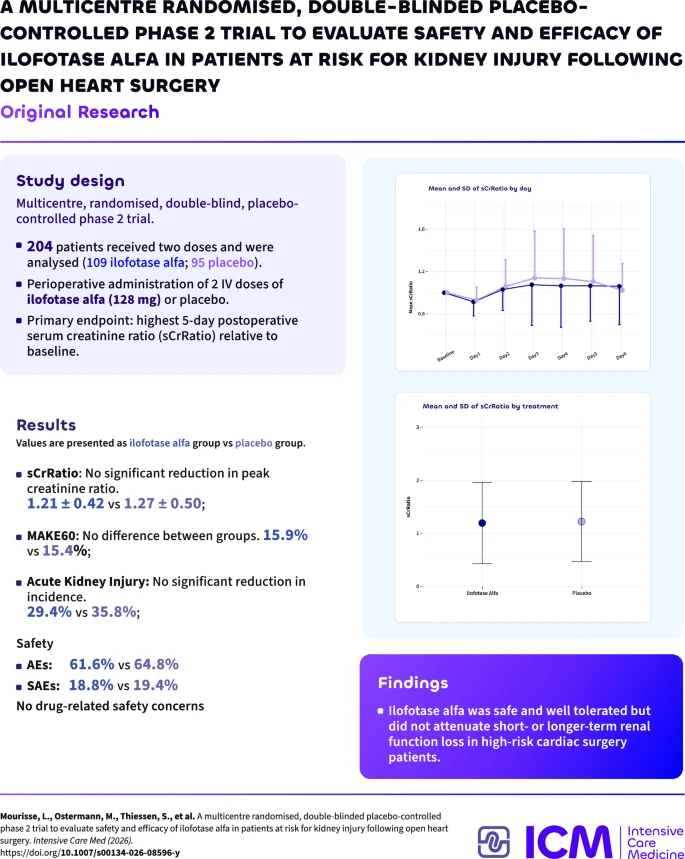
Among 244 randomized patients, 204 completed treatment with two doses and were included in the analysis: 109 received ilofotase alfa, and 95 placebo.
The primary endpoint—the mean ± standard deviation (SD) sCrRatio—was 1.21 ± 0.42 in the ilofotase alfa group versus 1.27 ± 0.50 in the placebo group, a difference that was not statistically significant (p=0.31). This indicates that ilofotase alfa did not meaningfully attenuate postoperative serum creatinine elevation compared to placebo.
Regarding the secondary endpoint, the incidence of MAKE60 was similar between groups: 15.9% in the ilofotase alfa group and 15.4% in the placebo group (p=0.87), indicating no beneficial effect on longer-term kidney outcomes or mortality.
No safety signals or adverse effects attributable to ilofotase alfa were identified, supporting its tolerability in this patient cohort.
Expert Commentary
This well-designed phase 2 trial provides valuable evidence that despite promising mechanistic rationale, ilofotase alfa does not confer significant renal protection in patients at high risk for AKI following on-pump cardiac surgery. The lack of effect on both short-term kidney injury markers and medium-term adverse events underscores the complexity of preventing AKI in this setting.
Potential limitations include the selection of dosing and timing of ilofotase alfa administration, and the challenge of modifying renal injury pathways amidst the multifactorial insults of cardiac surgery. Additionally, the trial’s focus on patients with moderate CKD enhances clinical relevance but may limit generalizability to other risk strata.
Further exploration of immunomodulatory or enzymatic therapies should consider alternative dosing strategies or combination approaches. Integration of biomarker-guided patient selection might also identify subgroups more likely to benefit.
Conclusion
This phase 2 randomized controlled trial demonstrated that ilofotase alfa administration during complex on-pump cardiac surgery did not reduce acute kidney injury, as measured by postoperative creatinine rise, nor did it reduce major adverse kidney events within 60 days. The treatment was safe and well tolerated but did not improve renal outcomes in this high-risk population.
These findings emphasize the continued unmet need for effective interventions to prevent AKI in cardiac surgery patients and guide future research directions in the field.
Funding and Trial Registration
The study was registered under EUCT Number 2023-505859-45, US IND Number 117605, and ClinicalTrials.gov ID NCT06168799.
Funding sources were not detailed in the abstract provided.
References
- Mourisse L, Ostermann M, Thiessen S, et al. A multicenter randomized, double-blinded placebo-controlled phase 2 trial to evaluate safety and efficacy of ilofotase alfa in patients at risk for kidney injury following open heart surgery. Intensive Care Med. 2026 Sep 21. PMID: 42766022.
- Bihorac A, et al. Long-term risk of mortality and acute kidney injury after cardiac surgery. Crit Care Med. 2010.
- Bonventre JV, Yang L. Cellular pathophysiology of ischemic acute kidney injury. J Clin Invest. 2011.
- Pickkers P, et al. Therapeutic potential of alkaline phosphatase in sepsis-associated acute kidney injury: a narrative review. Front Med (Lausanne). 2021.