Highlight
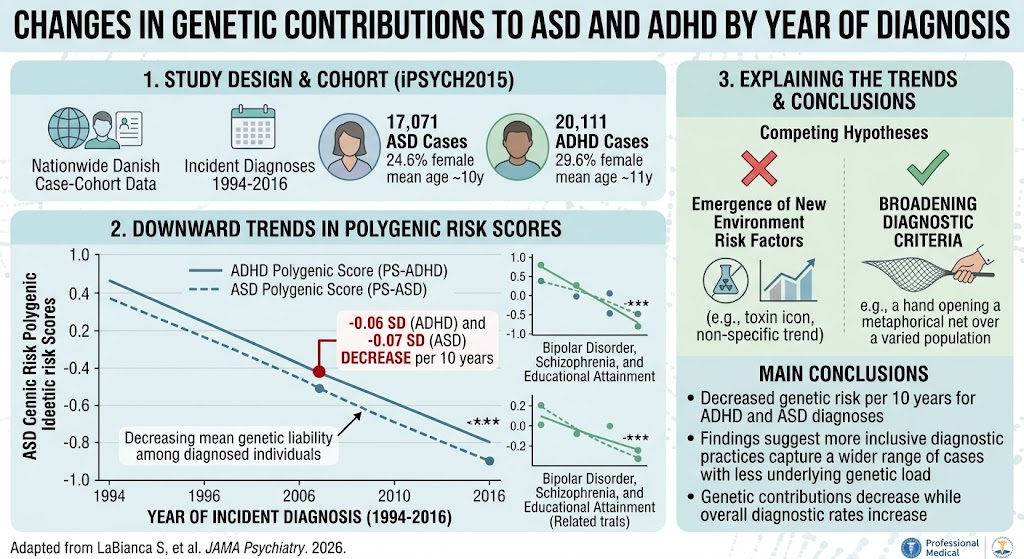
This population-based study from Denmark evaluated genetic risk changes associated with autism spectrum disorder (ASD) and attention-deficit/hyperactivity disorder (ADHD) diagnoses from 1994 to 2016. Using polygenic risk scores, the research identified a statistical decrease in genetic liability among more recently diagnosed individuals, suggesting expanded diagnostic criteria rather than new risk factors drive rising incidence rates.
Study Background
The prevalence of ASD and ADHD has increased sharply over recent decades worldwide, raising critical questions regarding underlying contributors. Traditionally, factors such as enhanced diagnostic awareness, reduced stigma, and changing clinical criteria have been implicated as primary drivers of higher recorded incidence. However, there remains a paucity of large-scale research analyzing how genetic risk profiles may have shifted concurrent with these diagnostic trends. This is clinically relevant because identifying whether increasing rates reflect true epidemiological shifts versus broadening case definitions affects both etiological understanding and health policy planning.
Study Design and Methods
This cohort study utilized data from the Lundbeck Foundation Initiative for Integrative Psychiatric Research (iPSYCH2015), a nationally representative case-cohort in Denmark. The sample included 17,071 individuals with incident ASD diagnoses (24.6% female; mean diagnosis age 9.7 years) and 20,111 with ADHD diagnoses (29.6% female; mean age 11.0 years) recorded between 1994 and 2016. Genetic risk was quantified by polygenic scores (PGS) derived from genome-wide association data across psychiatric disorders (ADHD, ASD, depression, bipolar disorder, schizophrenia) and cognitive-behavioral traits (addiction, educational attainment, IQ, neuroticism, risk-taking). Using regression models adjusted for age, sex, and ancestry, changes in the mean genetic risk profile by year of diagnosis were assessed, with comparison to simulated scenarios representing different hypothetical drivers of rising rates.
Key Findings
The analysis demonstrated a significant inverse association between year of diagnosis and mean polygenic risk scores for both ASD and ADHD. Specifically, individuals diagnosed with ADHD in more recent years exhibited lower genetic susceptibility for ADHD (β per 10-year increase: -0.06 standard deviations [SD]; 95% CI: -0.09 to -0.03; P = .001) and related disorders, including ASD, bipolar disorder, and schizophrenia. Similarly, a more recent ASD diagnosis correlated with reduced genetic risk for ASD itself (β per 10-year increase: -0.07 SD; 95% CI: -0.10 to -0.04; P < .001) and other psychiatric and cognitive traits such as bipolar disorder, schizophrenia, and educational attainment.
These findings were contrasted with simulations reflecting various scenarios such as true incidence increase driven by genetics versus diagnostic broadening. The empirical data most closely matched expectations from expanded diagnostic criteria capturing cases with milder or atypical presentations carrying lower genetic risk burdens. This comprehensive polygenic scoring approach across multiple psychiatric and cognitive domains allowed for nuanced disambiguation among competing explanations for rising ADHD and ASD rates.
Expert Commentary
This study adds important evidence that the notable increase in ASD and ADHD diagnoses observed over the past two decades does not stem primarily from a surge in genetic risk variants in the population. Instead, it supports the hypothesis that evolving clinical thresholds and diagnostic awareness have expanded the identified case pool to include individuals with lower genetic liability and presumably milder phenotypes. These results highlight the complexity of interpreting surveillance data and underscore the necessity for phenotype refinement in genetic studies.
Limitations include potential population-specific effects given the Danish cohort, and the need for complementary investigations examining environmental and epigenetic influences. However, the large sample size, robust genetic data, and advanced simulation modeling lend substantial validity to the conclusions.
Conclusion
The decreasing genetic risk profiles in more recently diagnosed ASD and ADHD cases support broadening diagnostic criteria rather than emergent genetic risk as a primary driver of increased incidence. This has significant implications for clinical practice, suggesting an increasingly heterogeneous diagnostic landscape. Further, it calls for continued refinement of diagnostic tools and personalized approaches considering genetic risk alongside clinical presentation. Future research integrating genetic, environmental, and developmental data will be essential to deepen understanding and optimize management strategies for neurodevelopmental disorders.
Funding
This research was funded by the Lundbeck Foundation Initiative for Integrative Psychiatric Research (iPSYCH), with collaborative support from the iPSYCH Study Consortium and the Autism Spectrum Disorder Working Group of the Psychiatric Genomics Consortium.
References
- LaBianca S, Lousdal ML, Dybdahl Krebs M, et al. Changes in Genetic Contributions to ASD and ADHD by Year of Diagnosis. JAMA Psychiatry. 2026;83(9):921-929. doi:10.1001/jamapsychiatry.2026.xxxx
- Thapar A, Cooper M. Attention deficit hyperactivity disorder. Lancet. 2016;387(10024):1240-1250. doi:10.1016/S0140-6736(15)00238-X
- Hyman SE. Precision medicine for mental disorders: opportunities and challenges. JAMA. 2016;316(7):703-704. doi:10.1001/jama.2016.11295
- CDC. Data & Statistics on Autism Spectrum Disorder. Centers for Disease Control and Prevention. Updated 2023. Available from: https://www.cdc.gov/ncbddd/autism/data.html