Highlight
This multicentre randomised trial in the Netherlands evaluated whether the immediate insertion of a levonorgestrel-releasing intrauterine system (LNG-IUS) following endometrial ablation reduces the incidence of hysterectomy in women with heavy menstrual bleeding. The combined approach halved the risk of hysterectomy over two years compared to ablation alone without increasing serious adverse events.
Study Background
Heavy menstrual bleeding (HMB) is a prevalent gynecological condition affecting women’s quality of life and often leading to significant healthcare interventions. Endometrial ablation is an established minimally invasive treatment for HMB, but recurrence requiring further intervention, including hysterectomy, remains a concern. Approximately 10% of women undergo hysterectomy within two years post-ablation due to persistent or recurrent symptoms. Pharmacologic suppression of residual or regenerating endometrium via the levonorgestrel-releasing intrauterine system (LNG-IUS) may enhance long-term outcomes by mitigating symptom recurrence and reducing surgical escalation.
Study Design
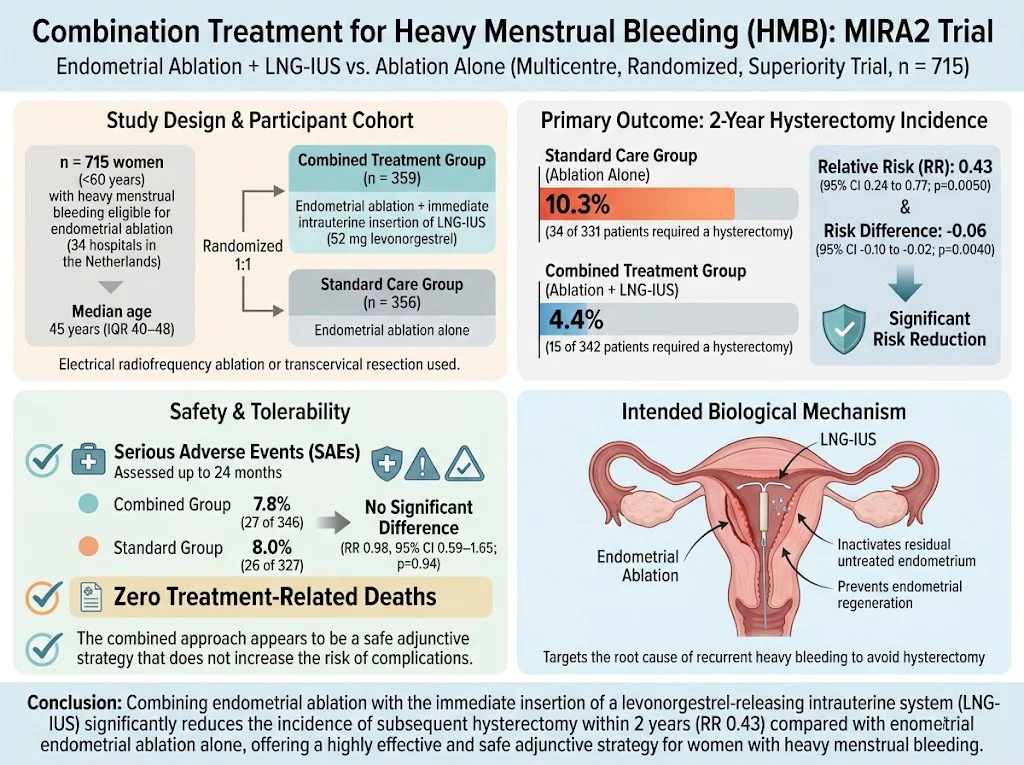
The MIRA2 trial was a pragmatic, open-label, randomised, controlled, superiority study conducted across 34 hospitals in the Netherlands. It enrolled 715 women under 60 years old with clinically significant HMB eligible for endometrial ablation. Participants were randomly assigned 1:1 to receive either endometrial ablation plus immediate insertion of an LNG-IUS (delivering 20 μg of levonorgestrel daily for the first year) or endometrial ablation alone. Ablation modalities included electrical radiofrequency ablation or transcervical resection of the endometrium. Randomisation was stratified by age and presence of dysmenorrhoea, but masking was not performed due to the nature of interventions. The primary outcome was the proportion of patients undergoing hysterectomy within two years post-treatment, analysed on a modified intention-to-treat basis.
Key Findings
Of the 715 randomized participants (median age 45, interquartile range 40-48), primary outcome data at two years were obtained for 631 women (88%). In the combined treatment arm (endometrial ablation plus LNG-IUS), 15 of 342 women (4%) required hysterectomy compared with 34 of 331 (10%) in the ablation-alone group. This corresponds to a relative risk (RR) reduction of 57% (RR 0.43, 95% CI 0.24-0.77; p=0.005), with an absolute risk difference of -6% (95% CI -10% to -2%; p=0.004). These findings confirm a statistically and clinically significant reduction in hysterectomy rates when LNG-IUS is combined with endometrial ablation.
Serious adverse events occurred in 8% of participants in both groups (27/346 in combined treatment vs 26/327 in ablation alone; RR 0.98, 95% CI 0.59-1.65; p=0.94), indicating no increased safety risks attributable to the addition of the LNG-IUS. No treatment-related deaths were reported. The study did not specify detailed secondary outcomes regarding bleeding patterns, quality of life, or device expulsion rates but established the primary patient-centered outcome of hysterectomy avoidance.
Expert Commentary
These results reinforce the biological rationale that suppressing residual endometrium after ablation with levonorgestrel reduces endometrial regrowth and recurrent bleeding, thereby lowering the need for definitive surgery. Given the minimally invasive nature of both interventions, and the well-documented safety profile of LNG-IUS, this approach offers an appealing stepwise management strategy for moderate-to-severe heavy menstrual bleeding. It may particularly benefit women aiming for uterine preservation and those at higher risk or unwilling to undergo hysterectomy.
Nonetheless, the open-label design introduces potential bias in clinical decision-making for hysterectomy, although the hard endpoint of surgery is objective. Missing data on 6% of participants is modest but could influence long-term outcome interpretation. Further research addressing patient-reported outcomes, bleeding control, satisfaction, and cost-effectiveness would enrich the clinical uptake of this combined approach.
Conclusion
The MIRA2 trial provides high-quality evidence supporting the immediate insertion of levonorgestrel-releasing intrauterine system following endometrial ablation in women with heavy menstrual bleeding. This combined intervention significantly decreases the need for hysterectomy within two years without increasing serious adverse events, representing a valuable adjunctive therapeutic option in gynecologic practice. Guideline updates and clinician awareness of this strategy could improve patient-centered care and reduce surgical morbidity in this population.
Funding and Trial Registration
This study was funded by the Netherlands Organization for Health Research and Development. It was registered on the International Clinical Trials Registry Platform under the identifier NL-OMON54839.
References
1. Oderkerk TJ, Leemans JC, Beelen P, et al. Endometrial ablation plus levonorgestrel-releasing intrauterine system versus endometrial ablation alone in women with heavy menstrual bleeding in The Netherlands (MIRA2): a multicentre, open-label, randomised, controlled, superiority trial. Lancet. 2026 Oct 21;408(10566):1828-1838. PMID: 42906565.
2. Cooper KG, Clark TJ. Advances in the management of heavy menstrual bleeding. Obstet Gynecol. 2022;140(2):201-212.
3. American College of Obstetricians and Gynecologists. Management of heavy menstrual bleeding. Practice Bulletin No. 128. Obstet Gynecol. 2021;138(3):e87-e99.
Specialty calculators
For clinical reference; use professional judgment.