Highlight
This large cohort study of over 14,000 psoriatic arthritis (PsA) patients treated with biologic or targeted synthetic DMARDs (b/tsDMARDs) across five Nordic registries identifies that difficult-to-manage (D2M) PsA affects approximately 2% of patients, while about 1.2% meet criteria for treatment-refractory disease. Key characteristics among these patients include a higher prevalence of female sex, comorbid depression, and opioid use—highlighting a complex patient phenotype requiring focused clinical attention.
Study Background
Psoriatic arthritis is a chronic inflammatory arthritis associated with psoriasis, requiring tailored management to control symptoms, prevent joint damage, and maintain quality of life. Biologic and targeted synthetic DMARDs have transformed PsA management; however, a subset of patients experiences persistent disease activity or treatment failure despite multiple therapeutic attempts. The European Alliance of Associations for Rheumatology (EULAR) recently proposed a framework to define “difficult-to-manage” and “treatment-refractory” PsA, but real-world prevalence and characteristics of such cases have not been extensively studied.
Study Design and Methods
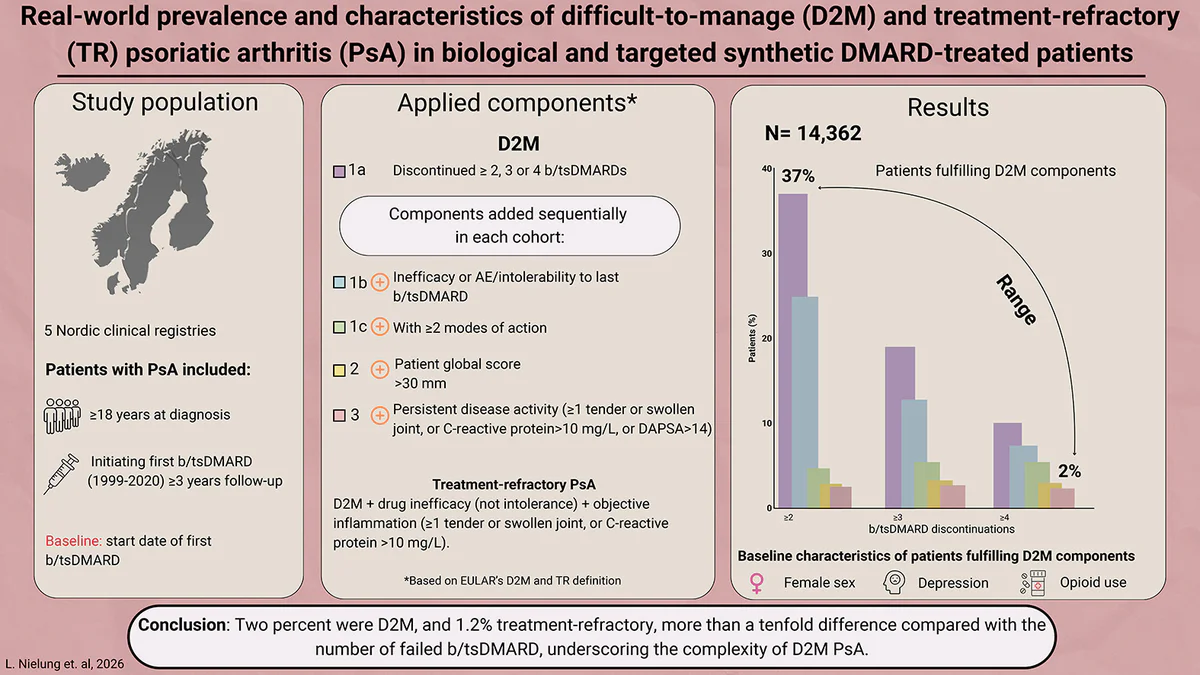
This retrospective cohort study analyzed data from five national biologics registries in the Nordic countries, encompassing PsA patients who initiated their first b/tsDMARD between 1999 and 2020. Comprehensive follow-up with a median duration of 6.3 years (IQR 2.4–10.7) allowed assessment of treatment patterns and outcomes.
Three principal cohorts were defined based on numbers of b/tsDMARD discontinuations: ≥2, ≥3, and ≥4 switches. Sequential criteria reflecting the EULAR framework were applied to refine these cohorts, including:
- Discontinuation reasons: inefficacy or side effects.
- Discontinuation across multiple mechanisms of action: signaling varied therapeutic resistance.
- Problematic symptoms: patient global assessment score ≥30 mm.
- Persistent objective disease activity: tender/swollen joint count ≥1, elevated CRP (>10 mg/L), or disease activity score (DAPSA28) >14.
Treatment-refractory disease was defined by failure due to primary or secondary inefficacy (excluding side-effect-related discontinuations) combined with objective markers of inflammation.
Key Findings
Among 14,362 PsA patients initiating b/tsDMARD therapy:
- Discontinuation of ≥2, ≥3, and ≥4 b/tsDMARDs occurred in 36%, 18%, and 10% respectively, indicating substantial treatment cycling in routine care.
- Difficult-to-manage disease, fulfilling all components of the sequential criteria (discontinuations, reasons, symptom severity, and persistent inflammation), was identified in 2–3% across cohorts.
- Treatment-refractory PsA, requiring objective inflammatory activity and primary/secondary inefficacy as reasons for discontinuation, was seen in approximately 1.2% (for ≥2 and ≥3 discontinuations) and 0.8% (for ≥4 discontinuations) of patients.
- Patients with multiple b/tsDMARD discontinuations more frequently were female, had diagnosed depression, and used opioids, suggesting a multifactorial complexity including psychosocial dimensions influencing disease management.
The study could not validate EULAR definitions prospectively but offers valuable descriptive epidemiology regarding the prevalence and patient characteristics associated with challenging PsA cases.
Expert Commentary
These findings underscore the real-world challenge of managing PsA patients who do not achieve adequate disease control despite multiple b/tsDMARD therapies. The higher representation of females and comorbid depression aligns with prior literature linking psychosocial factors to disease perception and treatment response. Opioid use signals undertreated pain and highlights the unmet need for comprehensive management beyond inflammation suppression.
The registry-based, retrospective nature introduces limitations including potential misclassification of reasons for discontinuation and lack of standardized assessments across countries. The variable follow-up times and changes over two decades in available therapies and treatment strategies may also influence generalizability. Nevertheless, this multicenter Nordic collaboration leverages real-world data to delineate a clinically important subgroup of PsA patients.
The study highlights an urgent need for prospective investigations integrating clinical, biological, and psychosocial metrics to validate and refine the EULAR framework and to develop targeted interventions for D2M and treatment-refractory PsA.
Conclusion
In a large, multinational registry-based cohort of PsA patients treated with biologic and targeted synthetic DMARDs, about one-third experienced multiple treatment discontinuations, with 2% identified as difficult-to-manage and 1.2% as treatment-refractory according to a registry-adapted EULAR-inspired framework. These patients exhibit female predominance, higher rates of depression, and opioid use, reflecting the complex interplay between disease biology and psychosocial factors.
This study elucidates the prevalence and profile of challenging PsA cases in routine care and calls for prospective studies to validate clinical criteria and optimize management strategies for this high-needs population.
Funding and Clinical Trials
The study was conducted using data from national biological registries in the Nordic countries, supported by local health authorities and research grants. No specific clinical trial registration is reported for this retrospective cohort analysis.
References
- Nielung LM, Giuseppe DD, Hetland ML, et al. Difficult-to-manage and treatment-refractory psoriatic arthritis in patients treated with biological and targeted synthetic DMARDs: prevalence and characteristics in 5 Nordic registries. Ann Rheum Dis. 2026;85(11):2164-2173. PMID: 42697827.
- Coates LC, Helliwell PS. Psoriatic arthritis: state of the art review. Clin Med (Lond). 2017;17(1):65-70.
- EULAR recommendations for the management of psoriatic arthritis with pharmacological therapies. Ann Rheum Dis. 2022;81(11):1407-1414.
Specialty calculators
For clinical reference; use professional judgment.