Highlight
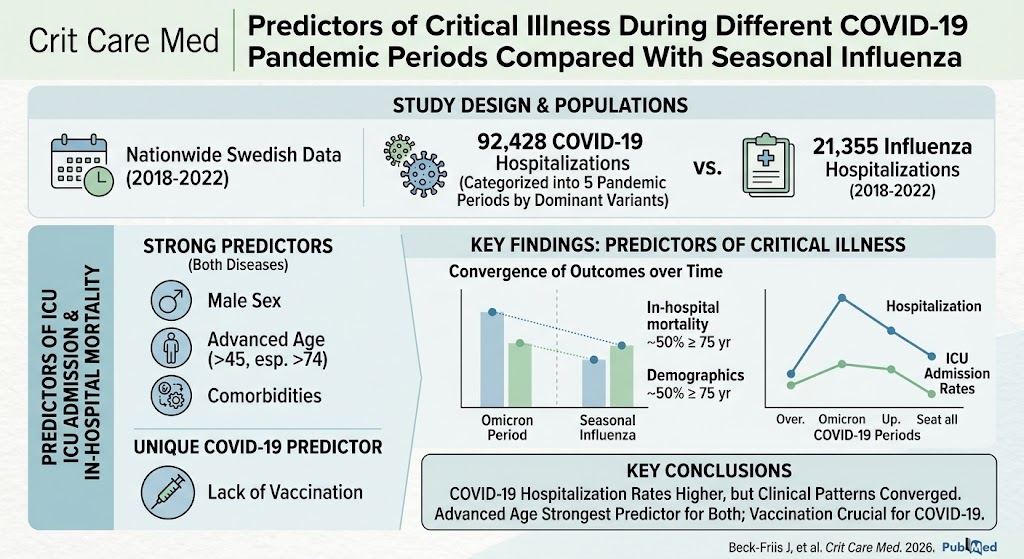
This large population-based analysis reveals that though COVID-19 hospitalizations have consistently exceeded those of seasonal influenza, demographic and clinical patterns have converged over time, especially during the Omicron period. Key predictors for ICU admission and in-hospital death vary between COVID-19 and influenza but share common risk factors such as advanced age and male sex. Notably, lack of SARS-CoV-2 vaccination remains a strong independent predictor for severe COVID-19 outcomes that differs from influenza.
Study Background
The global COVID-19 pandemic has undergone several evolutionary phases driven by viral variants, improved therapeutic modalities, and rising population immunity through vaccination and prior infections. Over time, these factors have reshaped the epidemiology, clinical presentation, and severity of COVID-19. Understanding how predictors of severe disease have evolved during different pandemic waves is crucial to optimizing clinical risk stratification and public health responses. Seasonal influenza, a familiar respiratory illness with known risk factors for severe outcomes, serves as an important comparator to contextualize COVID-19 severity and patient profiles in a real-world healthcare setting.
Study Design
This study used a retrospective, nationwide registry-based cohort design in Sweden, involving all individuals hospitalized for COVID-19 from 2020 through 2022 (N=92,428) and those hospitalized for influenza between 2018 and 2022 (N=21,355). COVID-19 hospitalizations were divided into five groups based on pandemic waves defined by dominant SARS-CoV-2 variants, with an additional comparator group for influenza hospitalizations. Patients were followed from hospital admission until ICU admission, in-hospital death, discharge, or study end.
Incidence rates for hospitalization, ICU admission, and mortality were calculated. Multivariate Cox proportional hazards regression models adjusted for age, sex, socioeconomic parameters, comorbid conditions, and COVID-19 vaccination status identified predictors of critical illness—defined as ICU admission and in-hospital mortality. Influenza vaccine status data were not available.
Key Findings
Hospitalization and ICU Admission Trends: Hospitalization rates for COVID-19 were highest during the earlier pandemic waves and notably decreased during the delta-variant dominant period. The Omicron period showed hospitalization rates closer to those observed for seasonal influenza. ICU admission rates were highest in the early waves but were lowest during the Omicron period, indicating reduced severity aligned with the variant’s clinical profile.
Demographics and Disease Severity: The Omicron wave’s inpatient demographic characteristics increasingly resembled those hospitalized for influenza, including age distribution (around 50% aged ≥75 years), length of hospital stay, ICU admission rates, and in-hospital mortality. Earlier COVID-19 waves affected relatively younger groups more frequently.
Predictors of ICU Admission: For COVID-19 patients, strongest predictors of ICU admission included male sex, unvaccinated status, and age between 45 and 74 years, emphasizing the role of vaccination in mediating disease severity. In influenza patients, risk factors for ICU admission were younger (45–64 years) age and presence of chronic lung diseases. These distinctions likely reflect differences in pathophysiology and host response between the two infections.
Predictors of In-Hospital Mortality: Advanced age was the most significant predictor of death for both COVID-19 and influenza, with a marked risk rise after age 74. Male sex and chronic comorbidities (such as cardiovascular and pulmonary diseases) also significantly increased mortality risks in both infections. Unvaccinated status independently predicted COVID-19 mortality but is not comparable due to unavailable influenza vaccination data.
Expert Commentary
This comprehensive longitudinal analysis underscores how a rapidly evolving pandemic context can alter clinical risk patterns. The convergence of COVID-19 and influenza severity profiles during the Omicron-dominant period may suggest that continued immunity through vaccination and prior infection is modulating COVID-19’s impact on health systems similar to endemic respiratory viruses.
Strengths of the study include its large, population-based design, and adjustment for multiple confounders, including vaccination. Limitations include absence of influenza vaccination data and potential differences in testing or hospitalization thresholds over time. Additionally, variant-specific data enabled nuanced temporal stratification but residual confounding by behavioral or healthcare changes during the pandemic cannot be excluded.
These findings align with international evidence emphasizing vaccination as a critical intervention and advanced age as the main driver of severe respiratory viral illness, supporting ongoing prioritization of elderly and at-risk populations for preventive strategies.
Conclusion
Throughout the COVID-19 pandemic, hospitalization rates consistently exceeded those seen with seasonal influenza; however, clinical and demographic characteristics converged over time, particularly during the Omicron wave. Advanced age emerges as the strongest predictor for severe disease and death in both COVID-19 and influenza patients. Unlike influenza, unvaccinated status remains a potent independent risk factor for critical COVID-19 outcomes, reaffirming vaccination’s essential role in mitigating disease severity. These insights inform risk stratification, resource allocation, and targeted prevention efforts in managing respiratory viral diseases.
Funding and ClinicalTrials.gov
The study received no specific external funding. Being a registry-based observational study, it does not have a clinicaltrials.gov registration.
References
1. Beck-Friis J, Santosa A, Li H, Nyberg F, Gisslén M, Oras J, Yilmaz A. Predictors of Critical Illness During Different COVID-19 Pandemic Periods Compared With Seasonal Influenza. Crit Care Med. 2026 Sep 7. PMID: 42704263.
2. Tenforde MW, Self WH, et al. Characteristics of Adult Outpatients and Inpatients Hospitalized With COVID-19 in the United States. Clin Infect Dis. 2021.
3. Iuliano AD, et al. Estimates of global seasonal influenza-associated respiratory mortality: a modelling study. Lancet. 2018.
4. WHO. Weekly epidemiological update on COVID-19 – 2023.
5. CDC. Flu Risk Groups and Vaccination Recommendations. 2022.