Highlight
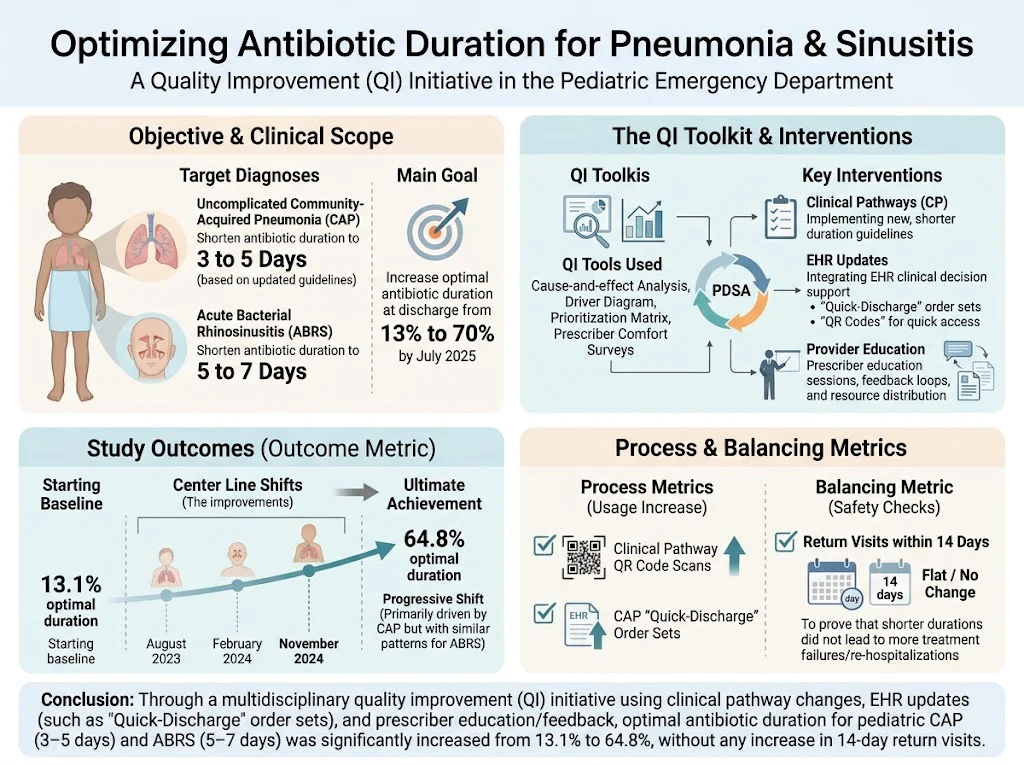
Recent guidelines recommend shorter antibiotic courses for uncomplicated pediatric pneumonia and sinusitis. A multidisciplinary quality improvement initiative in a pediatric emergency department significantly increased appropriate short-duration antibiotic prescribing from 13% to nearly 65% over two years without increasing return visits, demonstrating that system-based interventions can effectively implement evidence-based guidelines in acute care settings.
Study Background and Clinical Context
Community-acquired pneumonia (CAP) and acute bacterial rhinosinusitis (ABRS) are common pediatric respiratory infections frequently managed in emergency departments (EDs). Appropriate antibiotic management, including duration of therapy, is crucial to maximize clinical outcomes while reducing risks such as antimicrobial resistance, adverse events, and healthcare costs.
National and international guidelines have recently shortened recommended antibiotic durations for these infections based on accumulating evidence. For uncomplicated CAP, 3 to 5 days of antibiotics are now commonly advised, and for ABRS, 5 to 7 days is considered adequate. Despite this, many pediatric ED providers historically prescribed longer courses, due to inertia, variable comfort with guideline changes, and challenges in practice integration.
This discordance presents an unmet need and opportunity to optimize antibiotic prescribing practices in pediatric EDs—high-volume, acute care settings that significantly contribute to overall outpatient antibiotic use for these diagnoses.
Study Design and Methods
To address this, a multidisciplinary team composed of clinicians, pharmacists, quality improvement experts, and informatics specialists initiated a quality improvement (QI) project targeting CAP and ABRS antibiotic duration optimization in a pediatric emergency department.
Multiple QI tools were utilized: cause-and-effect analysis to identify barriers, driver diagrams to outline change strategies, and prioritization matrices to select high-impact interventions. Initial prescriber surveys assessed comfort with shorter antibiotic courses, informing tailored education.
The project employed Plan-Do-Study-Act (PDSA) cycles implementing several key interventions:
- Updated clinical pathways (CP) emphasizing guideline-concordant antibiotic durations.
- Electronic Health Record (EHR) modifications including updated Quick Response codes and CAP-specific “Quick-Discharge” order sets to facilitate prescribing shorter courses.
- Prescriber education sessions and ongoing feedback regarding prescribing patterns.
- Distribution of supportive resources to reinforce proper antibiotic duration decisions.
Primary outcome measure was the percentage of pediatric patients discharged with CAP or ABRS who received antibiotic durations consistent with current guidelines. Process metrics tracked the uptake of new CP codes and order sets. The balancing metric was return visits within 14 days for the same diagnosis, to ensure shortened antibiotic courses did not lead to increased treatment failures or complications.
Key Findings and Results
Over the approximately two-year project period, outcome data revealed a substantial increase in optimal antibiotic duration prescribing:
- The centerline for appropriate antibiotic duration rose from 13.1% at baseline (before interventions) to 64.8% by November 2024.
- Notably, the improvements were primarily driven by changes in CAP prescribing, which constituted the majority of cases, though ABRS durations similarly improved.
- Process metrics demonstrated increased use over time of CP Quick Response codes and CAP Quick-Discharge order sets, indicating successful integration of the tools designed to facilitate best practices.
- The balancing metric showed no increase in return visits within 14 days, supporting the safety and clinical appropriateness of shorter antibiotic courses in this setting.
These findings collectively validate the efficacy of a bundled approach combining clinical pathway redesign, EHR optimization, prescriber education, and targeted feedback in changing prescribing behavior in a high-turnover, time-pressured emergency setting.
Expert Commentary
This study exemplifies successful antimicrobial stewardship interventions focused on the pediatric emergency department, a critical but often under-engaged setting for stewardship efforts. Shortening antibiotic duration adheres to the principles of minimizing potential harms associated with antibiotic overuse, such as resistance and adverse drug events.
The absence of increased return visits highlights that guideline-recommended shorter courses do not compromise clinical outcomes in uncomplicated cases, aligning with evidence from randomized controlled trials and meta-analyses.
Challenges include sustaining long-term adherence amid staff turnover and evolving clinical pressures, as well as generalizability to other institutions with differing resources and patient populations. This study’s structured QI framework and multipronged intervention can serve as a replicable model for similar contexts.
Conclusion and Future Directions
This pediatric emergency department’s QI initiative markedly improved adherence to recommended short antibiotic durations for CAP and ABRS, demonstrating that evidence-based guidelines can be effectively operationalized without compromising patient safety.
Future efforts should explore extending these interventions to other common pediatric infections and expanding stewardship practices across outpatient pediatric care settings. Continued monitoring and feedback loops will be key to embedding guideline concordance into routine clinical workflows.
Ultimately, such quality improvement projects contribute to reducing unnecessary antibiotic exposure in children, supporting broader public health goals to combat antimicrobial resistance.
Funding and Clinical Trials
The original study by Saucedo et al. does not detail specific funding sources or clinical trial registration, consistent with the nature of a quality improvement initiative within a healthcare institution.
References
1. Saucedo JA, Hueschen LA, Nedved A, et al. Optimizing Antibiotic Duration for Pneumonia and Sinusitis in the Pediatric Emergency Department. Pediatrics. 2026 Nov 1;158(5). PMID: 42863842.
2. Harris M, Clark J, Coote N, et al. British Thoracic Society guidelines for the management of community-acquired pneumonia in children: update 2011. Thorax. 2011 Oct;66 Suppl 2:ii1-23.
3. Wald ER, Applegate KE, Bordley C, et al. Clinical practice guideline for the diagnosis and management of acute bacterial sinusitis in children aged 1 to 18 years. Pediatrics. 2013 Apr;132(1):e262-80.
4. Gerber JS, Ross RG, Bryan M, et al. Effect of an outpatient antimicrobial stewardship intervention on broad-spectrum antibiotic prescribing by primary care pediatricians: a randomized trial. JAMA. 2013 Jul 3;310(19):2025-33.
Specialty calculators
For clinical reference; use professional judgment.