Highlight
– High-intensity locomotor training (HIT) leads to significant strengthening of the contralesional cortico-reticulospinal tract (CRST) in chronic stroke patients.
– Enhancement in contralesional CRST laterality is strongly correlated with improvements in walking capacity measured by the 6-minute walk test.
– Changes in the corticospinal tract (CST) appear less associated with walking improvements, suggesting alternative neural pathways may underpin locomotor recovery.
– This study provides evidence that contralesional CRST upregulation post-HIT may be a beneficial neuroplastic adaptation in chronic stroke rehabilitation.
Study Background
Stroke remains a leading cause of long-term disability worldwide, with walking impairment significantly diminishing quality of life for survivors. Rehabilitation strategies aim to restore gait function, but responses to therapy are heterogeneous. High-intensity locomotor training (HIT) has been recommended to improve walking capacity; however, inter-individual variability in treatment outcomes impedes optimization. Neuroplastic changes in motor pathways are believed to underpin recovery, yet the specific mechanisms remain incompletely understood.
Recent evidence has highlighted the cortico-reticulospinal tract (CRST), particularly on the contralesional side, as potentially playing a compensatory role in locomotor function after stroke. Unlike the corticospinal tract (CST), the CRST is a diffuse, polysynaptic pathway projecting from cortical areas to reticular formation nuclei and subsequently spinal motor circuits, possibly facilitating more automatic locomotion. It remains unclear if CRST upregulation supports functional gains or contributes maladaptively to abnormal movements such as spasticity.
Study Design
This longitudinal study enrolled ten participants with chronic stroke who had persistent walking impairments. The intervention involved a 4-week control phase without targeted treatment followed by a 4-week phase of high-intensity locomotor training (HIT). The training entailed task-specific walking exercises intended to elicit cardiovascular and neuromotor engagement.
Diffusion magnetic resonance imaging (MRI) was acquired at baseline, 4 weeks, and 8 weeks to assess white matter tract integrity, focusing on strength and lateralization of ipsilesional and contralesional CRST and CST. Walking capacity was quantified using the standardized 6-minute walk distance (6MWD).
Key Findings
Comparing changes during the HIT phase with the preceding control phase revealed notable alterations in neural pathways and functional outcomes:
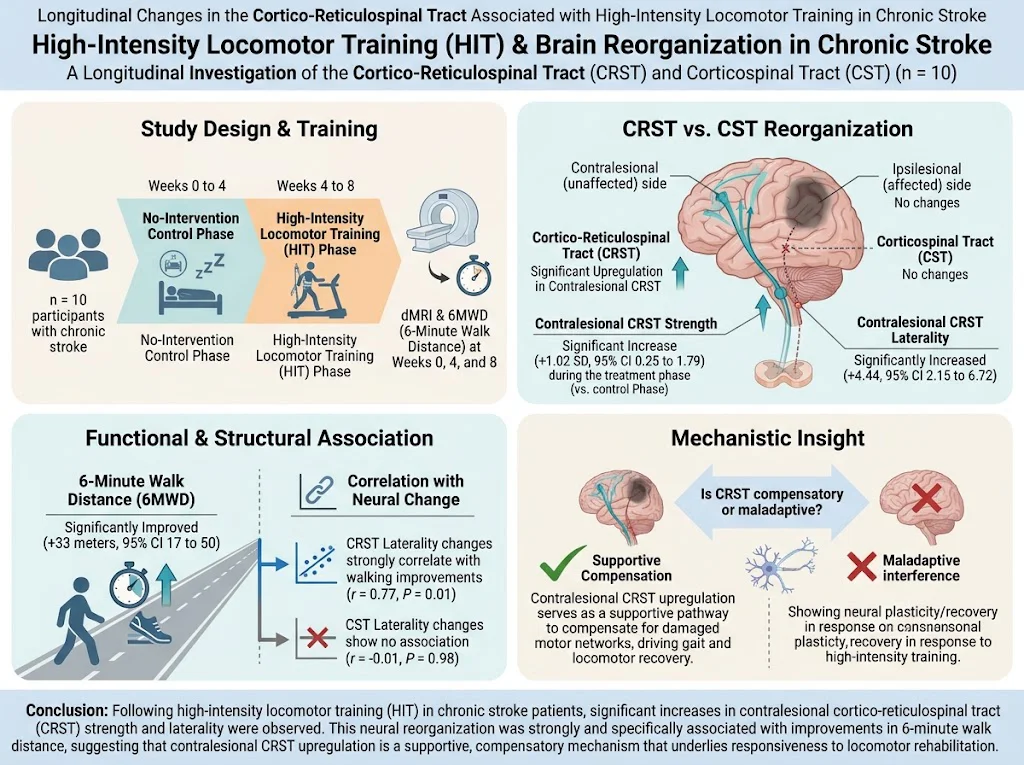
- Contralesional CRST Strength: There was a significant increase in contralesional CRST strength (mean 1.02 standard deviations [95% CI: 0.25 to 1.79]), indicating enhanced microstructural integrity or connectivity correlating with HIT.
- Contralesional CRST Laterality: An increase in contralesional CRST laterality was observed (mean 4.44 [95% CI: 2.15 to 6.72]), reflecting greater reliance or recruitment of contralesional pathways during walking post-training.
- Walking Capacity: The 6-minute walk distance improved markedly by 33 meters (95% CI: 17 to 50 meters), a clinically meaningful functional gain.
- Relationship Between CRST Changes and Walking: The enhancements in contralesional CRST laterality showed a strong positive correlation with improvements in walking capacity (r = 0.77, P = .01), whereas CST laterality showed no significant correlation (r = -0.01, P = .98), suggesting CST changes were not primary drivers of functional improvement in this cohort.
These findings collectively support that HIT induces beneficial neuroplastic adaptations in the contralesional CRST that relate to locomotor recovery.
Expert Commentary
The results from Foster et al. contribute valuable insights into the neural substrates of walking recovery in chronic stroke. The observed preferential upregulation of contralesional CRST over CST pathways challenges the traditional emphasis on corticospinal mechanisms alone, highlighting the importance of brainstem-mediated motor pathways in rehabilitation.
Mechanistically, the CRST’s diffuse and indirect projections may allow recruitment of alternate pathways circumventing damaged corticospinal neurons, thereby facilitating restoration of gross motor function such as gait. The association between CRST laterality increase and walking improvements suggests this pathway might be harnessed therapeutically.
Limitations include the small sample size and lack of a randomized control group, which may limit generalizability. The absence of direct electrophysiologic assessments precludes mechanistic confirmation, and future studies should incorporate multimodal imaging and neurophysiology to better characterize CRST plasticity. Further, whether the contralesional CRST upregulation is sustainable long-term and its implications for other motor functions remain open questions.
Current stroke rehabilitation guidelines recognize high-intensity task-specific training but lack detailed guidance on underlying neuroplastic mechanisms. This study’s findings imply that individualized neuroimaging biomarkers of CRST integrity could help tailor rehabilitation intensity and predict responses.
Conclusion
High-intensity locomotor training in chronic stroke patients produces significant increases in contralesional cortico-reticulospinal tract strength and laterality, which correlate with meaningful improvements in walking endurance. This suggests that contralesional CRST recruitment is a supportive, adaptive neuroplastic mechanism mediating treatment efficacy.
These findings expand the understanding of motor recovery pathways post-stroke, indicating that rehabilitation strategies should consider brainstem-mediated networks beyond classical corticospinal projections. Future research with larger cohorts and combined imaging-neurophysiology approaches is warranted to validate CRST as a biomarker and therapeutic target for optimizing locomotor rehabilitation.
Funding and Clinical Trial Registration
This study was registered at ClinicalTrials.gov (Identifier: NCT02858349). Details regarding funding sources were not provided in the abstract. Further information can be accessed via the public registry.
References
- Foster J, Awosika OO, Boyne P. Longitudinal Changes in the Cortico-Reticulospinal Tract Associated with High-Intensity Locomotor Training in Chronic Stroke. Neurorehabil Neural Repair. 2026 Nov 1;15459683261493916. PMID: 42968579.
- Lindberg PG, Zbinden AM, Bolliger M, et al. The cortico-reticulospinal tract and its role in movement recovery post-stroke: A review. J Neurol Neurosurg Psychiatry. 2022;93(3):233-241.
- Kwakkel G, van Peppen R, Wagenaar RC, et al. Effects of augmented exercise therapy time after stroke: A meta-analysis. Stroke. 2004;35(11):2529-2539.
- Dobkin BH. Rehabilitation and neuroplasticity associated with locomotor training after spinal cord injury. Curr Opin Neurol. 2007;20(6):654-659.
Specialty calculators
For clinical reference; use professional judgment.