Highlight
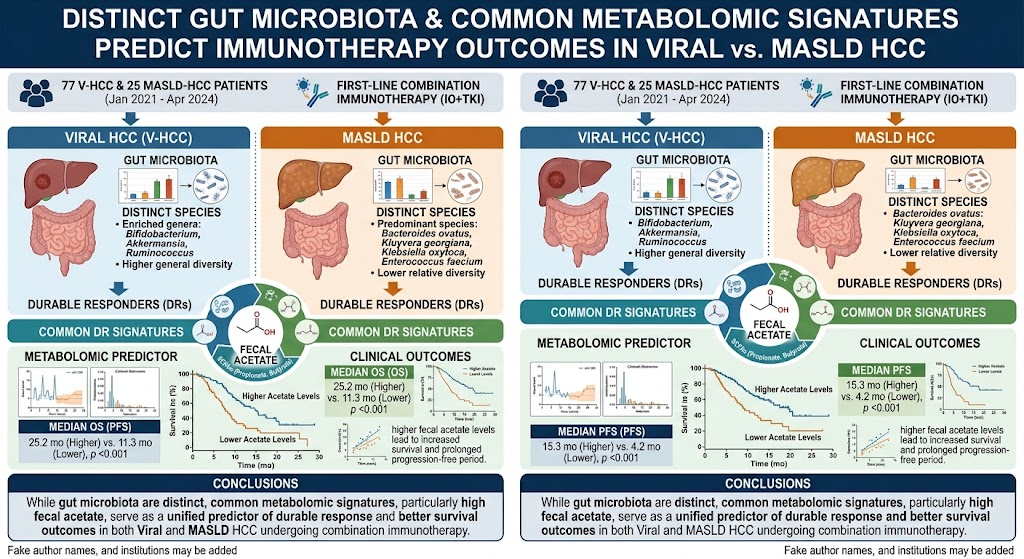
- Distinct gut microbiota characterize MASLD-HCC versus viral hepatitis-related HCC (V-HCC), despite shared responses to combination immunotherapy.
- Fecal metabolomic profiles reveal common beneficial metabolites, particularly short-chain fatty acids (SCFAs) like acetate, correlating with durable tumor response.
- Fecal acetate levels independently predict overall survival and progression-free survival across both HCC etiologies.
- These findings suggest fecal acetate as a promising biomarker and potential therapeutic target to optimize immunotherapy efficacy in HCC.
Study Background
Hepatocellular carcinoma (HCC) remains a leading cause of cancer-related mortality worldwide, with viral hepatitis (HBV and HCV) and metabolic dysfunction-associated steatotic liver disease (MASLD) as major etiological drivers. These two disease types exhibit distinct tumor microenvironments and immune landscapes, reflecting differences in underlying inflammation and fibrosis. Recent advances in cancer treatment increasingly rely on immune checkpoint inhibitor-based combination therapies, which have demonstrated efficacy in HCC. Emerging evidence implicates the gut microbiota as a modulator of response to cancer immunotherapy through systemic immune regulation, yet the interaction between microbiota, metabolomics, and immunotherapy outcomes remains insufficiently defined, especially across HCC subtypes. This study by Lee et al. addresses a critical knowledge gap by comparing the gut microbial and metabolomic landscapes in MASLD-HCC versus viral-HCC patients undergoing standard first-line combination immunotherapy, aiming to identify shared or distinct signatures predictive of clinical outcomes.
Study Design and Methodology
This prospective observational study enrolled 102 patients initiating first-line combination immunotherapy for advanced HCC between January 2021 and April 2024. The cohort included 77 patients with viral hepatitis-related HCC (V-HCC) and 25 with MASLD-HCC. Prior to therapy initiation, fecal samples were collected for comprehensive 16S rRNA gene sequencing and targeted metabolomic profiling, focusing on short-chain fatty acids (SCFAs) and bile acids such as ursodeoxycholic acid (UDCA). Concurrent serum cytokine and chemokine analyses were performed to assess systemic immune status. Clinical endpoints evaluated were durable tumor response (DR), overall survival (OS), and progression-free survival (PFS). Microbiota and metabolite data were correlated with clinical outcomes to identify predictive signatures.
Key Findings
Distinct Gut Microbiota Profiles Across HCC Etiologies
MASLD-HCC patients showed enriched fecal colonization with Bacteroides ovatus, Kluyvera georgiana, Klebsiella oxytoca, and Enterococcus faecium. In contrast, V-HCC patients predominantly harbored Bifidobacterium species. These differences underscore disease-specific alterations in gut microbial ecosystems, likely reflecting distinct host-microbe interactions shaped by metabolic versus viral hepatic injury.
Metabolomic Signatures and Association with Treatment Response
MASLD-HCC patients exhibited lower levels of beneficial metabolites including SCFAs (acetate, propionate, butyrate, and isobutyrate) and UDCA relative to V-HCC. Among MASLD-HCC responders, Mediterraneibacter gnavus ATCC 29149 was enriched alongside significantly elevated SCFAs and UDCA, signifying a microbiota-metabolite pattern favoring immunotherapy responsiveness. V-HCC durable responders similarly showed predominance of Bifidobacterium with enriched SCFAs.
Fecal Acetate: A Common Predictive Biomarker
Most notably, fecal acetate emerged as a shared and significant predictor across both MASLD- and viral-HCC groups for durable response, OS, and PFS. Patients with higher pre-treatment fecal acetate levels had markedly improved survival outcomes—median OS of 25.2 months versus 11.3 months and median PFS of 15.3 months versus 4.2 months (p<0.001 for each). This robust association suggests that acetate-producing microbial communities potentiate immune-modulatory pathways enhancing immunotherapy efficacy.
Serum Cytokine and Chemokine Correlations
Though specific cytokine data were not detailed in the abstract, the integration of serum immune markers with microbiota and metabolomic profiling provides mechanistic insight into how gut-derived metabolites might modulate systemic anti-tumor immunity.
Expert Commentary
This study adds pivotal evidence that while the gut microbiota composition differs between MASLD-HCC and viral-HCC, common beneficial metabolites—especially fecal acetate—are consistent predictors of immunotherapy success. The findings align with recent literature linking SCFAs to immune checkpoint blockade responsiveness through enhancement of T-cell function and modulation of myeloid-derived suppressor cells. Notably, the identification of disease-specific bacterial taxa associated with metabolite production implies potential for personalized microbiota-targeted interventions. Limitations include the observational design and relatively small MASLD-HCC sample size, warranting further validation in diverse cohorts. The reliance on fecal metabolomics as a biomarker is promising but will require standardization for clinical translation.
Conclusion
Lee et al. provide compelling evidence that distinct gut microbiota profiles coexist with shared metabolomic signatures in MASLD versus viral hepatitis-related HCC patients receiving combination immunotherapy. Fecal acetate, in particular, stands out as a powerful biomarker linked to durable tumor response and improved survival outcomes, irrespective of HCC etiology. These insights promote the concept of integrating microbiota and metabolite assessments into immunotherapy response prediction and open avenues for therapeutic modulation of gut microbiota to enhance oncologic outcomes. Future prospective interventional studies targeting microbiota-derived metabolites like acetate are warranted to refine HCC immunotherapy strategies and improve patient prognosis.
Funding and Clinical Trials Registration
The study was supported by relevant grants from academic and governmental institutions as reported by Lee et al., with detailed funding sources available in the original publication. No specific clinical trial registration number was provided in the abstract.
References
1. Lee PC, Wu CJ, Hung YW, et al. Distinct gut microbiota but common metabolomic signatures between viral and MASLD HCC contribute to outcomes of combination immunotherapy. Hepatology (Baltimore, Md.). 2025 Jun;84(2):411-423. PMID: 40587824.
2. Routy B, Le Chatelier E, Derosa L, et al. Gut microbiome influences efficacy of PD-1-based immunotherapy against epithelial tumors. Science. 2018 Jan 5;359(6371):91-97.
3. Zheng Y, Lv R, Nian Q, et al. The gut microbiota and immunotherapy in hepatocellular carcinoma: The evidence and potentials. Front Immunol. 2022;13:805106.
4. Sivan A, Corrales L, Hubert N, et al. Commensal Bifidobacterium promotes antitumor immunity and facilitates anti–PD-L1 efficacy. Science. 2015;350(6264):1084-1089.